

Table of Contents
- 1. Communication and Listening Skills Grow Through Cooperative Games
- 2. Teamwork and Collaboration: Building Shared Goals Early
- 3. Sharing, Turn-Taking, and Negotiation in Practice
- 4. Problem-Solving and Conflict Resolution Without a Scoreboard
- 5. Empathy, Respect, and Confidence That Carry Into Kindergarten
- Cooperative Play Examples That Work for Ages 3 to 5
- Social Skills Games for Preschoolers: What to Look For
- Teamwork Activities for Preschoolers: Facilitating Play at Home or in Class
- Frequently Asked Questions
Last Updated: October 8, 2026
1. Communication and Listening Skills Grow Through Cooperative Games
Cooperative games are activities where every player works toward a shared goal instead of competing against each other. For preschoolers, that single design choice changes everything about how they talk, listen, and respond to the people around them.
When there is no winner to beat, children stop rehearsing their next move and start paying attention to each other. They ask questions. They wait for an answer. They repeat instructions back to a friend who missed them the first time.
A common mistake is treating listening as a solo skill drilled at circle time. In practice, listening develops fastest when a child needs information from a peer to keep playing. That need is what cooperative play builds.
2. Teamwork and Collaboration: Building Shared Goals Early
Teamwork and collaboration look different at three and four years old than they do in a classroom of eight-year-olds. The goal is not efficiency. It is the experience of needing someone else to finish something.
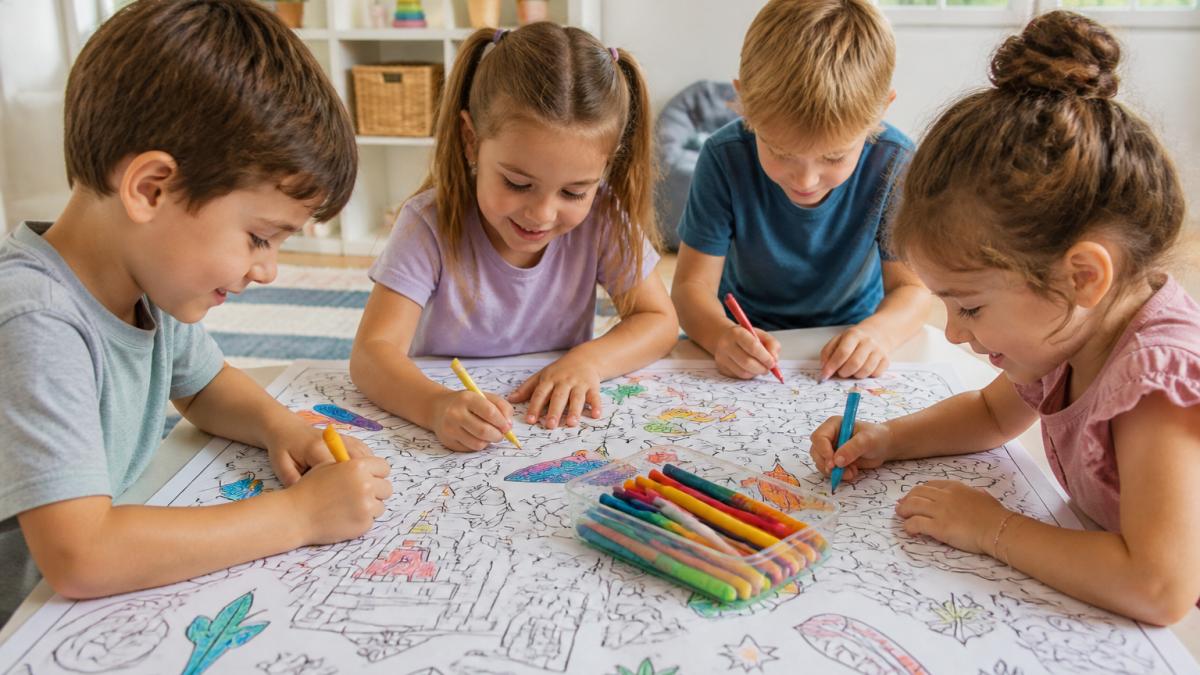
Shared goals give preschoolers a reason to cooperate that has nothing to do with adult instruction. When a group is coloring one giant sheet, nobody can complete it alone. That is the whole lesson, delivered without a lecture.
What most guides miss is how often collaboration fails for a simple physical reason: the materials are too small. Four children crowded around a single 8.5" x 11" page will fight. Four children around a 30" x 50" canvas will negotiate, because there is room for everyone's elbows. Scale solves a surprising number of social problems before they start.
- Shared goal: the group finishes one thing together
- Distinct roles: each child owns a section, an animal, or a color
- Visible progress: everyone can see the work growing
- No elimination: nobody sits out, and nobody loses
3. Sharing, Turn-Taking, and Negotiation in Practice
Sharing and turn-taking are not personality traits. They are skills that need repetition, and cooperative games give preschoolers dozens of low-stakes chances to practice them in a single afternoon.
Negotiation shows up early in these moments. "You do the red ones, I'll do the blue ones" is a real agreement between two four-year-olds. It sounds small. It is the foundation of every group project they will ever join.
Adults can help by naming the agreement out loud once it happens. "You two decided to split the colors. That worked." Recognition is what turns a one-time solution into a habit a child reaches for again.
4. Problem-Solving and Conflict Resolution Without a Scoreboard
Removing the scoreboard removes the most common source of conflict in preschool play. When there is no winner, arguments shift from "who is ahead" to "how do we finish this," and that is a far more productive problem to solve.
Problem-solving in cooperative play tends to follow a predictable pattern: a child notices an obstacle, states it, proposes something, and waits to see if anyone agrees. Your job is to let that sequence run. The pause before a child speaks is where the thinking happens.
Conflict resolution works the same way. Two children both want the same marker. The resolution they reach on their own, even a clumsy one, sticks better than any solution you hand them. Over time, these small negotiations build the resilience and confidence children carry into kindergarten.
5. Empathy, Respect, and Confidence That Carry Into Kindergarten
Empathy grows when a child can see the effect of their actions on someone else. Cooperative play makes that effect visible. A child who hands over a crayon watches a friend's face change. That is the feedback loop empathy is built on.
Respect follows the same path. When a group activity depends on everyone's contribution, children start treating each other's work as worth protecting. Nobody scribbles over a section a friend spent ten minutes on when the finished sheet belongs to all of them.
Confidence is the quieter outcome. A child who has been trusted to hold up their end of a group project walks into a kindergarten classroom already knowing they can contribute. That belief is hard to teach directly. It is much easier to build through play.
Head Start Early Learning Outcomes Framework outlines social-emotional milestones for this age group, and cooperation sits at the center of them.
Cooperative Play Examples That Work for Ages 3 to 5
The best cooperative play examples for preschoolers share three traits: a shared goal, enough physical space for several children at once, and no elimination. Here are activities that fit those rules at different ages. Expanding these collaborative dynamics into the fresh air allows children to practice teamwork through various outdoor toddler activities that encourage movement and shared discovery.
Board Games Giant Word Search Puzzle →
Ages 3 to 4:
- A giant coloring sheet on the table, with each child assigned a corner
- A group hunt for named objects on a large shared page
- Passing a single ball around a circle while everyone counts together
Ages 4 to 5:
- A giant word search where the group finds words as a team
- Building one long road or track across the floor with shared blocks
- A themed trace-and-color sheet where children help each other spell animal names
Social Skills Games for Preschoolers: What to Look For
Social skills games for preschoolers should be judged on one question: does the game require children to talk to each other to succeed? If the answer is no, it is a parallel activity, not a cooperative one.

Use this checklist before you buy or set up anything:
- Is there one shared goal rather than individual winners?
- Can three or more children participate at the same time?
- Is the surface or space large enough that nobody is crowded?
- Does the activity require at least some verbal exchange?
- Can a child who arrives late still join in?
- Does it work without a screen?
Large-format activities pass this checklist more often than small ones, simply because space removes the most common trigger for conflict.
Teamwork Activities for Preschoolers: Facilitating Play at Home or in Class
Adults shape how well cooperative play works, and the facilitation is mostly about restraint. Set up the activity, explain the shared goal once, then step back and let the group work.
A few practical moves help:
- Assign roles, not turns. "You're in charge of the animals, you're in charge of the letters" prevents most disputes.
- Name agreements out loud. When two children settle something, repeat what they decided so it registers.
- Resist solving. Give a disagreement a full minute before you intervene.
- Keep the group small. Three to five children is the sweet spot at this age.
- Protect the work. Hang the finished sheet up so the group sees what they made together.
For a group activity that scales to a classroom or a co-op morning, the Learning and Fun Pack (6 Sheets) gives you six different giant sheets, one each for literacy, geography, community, farm life, and civics, at $72 for the set. Teachers use them for early finishers, indoor recess, and quiet table time.
For families, the I Spy Candyland Table Top Coloring Banner is a 30" x 50" canvas built for exactly this kind of shared play. Several preschoolers can work on it at once, and the finished banner goes up on the wall afterward. It is $19.99, made in the USA, and shipped from Utah.

If you are shopping for a mixed-age group, the EARLY LEARNING BUNDLE pairs the Alphabet, Know Your Colors, and Trace & Color Farm sheets at $59.97. The Board Games Giant Word Search Puzzle at $19.99 works well for the older end of the range, since the color-in letter design lets a group hunt for words together.

National Association for the Education of Young Children on play notes that play is the primary way young children develop social competence, which is why the setup around the activity matters as much as the activity itself.
| Benefit | What It Looks Like in Play | Activity That Builds It | Best Age Range |
|---|---|---|---|
| Communication and listening | Children ask, answer, and repeat instructions | Group word search | 4 to 5 |
| Teamwork and collaboration | One shared goal, distinct roles | Giant table-size coloring sheet | 3 to 5 |
| Sharing and turn-taking | Negotiating colors and sections | Themed trace-and-color sheet | 3 to 5 |
| Problem-solving and conflict resolution | Children resolve disputes themselves | Any large shared canvas | 4 to 5 |
| Empathy, respect, and confidence | Children protect each other's work | Choose Kindness coloring sheet | 3 to 5 |
The hardest part of cooperative play is not finding activities. It is resisting the urge to manage every moment. Give preschoolers a shared goal, enough space, and a minute of quiet when things get tense, and the skills build themselves. Cherry Creek Lane makes giant, table-sized coloring sheets, puzzles, and wall-sized calendars designed for exactly that kind of screen-free, group play, with every product made in the USA and shipped from Utah. Shop coloring sheets at Cherry Creek Lane and turn one table into a shared project the whole group finishes together.
Frequently Asked Questions
What are the five benefits of cooperative games for preschoolers?
The five core benefits are stronger communication and listening skills, teamwork and collaboration, sharing and turn-taking, problem-solving and conflict resolution, and empathy and confidence. Each benefit builds on the others: when children practice listening during a cooperative game, they get better at negotiating turns and resolving disagreements. Over time, these skills carry into kindergarten and beyond, where group work and following directions become daily expectations.
What are some cooperative play examples I can try at home?
Simple cooperative play examples include a group coloring project where everyone works on one giant sheet, a treasure hunt where clues must be solved together, and building a block tower with a shared goal of making it as tall as possible. A table-size coloring sheet works well because several children can color at once without competing for space, and the shared canvas naturally encourages conversation and turn-taking.
How do cooperative games help children develop social skills?
Cooperative games remove the win-lose dynamic, so children practice social skills without the pressure of individual competition. They learn to express ideas, listen to peers, negotiate who goes first, and resolve disagreements as a group. Research on early childhood development consistently links cooperative play to gains in empathy, peer interaction, and the ability to follow group rules, all of which support a smoother transition into structured classroom settings.
How can parents encourage cooperation during play?
Start by choosing activities with a shared goal rather than a winner, such as a giant word search or a group coloring banner. Sit with your child and model the language you want to hear: 'Can I use the blue crayon when you're done?' or 'Let's figure out where this piece goes together.' Keep sessions short for younger preschoolers, around 10 to 15 minutes, and praise the cooperation itself, not just the finished result.