

Table of Contents
- Why Screen-Free Outdoor Activities Matter for Families
- Free Outdoor Activities for Families That Cost Nothing
- Outdoor Games for Families: Active Play and Movement
- Nature Activities for Kids: Bugs, Birds, Rocks, and Logs
- Screen-Free Summer Activities for Hot Days and Rainy Days
- Creative Building, Crafts, and Imaginative Play Outdoors
- Making It Work: Age Ranges, Accessibility, and Family Planning
- Frequently Asked Questions
Last Updated: October 9, 2026
Why Screen-Free Outdoor Activities Matter for Families
At Cherry Creek Lane, we build our whole business around that idea. Fresh air does something a screen cannot. Kids move, notice, and get bored enough to invent something. Parents stop scrolling and start talking.
Below, we'll show you exactly how to run each activity, what ages it suits, and how to adapt it when the weather or the space does not cooperate.
Free Outdoor Activities for Families That Cost Nothing
Free outdoor activities for families work because they use what is already outside: trees, rocks, birds, bugs, and open space. No admission fees, no equipment beyond what you own, and no planning marathon the night before.
A common mistake is treating "free" as "lesser." In practice, a stick and a sidewalk can hold a five-year-old longer than a paid attraction.
Nature Walks and Backyard Exploration
A nature walk is a slow walk with a job. Hand each child a small notebook and ask them to record three things they see, hear, or smell.
Start in your own yard before you drive anywhere. Backyard exploration works for toddlers and teens alike, and it removes the travel time that kills momentum.
For reluctant walkers, add a simple rule: everyone finds one thing nobody else noticed. It shifts the focus from distance to discovery.
Scavenger Hunts and I-Spy Games
Scavenger hunts and I-Spy games are the easiest way to give a walk a finish line. Write a list of ten items, hand out the paper, and set a timer. First one done picks the snack.
Keep the list loose enough to work anywhere: a smooth rock, something yellow, a bird, a leaf with a pointy edge, a sound you can only hear outside.
| Activity | Best Ages | Setup Time | Materials |
|---|---|---|---|
| Nature walk with notebook | 3 and up | 5 minutes | Notebook, pencil |
| Scavenger hunt | 4 and up | 10 minutes | Printed or handwritten list |
| I-Spy | 2 and up | None | None |
| Backyard bug hunt | 3 and up | 5 minutes | Magnifying glass, jar |
Outdoor Games for Families: Active Play and Movement
Outdoor games for families should get everyone breathing hard within five minutes. If the adults are standing around watching, the game is not working yet.
Active play is where mixed ages actually have an advantage. Younger kids copy older ones, older kids get to lead, and adults get a real workout instead of supervising from a chair.
DIY Obstacle Courses
A DIY obstacle course turns a plain yard into a challenge in under fifteen minutes. Use what you have: a broom handle across two buckets to jump over, a jump rope laid in a zigzag to balance along, a laundry basket to weave around, a line of shoes to hop between.
Time each run and let kids beat their own record rather than each other's. That keeps the competition friendly and keeps younger kids in the game. Adults should run it too. Nothing motivates a hesitant child like watching a parent trip over a bucket.
Nature Activities for Kids: Bugs, Birds, Rocks, and Logs
Nature activities for kids work best when they have a collecting or counting goal. A bug hunt with a magnifying glass and a jar beats a vague instruction to "go explore" every time.
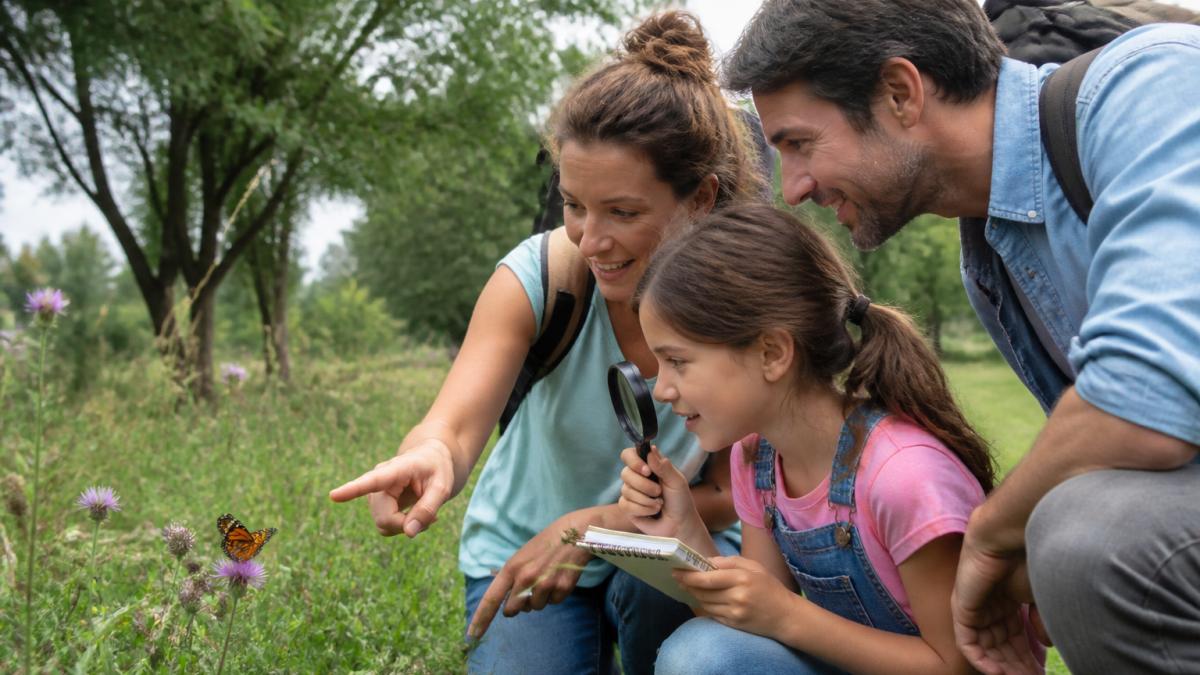
Try these three, all of which need no special gear:
- Bug safari: Count how many different bugs you find in ten minutes. Do not catch anything that stings.
- Bird listening: Sit still for five minutes and tally every different bird sound. Most kids make it to three before they start hearing more.
- Rock and log study: Look under one log, observe for two minutes, then put it back exactly as you found it. That last step matters, and it teaches care for the habitat.
Safety basics: check for ticks after wooded walks, teach kids to look before they lift a rock, and leave nests and animal homes alone.
Screen-Free Summer Activities for Hot Days and Rainy Days
Screen-free summer activities need a backup plan for the days that are too hot, too rainy, too cold, or too smoky to be outside. That is where most families give up and hand over the tablet. The fix is a small kit that lives in one spot and a short list of swaps for each condition. Equipping your kit with breathable shirts for active families ensures that even the most humid afternoons remain comfortable enough for indoor movement and play.
Camping Table Size Coloring Sheet →
Weather and location swaps
| Condition | Outdoor version | Swap to |
|---|---|---|
| Heat above 90°F | Obstacle course, bug hunt | Early-morning or evening version, or shaded porch sit-spot and coloring sheet |
| Rain | Scavenger hunt, chalk town | Window I-Spy, indoor fort with sheets, giant word search |
| Cold below 40°F | Nature walk | 15-minute bundled walk, then indoor bird-watching from a window |
| Poor air quality or smoke | Any active play | Indoor obstacle course with pillows, giant coloring sheet, word search |
| Urban or no yard | Backyard hunt | Sidewalk chalk, park bench I-Spy, balcony container-garden hunt |
| Small space | Obstacle course | Hallway hopscotch with painter's tape, tabletop building challenge |
The indoor kit that solves most afternoons
Keep one bin by the door or in a closet with: a giant coloring sheet, a giant word search, markers, colored pencils, painter's tape, a deck of cards, and a couple of old sheets. When the weather turns, the kit comes out and the afternoon is solved without a screen or a trip to the store.

Giant coloring sheets and word searches
A table-sized coloring sheet is the single most reliable indoor screen-free activity we know of. It spreads across the whole table, so several kids can work at once without fighting over space, and it holds attention far longer than a single page.
Our Summer Table Size Coloring Sheet measures 30"x50" and takes a beach theme, which makes it a natural fit for a rained-out beach day. The Summer Giant Word Search Puzzle is 30"x43.5" with color-in letters, so every word found gets colored in.

Safety and environmental care on fallback days
Indoor and close-to-home days still need the basics: supervise water play and never leave a child alone near a pool, bucket, or creek; apply sunscreen and insect repellent before outdoor time and reapply per the label; check for ticks after wooded walks; and teach kids to look before they lift a rock and to leave nests and animal homes alone.
Creative Building, Crafts, and Imaginative Play Outdoors
Creative play outdoors usually needs one prompt, not a full activity plan. "Build something that can hold three rocks" will occupy a group of kids longer than any structured craft.
Imaginative play follows fast once building starts. A fort becomes a ship, a pile of sticks becomes a market stall, and the story takes over.
Keep a bin by the back door with string, clothespins, cardboard, chalk, and old sheets. That bin is the whole craft budget.
Making It Work: Age Ranges, Accessibility, and Family Planning
The activities above work across a wide age range, but the way you set them up should change with the group. Use the table below to pick by age band, ability, and budget, then run the sample afternoon plan at the end.
Age bands and what actually changes
| Age band | What works | What to change |
|---|---|---|
| 2-3 | I-Spy, chalk scribbling, rock collecting, giant coloring sheets | Shorten every activity to 10-15 minutes; expect to lead the whole time |
| 4-6 | Scavenger hunts, bug safari, simple obstacle courses, stick forts | Use pictures instead of words on hunt lists; keep courses to 4-5 stations |
| 7-9 | Timed obstacle runs, bird tallying, building challenges, chalk town maps | Add a scorekeeper role and let them design one station |
| 10-12 | Course design, fort engineering, photography scavenger hunts | Give them ownership of setup and rules; they will resist being "managed" |
| Teens | Leading younger kids, mapping, cooking a snack outdoors | Offer a real job, not a babysitting assignment |
| Adults | Every activity here | Run the course, join the hunt, color the sheet, participation is the point |
Accessibility and mobility adaptations
Every activity in this guide has a seated or low-mobility version. A scavenger hunt works from a wheelchair, a porch chair, or a car window on a slow drive through the neighborhood.
For sensory-sensitive kids, offer sunglasses and a hat, warn before loud games, and let them opt out of the bug-and-log portion without losing the rest of the afternoon.
Cost and setup at a glance
| Activity | Ages | Setup time | Cost |
|---|---|---|---|
| Backyard scavenger hunt | 3 and up | 10 min | Free |
| DIY obstacle course | 4 and up | 15 min | Free |
| Bug and bird hunt | 3 and up | 5 min | Free |
| Stick fort and chalk town | 4 and up | 10 min | Free |
| Giant coloring sheet | 2 and up | 2 min | $19.99 |
| Giant word search | 5 and up | 2 min | $19.99 |
A ready-to-use Saturday afternoon plan
- 1:00 p.m., Backyard scavenger hunt. Hand out lists, set a 20-minute timer, first finisher picks the snack.
- 1:30 p.m., Snack and water break in the shade.
- 1:45 p.m., Build the obstacle course together. Each person adds one station.
A few planning notes from watching this play out:
- Mixed ages: Give older kids a job, such as timekeeper or list-reader. It keeps them engaged and takes pressure off you.
- Reluctant participants: Start the activity yourself. Most kids join within two minutes when they see an adult doing it.
- Weather and season: Keep an indoor kit for heat, rain, and poor air quality days. Our Summer Activity Calendar Coloring Sheet doubles as a planner, so kids can see the week and pick what comes next.
Frequently Asked Questions
What are some screen-free outdoor activities for kids of different ages?
Mix activities that scale by age: a nature walk works for toddlers in a stroller and older kids spotting birds, while a scavenger hunt can have picture clues for younger kids and written clues for older ones. A giant word search or coloring sheet lets a 3-year-old scribble while a 10-year-old hunts words on the same surface. Pair one active game with one quiet activity so everyone gets a turn at their level.

What can families do outside without screens that costs no money?
Plenty. Nature walks, I-Spy, rock collecting, leaf rubbings, DIY obstacle courses made from sticks and buckets, and backyard bug hunts all use what you already have. A park, a sidewalk, or your own yard is enough. For rainy or too-hot days, a reusable giant coloring sheet or word search keeps the screen off indoors without needing new gear each time.
How can I get my kids interested in playing outside when they'd rather be on a screen?
Start with something short and low-pressure, like a 15-minute I-Spy walk or a backyard scavenger hunt with a small prize. Let kids pick the theme (bugs, birds, rocks) so they feel ownership. Join in yourself instead of supervising from a chair. Rotating activities every 20 to 30 minutes helps, and keeping a giant coloring sheet or puzzle on hand gives a calm fallback when energy dips.
How do you plan a screen-free family day outdoors?
Pick one anchor activity (a nature walk or park visit), one active game (an obstacle course or tag), and one quiet option (a coloring sheet or word search) for downtime. Pack water, snacks, and sunscreen, and check the weather the night before so you have an indoor backup. Keep the plan loose: two or three activities is plenty for a full day, and letting kids choose the order keeps them engaged.
What is the 3 6 9 12 rule for kids?
The 3-6-9-12 guideline refers to common age-based screen time milestones some families use as a rough reference: no screens before age 3, limited use from 3 to 6, and gradually more independence after that. It is a family framework, not a medical rule. Many parents use it alongside outdoor time goals, aiming for at least one screen-free outdoor block each day.
The hard part is not finding things to do outside. It is having the plan ready before the boredom hits and the weather turns. Cherry Creek Lane makes that easier with giant table-sized coloring sheets, huge word search puzzles, and wall-sized calendars that bring the whole family to the same table, all made in the USA and shipped from Utah. Get started with Cherry Creek Lane and turn a rainy afternoon into a family tradition.