

Table of Contents
- Why Stress Relief Hobbies Matter for Parents
- Micro-Hobbies: 5-Minute Stress Relief Ideas for Busy Parents
- Self-Care Ideas for Busy Parents That Cost Nothing
- Hobbies to Do With Kids: Screen-Free Connection
- How to Find Time for Yourself as a Parent
- Hobbies for Quiet Time and Low-Energy Days
- Neurodivergent-Friendly and Sensory Hobbies for Parents
- Conclusion
- Frequently Asked Questions
Last Updated: September 15, 2026
Why Stress Relief Hobbies Matter for Parents
Parental stress is a physiological response to an impossible workload, and it compounds until small frustrations feel enormous. This guide from Cherry Creek Lane examines stress relief hobbies for busy parents, with options that fit real schedules.
Repetitive, low-stakes activity gives a racing mind somewhere to land. Occupational therapists call this "flow": attention narrows to a single absorbing task and mental chatter quiets. Coloring, knitting, and similar handwork produce that effect reliably, demanding just enough focus to crowd out rumination without adding pressure.
The barrier is rarely willingness. It is the guilt that arrives the moment you sit down.
Many parents feel any time spent on themselves is stolen from their children or household. That framing is a trap. A parent who has had twenty minutes of genuine restoration is a different parent at dinner, at bedtime, and at 6 a.m.
Micro-Hobbies: 5-Minute Stress Relief Ideas for Busy Parents
Five minutes is enough. Micro-hobbies are short, self-contained activities you can start and stop without setup, cleanup, or protected time.
Choose something with no ramp-up cost. If it requires gathering supplies, clearing a surface, and finding your place, it will not survive a five-minute window. Options for the gap between school pickup and dinner:
- Doodle on a scrap of paper. No subject, no goal. The repetitive motion of pen on paper works the same way as a fidget tool.
- Sort one small drawer. Counterintuitive, but low-stakes tidying gives a visible finished result, which many parents find genuinely calming.
- Step outside and name five things you can hear. This is a grounding technique used in mindfulness-based stress reduction programs, and it takes under two minutes.
- Brew tea and drink it standing still. Not while unloading the dishwasher. Standing still.
- Color one small section of a large sheet. A single flower, one state, one corner of a map.
That is why a giant coloring sheet earns its place in a small-time-budget routine. A 30"x 50" sheet has no visible finish line, so there is no pressure to complete anything: color one region, walk away, come back tomorrow. Cherry Creek Lane's World Coloring Map has detail fine enough that five minutes produces visible progress.

Self-Care Ideas for Busy Parents That Cost Nothing
Self-care has been marketed into a spending category, but the most sustainable self-care ideas for busy parents cost nothing and require no planning.
Start with what you already own and do. A walk around the block is one of the most reliable stress management tools available, and it does not need to be a workout. Ten minutes at a conversational pace changes how the rest of the afternoon feels (the CDC).
Other zero-cost options that hold up:
- Reading a library book for fifteen minutes, phone in another room
- Sitting in your car for five minutes after arriving home, before going inside
- Listening to one full album instead of background television
- Hand-writing three lines in a notebook about how the day actually went
- Stretching on the floor while your kids play nearby
Gratitude journaling helps some people but is not a universal fix. If writing down three good things feels hollow, skip it and take the walk instead. The point is regulation, not a wellness checklist.
Hobbies to Do With Kids: Screen-Free Connection
The most practical stress relief for many parents is not time away from their children but time beside them, doing something that requires managing no one.
This is the argument for parallel play. When you and your child work on the same low-demand activity, you are present without performing: no snacks to negotiate, no rules to enforce, just two people at a table.
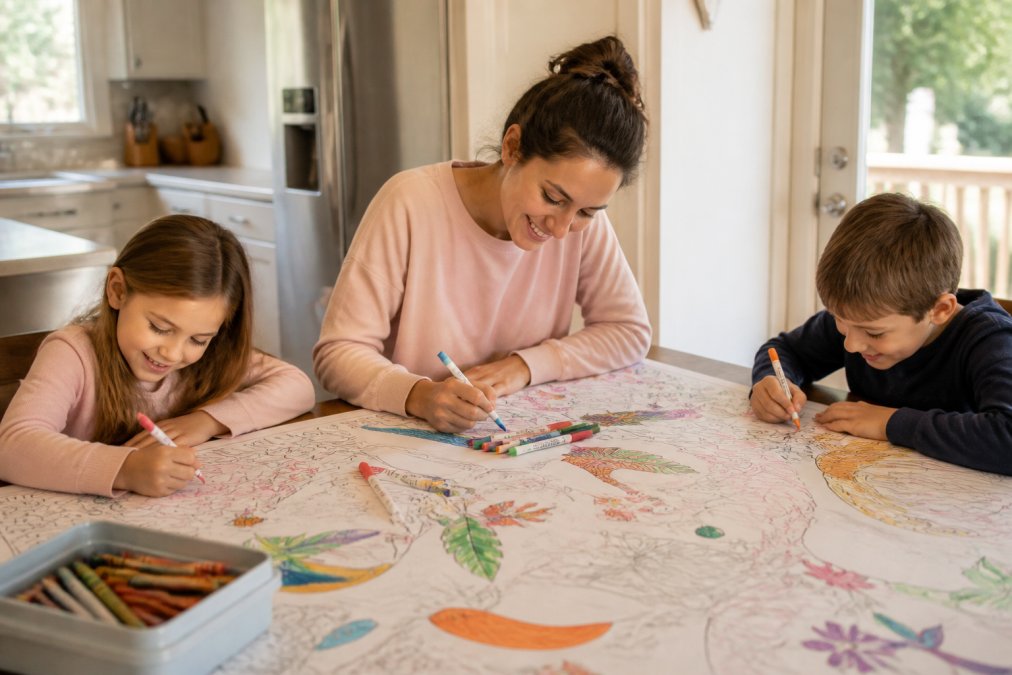
Large-format activities suit this better than individual ones. A table-sized sheet gives each person their own territory: two siblings sharing one small page will argue over space, but two working opposite corners of a 30"x 50" map usually will not.
For mixed-age groups, the same sheet scales: a three-year-old scribbles across a continent, a seven-year-old colors a coastline, a ten-year-old looks up where that coastline actually is. Cherry Creek Lane's United States & Capitals Coloring Map is built for this and holds up to crayons, markers, and colored pencils.

A common mistake is buying one sheet per child. That defeats the purpose. One shared sheet creates the togetherness; separate sheets create parallel isolation.
How to Find Time for Yourself as a Parent
Finding time is not a scheduling problem but a boundary problem, and boundaries are harder.
The honest version: you will not find time, you will have to take it, and taking it will feel uncomfortable at first. A sequence that works for most parents:
- Identify the fifteen minutes of your day that are currently going to a screen you do not enjoy.
- Put the hobby supplies physically in that spot beforehand. A sheet already unrolled on the table removes the activation energy.
- Tell one other adult what you are doing and when. Naming it out loud makes it real.
- Set a timer. A defined end point makes the guilt easier to sit with.
- Do not extend it. Ending on time builds trust with your household, which makes the next session easier to claim.
The first week feels selfish, the second feels normal, and by the third most parents report the fifteen minutes pays for itself in patience alone.
Put the activity where you already sit. A coloring sheet left unrolled on the kitchen table gets used. The same sheet rolled up in a closet does not. Convenience beats intention every time.
Hobbies for Quiet Time and Low-Energy Days
Some days you have no capacity for anything active. Most advice treats "low energy" as a single state, but a day when you are tired yet mentally present differs from one when you are touched-out, overstimulated, and running on four hours of broken sleep. The right hobby depends on which you are having.
Sort quiet-time options by how much they ask of your hands, eyes, and working memory: the lower the demand on all three, the better they suit a genuinely depleted day.
Tier 1: Tired but functional. You can follow a simple task and want a visible result.
- Coloring a large-format sheet. Low-impact, no instruction required, and it can be picked up and put down mid-stroke. The repetitive motion gives a racing mind a place to land without demanding problem-solving.
- A crossword or word search. The light cognitive challenge is more engaging than pure repetition for parents who find coloring too passive.
- Knitting or crochet on a project with no deadline. The rhythmic hand motion is the point, not the finished object.
- Reading a physical book for fifteen minutes with your phone in another room. Physical pages remove the notification pull that a phone or tablet reintroduces.
Tier 2: Touched-out and overstimulated. You want less input, not more.
- Listening to a podcast or album with your eyes closed. Closing your eyes is the active ingredient here; it cuts visual load, which is often the hidden cost of a long day.
- Sitting by a window with a warm drink and no screen. Boring on purpose.
- Lying on the floor while your kids play around you. You are present without performing, and nobody needs a snack negotiated.
- A warm shower with the lights low. Many parents report this is the only uninterrupted ten minutes they get, and it counts.
Tier 3: Running on empty. Even holding a pen feels like too much.
Neurodivergent-Friendly and Sensory Hobbies for Parents
The barriers are specific, and so are the workarounds.
Conclusion
Frequently Asked Questions
What are some low-effort hobbies for busy parents?
Low-effort stress relief hobbies include coloring, gratitude journaling, listening to a podcast while folding laundry, and five-minute stretching. These require no setup and fit into small windows of downtime. A giant table-sized coloring sheet works well because it stays out on the table, so you can color for two minutes or twenty without preparing anything. The goal is a hobby you can pick up and put down without guilt.
How can parents find time for hobbies with a hectic schedule?
Look for the small gaps you already have: the ten minutes after kids are asleep, the wait during soccer practice, or the time while dinner simmers. Treat one of those windows as protected leisure time instead of scrolling. Pairing a hobby with an existing routine, like coloring at the kitchen table after bedtime, makes it stick without adding another task to your calendar.
Why is it important for parents to have hobbies outside of childcare?
Hobbies give parents a sense of identity beyond their caregiving role and create space for emotional regulation. Creative expression, physical activity, and quiet time all support mental clarity and lower the buildup of parental stress. Parents who keep a hobby tend to model self-care for their kids and return to parenting with more patience and energy.
How do you start a hobby when you are exhausted?
Start with something that requires zero decisions: a coloring sheet already on the table, a puzzle left out, or a notebook beside your bed. Exhaustion makes setup feel impossible, so remove it. Choose a low-impact activity you can do sitting down, set a five-minute timer, and stop when it rings. Once the habit feels easy, the time naturally stretches on its own.