

Table of Contents
- Why the Best Family Communication Games Beat Ordinary Game Night
- Cooperative Board Games for Families That Force Real Teamwork
- Giant Puzzles for Family Collaboration: Bigger Canvas, Better Talk
- Conversation Starters for Families: Low-Pressure Ways to Get Everyone Talking
- Active Listening and Non-Verbal Cues: Games That Teach Both
- The Debrief Matters: Post-Game Reflection Prompts That Stick
- Communication Games for Neurodivergent Kids and Mixed-Age Groups
- Conclusion: Pick One Game and Play It This Week
- Frequently Asked Questions
Last Updated: October 1, 2026
Why the Best Family Communication Games Beat Ordinary Game Night
Family communication games are structured activities that build listening, turn-taking, and emotional expression through play rather than instruction. Below are the games that get everyone talking, plus the debrief questions that make the lessons stick.
Cooperative Board Games for Families That Force Real Teamwork
Cooperative board games for families work because everyone wins or loses together, removing the pressure that makes some kids shut down. With no single winner, the loudest player loses their advantage, and quieter kids must speak up because the team cannot succeed without them. The best picks have a shared goal and limited information: one player knows something the others do not, and the team has to talk it through.
Giant Puzzles for Family Collaboration: Bigger Canvas, Better Talk
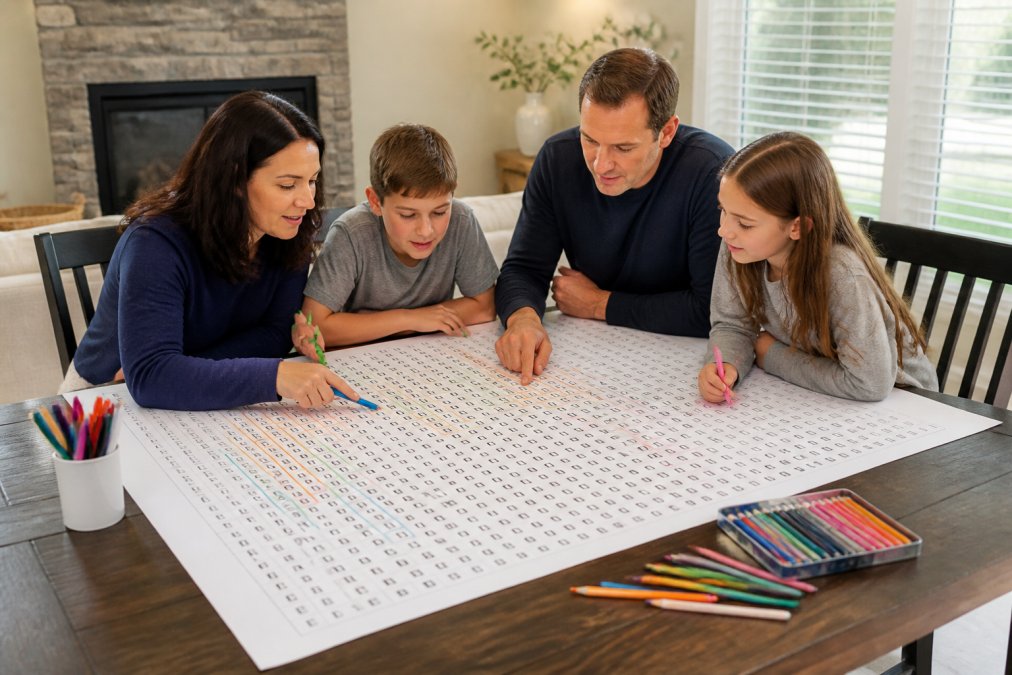
Giant puzzles for family collaboration change the physical setup of game night, and that changes the conversation. At 30 by 43.5 inches, no one can hover over the puzzle alone; players spread around the edges and must look up, make eye contact, and coordinate out loud.
Conversation Starters for Families: Low-Pressure Ways to Get Everyone Talking
Conversation starters for families work best when they are low-stakes and slightly silly, because "How was your day?" gets one-word answers. A good starter gives everyone something concrete to respond to, and works best when the adults answer too. Open-ended questions with no single correct answer lower the social risk of speaking, and lower risk gets a reluctant talker talking.
Tier the prompts by age so no one is left out
One list of questions will not fit a four-year-old and a fourteen-year-old at the same table. Tier them:
- Ages 4-7 (concrete and sensory): "If you could only eat one meal forever, what would it be, and who would cook it?" "Describe your day using only weather words." "What is the silliest sound you made today?"
- Ages 8-12 (opinion and imagination): "If our family had a team name, what should it be?" "What is one rule you would change if you were in charge for a day?" "What is the best thing that happened to you this week that no one here knows about?"
- Ages 13+ (identity and values): "What is something you believe now that you did not believe two years ago?" "Whose opinion do you trust most, and why?" "What is a small thing someone did for you that you still think about?"
Run it as a game, not an interview
Questions read aloud turn into an interrogation. Give the starters a game structure:
- Pass the Prompt. Write each question on a slip of paper, fold it, and drop it in a bowl. Each player draws one, reads it aloud, and answers first. Everyone else answers the same question in turn. The reader goes first so they are not put on the spot.
- Two Truths and a Question. Each player shares two true facts about their week and one made-up one. The family guesses the fake, then asks one follow-up question about whichever fact they want to hear more about.
- The Follow-Up Rule. Whoever answers gets exactly one follow-up question from the person to their left before the next player goes. This is the highest-value rule here, it teaches kids their words are worth listening to, the foundation of expressive language and emotional intelligence.
Handle the two hard cases
Every family has a reluctant talker and a dominant one. Plan for both.
- The reluctant talker: Let them pass once without penalty, then come back. Offer a choice of two prompts instead of an open floor: "The weather one or the superpower one?" Choice restores the control a quiet kid is protecting.
- The dominant talker: Use a physical token, a spoon, a coaster, anything, that the speaker holds. Only the token-holder talks, then passes it. It is the same turn-taking mechanic as cooperative board games, and it works because the rule is external, so no one feels corrected.
The digital-age angle most lists miss
Screen time trains kids to communicate in text, emoji, and short bursts with a delay between messages; face-to-face conversation removes the delay and adds a face. Conversation starters are one of the cheapest ways to close that gap. Run one round at the table with phones parked in a bowl in the middle of the room, not confiscated, just parked.
Active Listening and Non-Verbal Cues: Games That Teach Both
Active listening games train two skills at once: hearing what someone said, and reading what their face and body are telling you. Most family games only test the first. The second is where social cues and empathy live, and it transfers most directly to school, friendships, and eventually work.
Three games that need nothing but people
1. Back-to-Back Drawing. One person describes a simple picture while their partner draws it without looking. No questions allowed on the first round. On the second round, questions are allowed. Compare the two drawings.
-
Why it works: Round one isolates pure verbal description; round two adds clarification, the actual skill of listening, knowing when to ask. The visible gap between the drawings is the lesson, which lands for kids who tune out verbal feedback.
-
Scale it: Start with a shape (a house, a tree), move to a scene (a house with a tree and a sun), then forbid directional words like "left" and "right" on round two to force precise language.
-
Why it works: Naming the clue, not just the emotion, builds the skill. "Angry" is a lucky hit; "angry, because your jaw was tight and you were looking down" is evidence of reading a body.
-
Scale it: Start with big emotions (happy, angry, scared), then move to subtle ones (embarrassed, proud, disappointed, relieved).
-
Why it works: It makes listening measurable. You either got all three or you did not, and there is no arguing with the result.
-
Scale it: Two items for younger kids, four for teens. Once the basics are easy, require the feeling behind each item, not just the fact.
Adapt for neurodivergent kids
Traditional social-cue games assume a child can read faces and hold fast back-and-forth. For kids with ADHD or autism, that assumption is the barrier, not the game. A few adaptations keep them in the conversation:
- Allow a non-verbal turn. In Emotion Charades, let a player draw the emotion or point to a feelings chart instead of acting it out. The skill being trained is recognizing the cue, not performing it.
- Remove the timer. Time pressure is the single most common reason a neurodivergent kid shuts down. Let turns take as long as they take.
- Make the rule visible. Write the steps of Back-to-Back Drawing on a card and leave it on the table. Working memory load drops when the rule is external.
- Name the cue out loud yourself. If a child misses a body-language clue, do not quiz them. Say it plainly: "I noticed her arms were crossed, that usually means she is not comfortable yet." Modeling beats testing.
- Offer a pass. A player can say "pass" once per round with no penalty. Knowing the exit exists is often enough that they never use it.
The debrief is where the skill sticks
The debrief after each round matters more than the game. Ask: "What made this hard?" and "What would have helped?" Those two questions turn a silly activity into a real conversation about communication barriers.
| Moment in the Game | Reflection Prompt | Skill It Builds |
|---|---|---|
| A clue was misunderstood | "What would have made it clearer?" | Verbal expression |
| Someone guessed the emotion fast | "What clue gave it away?" | Reading non-verbal cues |
| A player had to repeat something back | "What was hard to remember?" | Active listening |
| A player passed | "What would have made it easier to try?" | Self-advocacy, trust |
The Debrief Matters: Post-Game Reflection Prompts That Stick
Post-game reflection prompts are the step almost every family skips, and skipping them wastes most of the game's value. The game creates the experience; the debrief turns it into a lesson a child carries into school, friendships, and eventually work.
A simple structure that works:
| Moment in the Game | Reflection Prompt | Skill It Builds |
|---|---|---|
| Someone got frustrated | "What did you need right then?" | Emotional intelligence |
| A clue was misunderstood | "What would have made it clearer?" | Verbal expression |
| A quiet player spoke up | "How did it feel to be heard?" | Confidence, empathy |
| The team lost | "What would we change next time?" | Collaborative problem solving |
Communication Games for Neurodivergent Kids and Mixed-Age Groups
For families with a wide age range, the goal is participation over performance. A game everyone can join beats a game only some can win.
Conclusion: Pick One Game and Play It This Week
The hardest part of building communication at home is not finding the right game, it is clearing the table and starting. Families that talk well together built the habit one game night at a time.
Frequently Asked Questions
What are some good family communication games?
Cooperative board games, giant table-sized word searches, and conversation starter prompts all work well. Cooperative games force players to talk through decisions together. Giant puzzles like a 30x43.5 inch word search let everyone work on the same sheet at once, which naturally sparks conversation. Conversation starter cards or themed prompts give families a structured way to share stories and opinions without the pressure of direct eye contact. Rotate between these three types so game night stays fresh.
How can games help improve family communication skills?
Games create a low-stakes setting where family members practice turn-taking, active listening, and giving constructive feedback. When you play a cooperative board game, you have to explain your reasoning and hear others out before making a move. That back-and-forth builds the same muscles used in everyday conversations. Giant puzzles add a shared physical focus, which can make it easier for kids who feel anxious about direct eye contact to open up while their hands are busy.
What are the best cooperative board games for families?
Look for games where every player works toward a shared goal rather than competing. Cooperative games typically require players to discuss options, negotiate roles, and agree on a plan each turn. That structure is what builds communication. For younger kids, simpler cooperative games with fewer rules work best. For mixed-age groups, giant table-sized puzzles serve the same purpose: everyone contributes to one shared outcome, and nobody loses.
How do giant puzzles help with family collaboration?
A giant puzzle like a 30x43.5 inch word search spreads across the whole table, so family members have to share space, pass supplies, and coordinate who searches which section. That physical layout creates natural opportunities for peer-to-peer communication. One person spots a word and calls it out; another checks the word list. The shared canvas makes collaboration visible and immediate. Cherry Creek Lane's giant word searches and table-sized coloring sheets are built for exactly this kind of group play.
What conversation starters work best for families with young kids?
Questions that do not have a right or wrong answer work best. Try prompts like 'What made you laugh today?' or 'If you could invent a new holiday, what would it be?' Keep them open-ended so kids can answer at their own level. Pair conversation starters with a hands-on activity like coloring a giant sheet, so talking feels like a side effect of the fun rather than the main event. That approach lowers pressure for shy kids and keeps the dialogue flowing naturally.