

Table of Contents
- Why Creative Bonding Matters More Than Ever in 2026
- Screen-Free Family Activities That Actually Get Everyone Talking
- Family Craft Kits and Collaborative Projects for All Ages
- How to Plan a Family Connection Night That Sticks
- Budget-Conscious Bonding: Big Connection, Small Spend
- Neurodivergent-Friendly Bonding: Adapting Activities for Every Brain
- Virtual and Hybrid Bonding: Staying Close When Apart in 2026
- Post-Activity Reflection: The Step Most Families Skip
- Frequently Asked Questions
Last Updated: September 25, 2026
Why Creative Bonding Matters More Than Ever in 2026
The average family now spends less than 40 minutes a day in focused, screen-free conversation, and that number keeps falling. Creative ways to bond in 2026 have become less about grand gestures and more about small, repeatable rituals that pull everyone away from their devices. At Cherry Creek Lane, we hear the same thing from parents and grandparents: the best moments happen when hands are busy and eyes are off screens.
Screen-Free Family Activities That Actually Get Everyone Talking
Screen-free family activities work best when they give everyone something to do with their hands. A shared task lowers the pressure of direct eye contact, and conversation tends to follow naturally. That is why coloring, puzzles, and group projects outperform passive entertainment like movie night. Engaging in these tactile pursuits becomes especially rewarding when bridging generational gaps through screen-free activities for grandchildren.
The Tech-Free Zone Rule
Pick one physical space and one time window where phones stay in a basket. The kitchen table works well because it already signals togetherness. Keep the rule simple and apply it to adults too, because kids notice double standards fast.
Conversation Starters That Go Beyond 'How Was Your Day?'
Generic questions get generic answers. Try prompts that invite a story instead:
- What was the funniest thing that happened to you today?
- If you could swap lives with anyone at this table for a day, who and why?
- What is one thing you want to learn before the year ends?
Family Craft Kits and Collaborative Projects for All Ages
Family craft kits remove the hardest part of creative time: setup. When the materials are already in one place, kids start faster and adults stress less. A single large-format project also solves the space problem, since everyone works on the same sheet instead of competing for separate supplies.
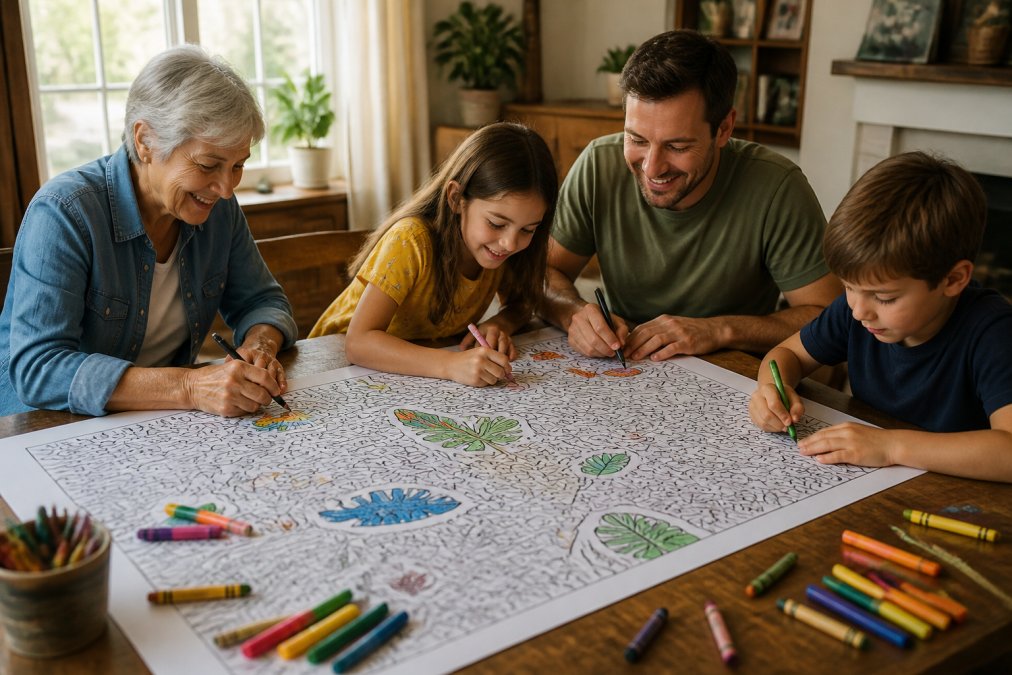
Giant Coloring Sheets: A Canvas for Connection
Giant coloring sheets turn any table or wall into a shared canvas. Cherry Creek Lane's 2026 Yearly Calendar measures 50"x30" and works with crayons, markers, and colored pencils. Because the surface is large, two or three people can color at once without crowding each other.

Making It Work for Mixed-Age Groups
A three-year-old and a seven-year-old can share the same sheet if you assign zones. Give younger kids the big open areas and older kids the detailed sections. The same logic applies to homeschooling families with several grade levels working side by side.
How to Plan a Family Connection Night That Sticks
A family connection night is a recurring, screen-free block of time set aside for one shared activity. The families who keep it going are the ones who plan it in three steps rather than trying to improvise.
The 3-Step Planning Framework
- Pick a fixed slot. Same day, same time each week. Friday after dinner or Sunday morning both work.
- Choose one activity. One craft, one game, one project. Not a menu.
- Prep in five minutes or less. Set out supplies the night before so the session starts without friction.
| Step | What You Do | Time Needed | Frequency |
|---|---|---|---|
| Pick a slot | Choose a recurring day and time | 2 minutes | Once, then keep it |
| Choose activity | Select one craft or game | 5 minutes | Weekly |
| Prep supplies | Lay out materials in advance | 5 minutes | Weekly |
Budget-Conscious Bonding: Big Connection, Small Spend
Most bonding advice assumes you will spend money. The gap in nearly every ranking article is a way to compare activities by what they actually cost in dollars and in adult effort, so you can pick the right one for a given week instead of defaulting to the most expensive option.
The Cost-to-Effort Matrix
Use this as a planning tool, not a scorecard. "Effort" means adult prep time, cleanup time, and the amount of supervision required. "Cost" means out-of-pocket spend per session, assuming reusable materials.
2026 Classic Sunday or Monday Start →
| Activity | Cost Per Session | Adult Effort | Best For |
|---|---|---|---|
| Giant coloring sheet (reused across weeks) | Under $1 amortized | Low (set out, wipe down) | Mixed ages, parallel play |
| Card and dice games from the junk drawer | $0 | Low | Two to four players, quick sessions |
| Paper-and-pencil story chain | $0 | Low | Older kids, conversation starters |
| Kitchen science (baking soda, vinegar, food coloring) | Under $3 | Medium (cleanup) | Hands-on kids who need movement |
| Neighborhood scavenger hunt (printed list) | $0 to print | Medium (route planning) | Outdoor sessions, teams |
| Build-a-blanket-fort night | $0 | Medium (setup and teardown) | Younger kids, high novelty |
| One large craft kit | $15 to $30 one time | Medium | A full month of sessions |
The Reusable-Materials Rule
Budget bonding fails when every week requires a new purchase. The fix is to build a small library of reusable anchors and rotate them:
- One large-format coloring sheet or poster that lives rolled up between sessions
- A deck of cards, a set of dice, and a pad of paper
- A bin of basic art supplies (crayons, markers, colored pencils, glue stick)
- One or two themed kits for months when you want novelty
Trade-Offs to Watch
- Free activities often cost more in adult effort. A scavenger hunt is free but requires route planning and a printed list.
- Kits cost more up front but reduce decision fatigue, which is the real reason many family nights die.
- Trading craft nights with another family doubles variety at no cost, but it also doubles scheduling friction. Pick one reliable partner family rather than a rotating group.
Cherry Creek Lane's coloring sheets start at $19.99, and each one covers multiple sessions for multiple kids, which is the pattern the matrix is built to reward.
Neurodivergent-Friendly Bonding: Adapting Activities for Every Brain
Neurodivergent-friendly bonding means adjusting the format, not lowering the goal. The gap in most ranking articles is that they treat "neurodivergent" as one category. In practice, the adaptations that help a sensory-seeking kid can make a sensory-avoidant kid miserable, so the useful move is to match the activity format to the sensory profile in the room.
Match the Format to the Sensory Profile
| Profile | What Helps | What to Avoid |
|---|---|---|
| Sensory-seeking (needs movement, pressure, input) | Standing work surfaces, big arm motions, textured materials, short bursts with a movement break | Long seated tasks, fine-detail work, quiet-only environments |
| Sensory-avoidant (overwhelmed by input) | Soft lighting, low noise, one material at a time, a defined personal zone | Crowded tables, overlapping sounds, strong smells, surprise touch |
| Attention-regulation (hard to start or stop) | Visible timer, clear start and end, a single instruction at a time | Open-ended "do whatever you want" prompts, multi-step directions delivered at once |
| Social-energy (drains fast in groups) | Parallel play, opt-out of conversation, a quiet corner nearby | Forced turn-taking, group performances, direct eye contact expectations |
Concrete Adaptations That Work
- Define a zone on a shared project. On a large coloring sheet, tape off each person's area so personal space stays clear and no one reaches into someone else's section.
- Use a visible timer. A kitchen timer or a phone face-up on the table makes the end of the session predictable, which reduces the anxiety that comes with not knowing when something stops.
- Allow parallel play. Two people working on the same sheet in silence is still bonding. Conversation is optional, not the metric.
- Keep the environment low-stimulation. Soft lighting, no background TV, and one activity at a time. Background noise competes with the activity for the same attention.
- Offer a sensory exit. A nearby quiet corner with a cushion lets someone step out for two minutes and come back without the session ending.
- Pre-announce transitions. "Five more minutes, then we clean up" gives the brain time to prepare for the shift.
Inclusion Trade-Offs to Name Out Loud
- A quiet, low-stimulation session may feel flat to a sensory-seeking kid. Pair it with a movement break rather than abandoning the format.
- Parallel play can look like disengagement to a parent who expects conversation. Reframe the goal as shared presence, not shared dialogue.
- A visible timer helps one kid and stresses another. Let the timer be optional and place it where only the person who wants it can see it.
- One-on-one sessions often work better than full-family sessions for kids who are easily overwhelmed. Rotate who gets the one-on-one slot rather than trying to make every session work for everyone.
The goal is participation on their terms, not a perfect family photo.
Virtual and Hybrid Bonding: Staying Close When Apart in 2026
Virtual bonding works when there is a shared object on both ends of the call. Grandparents in another state can color the same themed sheet as their grandchildren while on video, comparing progress at the end. Hybrid setups, where some people are in person and some join remotely, follow the same rule: everyone needs something to do with their hands.
Post-Activity Reflection: The Step Most Families Skip
Post-activity reflection is a two-minute conversation after the activity ends, and it is the step that turns a fun afternoon into a lasting memory. Ask three quick questions: What did you enjoy most? What was hard? What should we do next time?
Frequently Asked Questions
What are some creative ways to bond as a family without screens?
Start with a shared creative project that gives everyone a role. Giant coloring sheets work well because they are large enough for multiple people to work on at once without crowding. Pair that with a tech-free zone rule, a set time each week, and simple conversation starters. The key is consistency, not perfection. Even 30 minutes of focused, screen-free time together builds the habit of connection.
How do you plan meaningful family time on a budget?
Set a recurring night, keep it simple, and rotate who picks the activity. A $19.99 giant coloring sheet from Cherry Creek Lane gives hours of shared entertainment, and it is reusable across multiple sessions. Skip the pressure to make every moment Instagram-worthy. Low-cost bonding works best when the activity is easy to start and does not require a lot of prep or cleanup.
What are the benefits of collaborative art projects for family bonding?
Collaborative art builds shared experiences and gives family members a low-pressure way to communicate while doing something side by side. It also supports fine motor skills and focus in younger children. Because there is no single right answer, it reduces conflict and encourages teamwork. The finished piece becomes a visual reminder of time spent together, which reinforces the bond long after the activity ends.
How can families create lasting traditions in 2026?
Pick one activity and repeat it at the same time each week or month. A recurring family connection night, a holiday coloring tradition, or a Sunday afternoon craft session all work. The tradition does not need to be elaborate. What matters is that it happens consistently and that everyone knows it is protected time. Write it on a visible calendar so it does not get pushed aside by other commitments.