

Table of Contents
- How Long Does It Take to Color a Giant Poster?
- Time Estimates by Age Group and Coloring Style
- What's Included and What You'll Need Before You Start
- Step-by-Step: How to Color a Giant Poster (Without Burnout)
- The Best Markers for Giant Coloring Sheets (and What to Avoid)
- Large Coloring Posters for Kids: What to Look For
- Tips for Coloring Large Posters With Groups
- Common Mistakes That Slow You Down
- Frequently Asked Questions
Last Updated: September 30, 2026
How Long Does It Take to Color a Giant Poster?
Most families finish a giant poster in three to six hours of actual coloring, spread across several sittings. A simple design with big open shapes goes faster. A detailed mandala or a poster with tiny pattern work can run past ten hours.
The short answer depends on four things:
- The design. Big blocks of color move fast. Fine detail slows everyone down.
- The medium. Markers cover ground quickly. Colored pencils take longer but look richer.
- The number of hands. A group of four finishes far sooner than one person working alone.
- The age of the colorers. Attention spans vary wildly, and so does speed.
Time Estimates by Age Group and Coloring Style
The honest answer here is that age changes everything. A 4-year-old and a 14-year-old coloring the same giant poster will finish at completely different speeds.
Here's how the timing breaks down by age:
| Age Group | Typical Session Length | Total Time to Finish | Best Style |
|---|---|---|---|
| Ages 3-5 | 10-15 minutes | 8-12 hours (with help) | Large shapes, few colors |
| Ages 6-9 | 20-30 minutes | 5-8 hours | Bold blocks, simple patterns |
| Ages 10-13 | 30-45 minutes | 3-5 hours | Detailed fill-in work |
| Teens and adults | 45-90 minutes | 2-4 hours | Fine detail, shading |
Younger kids color fast but quit quickly. They'll fill a big shape in seconds, then wander off. Older kids and adults work slower per minute but stay at the table far longer.
A common mistake is expecting a preschooler to finish a whole sheet. They won't, and that's fine. Let them claim one corner and call it done.
What's Included and What You'll Need Before You Start
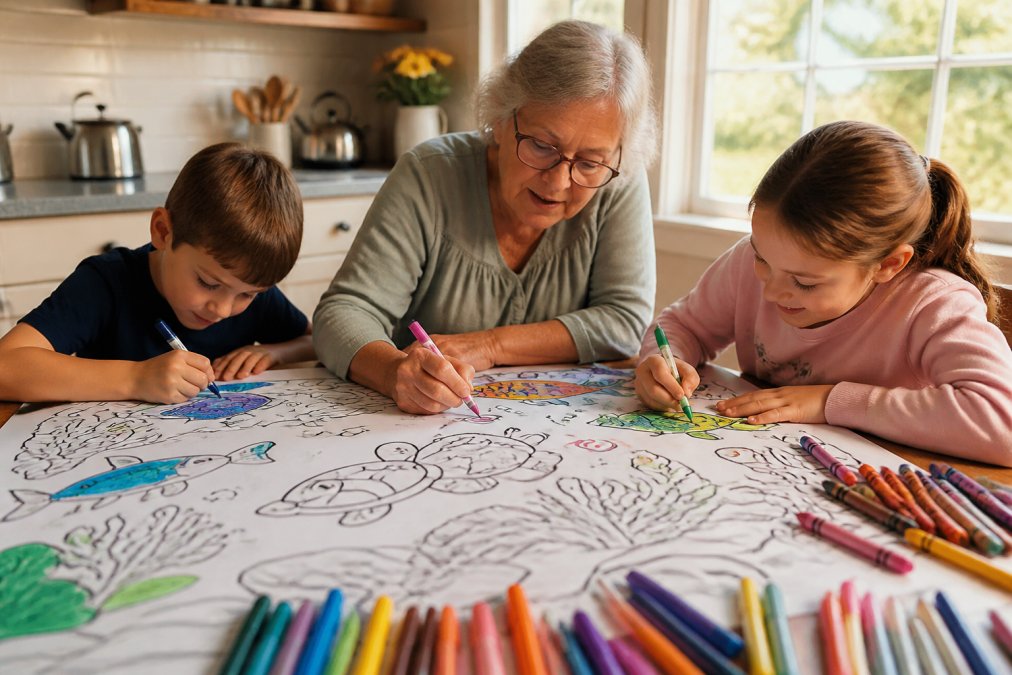
Every Cherry Creek Lane sheet arrives ready to color. Our table-sized coloring sheets measure 30"x50" and come printed on high-quality paper. That size covers a whole table or a good chunk of wall.
Before anyone picks up a marker, gather these basics:
- A flat surface with room to spread out
- A mix of crayons, markers, and colored pencils
- A cup or tray for each colorer
- Painter's tape if you're mounting it on a wall
- A scrap sheet to test marker colors first
You don't need fancy supplies. A basic set of washable markers and a box of crayons covers most of it.
Step-by-Step: How to Color a Giant Poster (Without Burnout)
The trick to finishing a giant poster is pacing. Treat it like a project, not a single afternoon.
Step 1: Set up the space
Pick a spot where the sheet can stay put between sessions. A dining table works well. So does a cleared floor area with a mat underneath.
Tape the corners down so it doesn't slide.
Step 2: Pick a medium
Match the medium to the colorer. Little kids do best with chunky crayons and washable markers. Older kids and adults can handle fine-tip markers and colored pencils.
We the people Table Size Coloring Sheet →
Step 3: Color in sessions
Work in short blocks. Set a timer for 30 minutes and stop when it goes off, even if everyone's still having fun. Stopping while it's still enjoyable makes people want to come back.
The Best Markers for Giant Coloring Sheets (and What to Avoid)
| Medium | Coverage Speed | Bleed-Through Risk | Best For | Time Impact on a 30"x50" Sheet |
|---|---|---|---|---|
| Broad-tip washable markers | Fastest, one stroke covers a wide band | Moderate to high on thin paper; low on 80 lb or heavier | Big open shapes, background fills | Cuts total time roughly in half versus pencils |
| Crayons | Moderate, pressure-dependent, leaves texture | None | Kids under 8, textured or waxy looks | Similar to markers on big shapes, slower on detail |
| Colored pencils | Slowest, narrow tip, layered strokes | None | Fine detail, shading, gradients | Often doubles or triples total time on the same sheet |
What to avoid:
- Permanent markers. They bleed through almost any paper, stain hands and tables, and are nearly impossible to remove from fabric.
- Fine-tip pens for big shapes. Filling a 6"x6" open area with a 0.5 mm tip is an exercise in frustration.
- Old, dried-out markers. They streak, skip, and force multiple passes, which erases the speed advantage markers are supposed to give you.
- Mixing wet and dry mediums in the same area. Marker over crayon beads up; crayon over marker smears. Keep mediums in separate zones.
A practical rule for families: give kids under 8 crayons or broad-tip washables, give ages 8-12 a choice between washables and pencils depending on the design, and give teens and adults pencils for detail zones plus markers for backgrounds. Matching the medium to the person and the area is the single biggest lever on total completion time.
Large Coloring Posters for Kids: What to Look For
Large coloring posters for kids should be big enough to share and tough enough to survive a few sessions. Size matters most. A poster that's too small causes crowding and arguments.
Look for these features:
- A generous size, like 30"x50", so several kids can work at once
- Thick paper that holds up to markers
- A design with a mix of big and small shapes
- A theme that fits your family or classroom
Tips for Coloring Large Posters With Groups
- Rotate the sheet 90 degrees between sessions so each person works a different edge.
- Let people stand for part of the session, standing over a table is often easier on the back than leaning in from a chair.
- Keep the sheet at table height, not on the floor. Floor coloring is the fastest route to a stiff neck.
- Take a two-minute hand stretch every 20 minutes. Open and close fists, roll wrists, shake out fingers.
Plan for the last 10 percent. The final details, small patterns, lettering, touch-ups, always take longer than expected and are the least fun for kids. Save them for a short adult or teen session after the kids have moved on, or accept that the poster is "done enough" and hang it.
Common Mistakes That Slow You Down
The biggest slowdowns are easy to avoid once you know them.
- Starting with tiny details. Save the fine work for last. Big shapes first build momentum.
- Using one marker at a time. Grab a handful of colors so you're not constantly swapping.
- Coloring on a soft surface. A couch or bed makes markers skip. Use a hard table.
- Skipping breaks. Tired hands color sloppily and lose interest fast.
- Letting one person do everything. Share the load and the poster gets done sooner.
Frequently Asked Questions
How long does it take to finish a giant coloring poster?
Most giant posters take 6 to 12 hours total to color, spread across several sessions. A 30x50 inch sheet like Cherry Creek Lane's We the People coloring sheet has enough surface area for multiple sittings. Younger kids might add 30 minutes at a time, while older kids and adults can color for 1 to 2 hours before needing a break. The total depends on how detailed you want the finished poster to look.
What factors influence how long it takes to color a large poster?
Four main factors: the size of the poster, the complexity of the design, the coloring tool you use, and how many people are working on it. A 30x50 inch sheet with large open areas goes faster than one with detailed mandala designs. Markers cover faster than colored pencils. And a group of four can finish in a quarter of the time it takes one person.
What are the best markers for giant coloring sheets?
Look for markers labeled bleed-resistant and quick-drying, since large sheets have more surface area and you want to avoid soak-through. Fine-tip markers work well for detailed areas, while broad-tip markers cover big spaces faster. Test on a corner first. Cherry Creek Lane's sheets use high-quality paper that handles crayons, markers, and colored pencils, so you have flexibility.
Should I color a giant poster alone or with a group?
Both work, but groups finish faster and often have more fun. For group sessions, divide the poster into sections so each person owns a area. This avoids crowding and keeps everyone engaged. Solo coloring is better for stress relief and creative focus, but expect it to take longer. A family of four can typically finish a giant poster in two or three sittings.
Coloring a giant poster is a marathon, not a sprint, and the memories matter more than the finish line. Cherry Creek Lane makes that easy with huge table-sized coloring sheets, giant crosswords, and wall-sized calendars built for the whole family. Every sheet is made in the USA and shipped from Utah, printed on high-quality paper that works with crayons, markers, and colored pencils. Get started with Cherry Creek Lane and turn any table into hours of screen-free fun.