

Table of Contents
- Why Playing Together Matters Across Age Gaps
- Age-Gap Cheat Sheets: How to Engage Siblings of Different Ages
- Collaborative Games for Mixed Age Groups
- Screen-Free Activities for Siblings That Actually Hold Attention
- How to Stop Sibling Rivalry During Play
- How to Engage Siblings of Different Ages Through Family Traditions
- Managing Parental Burnout While Keeping Everyone Busy
- Conclusion
Last Updated: August 17, 2026
Figuring out how to engage siblings of different ages is one of the trickiest parts of family life, and one of the most rewarding when you get it right. The challenge is real, but the solution isn't complicated: choose activities that flex across developmental stages rather than trying to find the mythical activity that every child loves equally.
According to child development research from the American Academy of Pediatrics, cooperative play between siblings builds social-emotional skills that children carry into adulthood, including empathy, conflict resolution, and turn-taking. The sibling relationship is often the longest relationship a person will have in their lifetime, and the habits formed during joint play shape how children relate to peers, partners, and coworkers decades later.
Why Playing Together Matters Across Age Gaps
Sibling interaction is one of the most powerful engines of cognitive development and language acquisition available to children. Older siblings model behavior, expand vocabulary, and demonstrate problem-solving in real time. Younger siblings push older ones to articulate ideas more clearly, which deepens understanding on both sides.
Children who play regularly with siblings develop stronger social cues and greater capacity for empathy because they're constantly negotiating with someone who has genuinely different needs and interests. The catch is that family dynamics shift constantly, a game that works beautifully one Saturday falls apart the next because someone's tired or hit a new developmental milestone.
Age-Gap Cheat Sheets: How to Engage Siblings of Different Ages
The single most useful mental model for mixed-age play is thinking in gap categories rather than individual ages. A 3-year-old and a 5-year-old present very different challenges than a 3-year-old and a 10-year-old.
2-4 Years Apart: The Sweet Spot for Mentorship
This gap is genuinely the easiest to work with. The older child is close enough in development to remember what the younger one is experiencing, which creates natural empathy. The best approach is to cast the older child as a mentor, not a competitor. Assign them a role: "You're the teacher today." This gives the older sibling status and purpose, while the younger child learns from someone they look up to. Activities that work well include simple board games with adjustable rules, collaborative art projects, and storytelling games where each child contributes a line.
Age-gap cheat sheet (2-4 years):
| Activity Type | Older Child's Role | Younger Child's Role | Adjustment Needed |
|---|---|---|---|
| Board games | Rule explainer | Dice roller | Simplify scoring |
| Art projects | Design lead | Color fill-in | Separate sections |
| Storytelling | Plot driver | Character picker | None |
| Building sets | Architect | Supply runner | Fewer small pieces |
5+ Years Apart: Bridging the Developmental Divide
This is where most parents struggle. The key insight is to stop trying to find activities that are equally challenging for both children and instead find activities where both have a meaningful, age-appropriate role.
Think of it as parallel contribution rather than equal participation. A 10-year-old and a 4-year-old can both work on a giant coloring sheet, the older child handles intricate details and shading, the younger child fills in large background areas. Neither is doing the same thing, but both are contributing to a shared outcome. That shared outcome is what creates bonding.
Large age gaps also benefit from structured mentorship moments. Give the older sibling a specific teaching task: show your brother how to fold paper into a boat, teach your sister the rules of this card game.
Collaborative Games for Mixed Age Groups
Collaborative games work best when competition is removed entirely. Cooperative play, where the whole family wins or loses together, eliminates the resentment that comes from a younger child always losing or an older child always winning without effort.
Adapting Rules So Every Child Can Win
The biggest mistake parents make is applying the same rules to every player. Most games can be adapted by adjusting the difficulty of each player's task, assigning roles based on ability, and creating a shared goal that requires every player's contribution.
For example, in a scavenger hunt, the youngest child finds items by color, the middle child finds items by category, and the oldest child solves riddles to find hidden clues. Everyone is playing the same game. Nobody is doing the same thing. This approach respects each child's developmental milestones while keeping the experience genuinely interactive.
Neurodivergent-Inclusive Play: Keeping Everyone in the Game
Many families include a child with ADHD, autism, sensory processing differences, or other neurodivergent profiles. Standard game formats often exclude these children unintentionally through noise levels, unpredictable rules, or high social demands.
Inclusive play isn't about lowering expectations, it's about designing the environment thoughtfully. A few adjustments make a significant difference:
- Choose open-ended activities over rule-heavy games when a child struggles with unpredictability
- Offer sensory-friendly materials: chunky crayons, soft markers, smooth puzzle pieces
- Build in legitimate "exit ramps" so a child can step away and re-enter without disrupting the group
- Use visual cues (a picture schedule of the activity) alongside verbal instructions
Giant coloring sheets work particularly well here because they're open-ended, low-pressure, and sensory-rich without being overwhelming.
Screen-Free Activities for Siblings That Actually Hold Attention
Screen-free activities succeed when they offer enough variety within a single activity to hold multiple attention spans simultaneously.
Giant Coloring Sheets: One Activity, Every Age Level
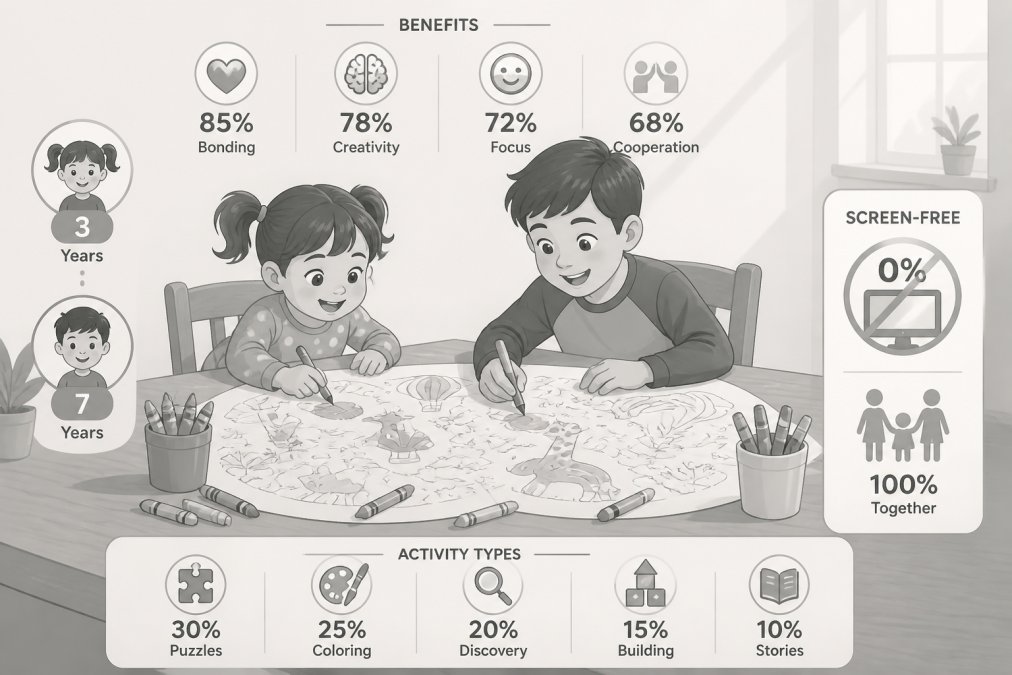
Giant coloring sheets are one of the most effective tools for engaging siblings of different ages at the same time. A table-sized sheet gives every child their own territory, removes the "she's in my space" conflict, and scales naturally across skill levels. A toddler scribbles in the sky. A 7-year-old colors the characters carefully. A 12-year-old adds shading and detail. Same sheet, same table, genuinely shared experience.
Cherry Creek Lane's giant coloring sheets are made in the USA and designed specifically for this kind of multi-age use. The large format means there's room for everyone, and the themed designs give older children enough complexity to stay interested while younger children can engage with simpler shapes.
Digital-Age Engagement Without a Screen
Screen-free doesn't mean anti-technology in spirit. Many children are drawn to screens because they offer interactivity, novelty, and immediate feedback. Replicate these qualities through physical activities: rotate activity themes monthly for novelty, add a game layer to any activity (time how fast siblings can complete a puzzle section together), and let children see visible progress as a coloring sheet goes from blank to finished.
Giant crosswords and word searches work well for older children, especially when a younger sibling is given the job of "letter finder," pointing to letters as the older child searches.
How to Stop Sibling Rivalry During Play
Sibling rivalry during play is almost always a resource conflict: space, attention, turns, or perceived fairness. Stopping it means addressing the resource conflict before it becomes an emotional one.
Setting Up the Environment Before Conflict Starts
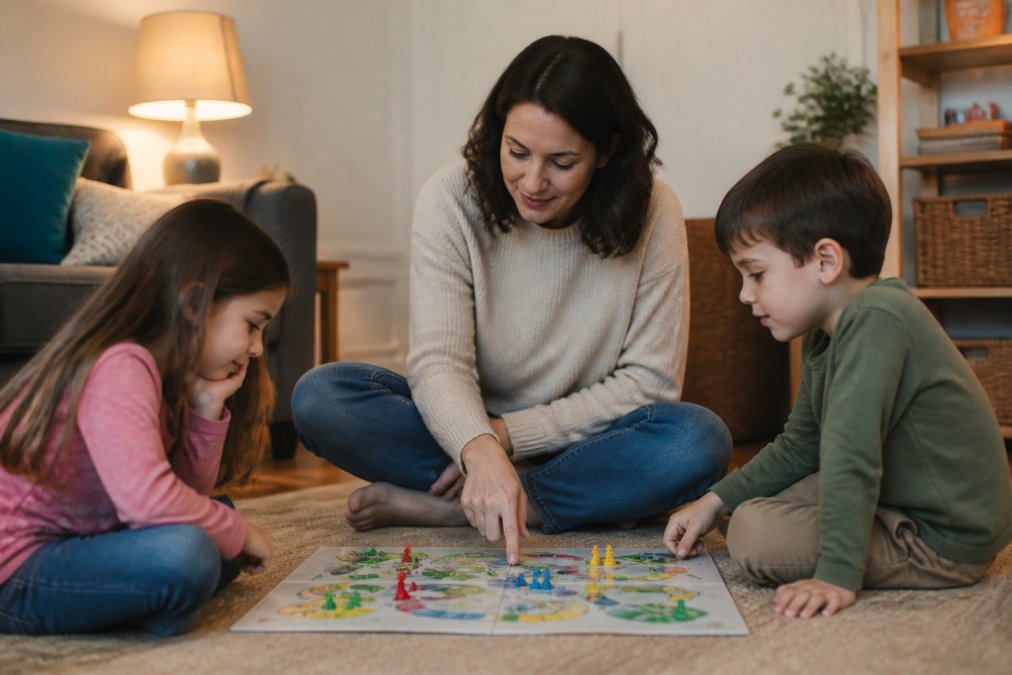
The environment does more work than most parents realize. Squabbling is significantly less frequent when each child has a clearly defined physical space, a designated set of materials, and a role that doesn't overlap with their sibling's role.
Before starting any shared activity:
- Assign seats or positions so there's no negotiation about who sits where
- Give each child their own set of materials
- Establish one clear rule: "We're all working toward the same thing"
- Remove scarce resources, if there's only one red marker, get a second one
Most sibling conflict during play isn't about the activity itself. It's about perceived inequality. Proactive environment design removes the triggers before they become arguments.
Parental Mediation Without Becoming the Referee
When conflict starts, try this sequence:
- Pause, give children 30-60 seconds to resolve it themselves
- Name, "I see two people who both want the blue marker"
- Ask, "What's a solution that works for both of you?"
- Offer, if they're stuck, offer two options and let them choose
- Exit, step back once resolved
This approach builds problem-solving skills over time. As guidance from the Child Mind Institute notes, children who practice conflict resolution in low-stakes sibling interactions develop stronger peer relations and emotional regulation in school settings.
How to Engage Siblings of Different Ages Through Family Traditions
Family traditions are the highest-use tool available for sibling bonding. They create shared identity, shared memory, and a recurring context for cooperative play that doesn't require parental invention every week.
The most effective family traditions for mixed-age siblings are predictable (the same time, same context each week or month), scalable (every child can participate at their own level), and produce something tangible (a finished coloring sheet, a completed puzzle, a filled-in wall calendar).
A monthly coloring tradition is one of the simplest to sustain. Set aside one evening per month, lay out a giant themed sheet, everyone works on it together, and hang it up when it's done. Over a year, you have twelve pieces of family art and twelve shared memories.
Managing Parental Burnout While Keeping Everyone Busy
Keeping siblings engaged is exhausting. Parents who are running on empty cannot facilitate quality play. Parental burnout management comes down to one principle: design activities that run themselves.
Activities that run themselves have a clear endpoint children can work toward independently, don't require constant rule enforcement, generate their own momentum, and don't require parental creativity to sustain. Giant coloring sheets, puzzles, and word searches all fit this profile. You set them up once. Children return to them. You're available but not required.
According to research on parental stress and child outcomes from the American Psychological Association, parental wellbeing directly affects the quality of family interactions. A parent who has built low-maintenance, high-engagement activities into the family routine is being strategic about where their energy goes.
The other piece is lowering the bar for what counts as "good enough." A coloring session where children argued twice but finished the sheet together is a success.
| Activity | Setup Time | Parental Involvement Required | Age Range | Runs Independently? |
|---|---|---|---|---|
| Giant coloring sheet | 2 minutes | Low | 2-12+ | Yes |
| Puzzle | 3 minutes | Low-medium | 4-12+ | Yes |
| Word search / crossword | 1 minute | Low | 6-12+ | Yes |
| Board game | 5-10 minutes | High (initially) | 5-12+ | After first play |
| Scavenger hunt | 15-20 minutes | High | 3-10 | No |
Build your family's activity repertoire around the top three rows of that table.
Getting siblings of different ages to genuinely engage with each other takes the right environment, the right activities, and a realistic approach to what "success" looks like. Cherry Creek Lane's giant coloring sheets, puzzles, and wall-sized calendars are built specifically for this challenge: open-ended enough for every age, large enough for every child to have their own space, and designed to run with minimal parental management. Every product is made in the USA and shipped from Utah, so quality is consistent and delivery is reliable. Shop Coloring Sheets and give your family an activity that actually brings everyone to the same table.
Frequently Asked Questions
How do you keep siblings of different ages entertained together?
Choose open-ended activities that each child can engage with at their own level. Giant coloring sheets work well because a toddler can fill in broad shapes while an older child adds detail and shading. Cooperative board games with adjustable rules, storytelling rounds, and building projects also let each sibling contribute meaningfully. The goal is one shared activity with multiple entry points, so no one feels bored or left out based on their developmental stage.
What are the best screen-free activities for siblings with a large age gap?
Large-format coloring sheets, puzzles with varying piece sizes, and word searches scaled to reading level are strong options when siblings are five or more years apart. Assign roles rather than identical tasks: the older child can read clues aloud while the younger one finds pieces. Family traditions built around a weekly craft or coloring session give both children something to look forward to and create shared memories without requiring the same skill level.
How can I stop siblings of different ages from fighting during playtime?
Conflict during play usually comes from unclear ownership, unequal turns, or one child dominating the activity. Set simple ground rules before play starts: designated spaces, a turn-taking signal, and a clear way to ask for help. Activities with enough physical space for both children, like a table-sized coloring sheet, reduce territorial squabbling. When tension rises, redirect rather than referee: offer a new task to the frustrated child instead of adjudicating who was right.
Why is it important for siblings of different ages to play together?
Joint play between siblings builds social-emotional skills that peer relationships alone rarely develop. Younger children gain language acquisition and behavioral modeling by watching older siblings. Older children practice empathy, patience, and leadership. Research in child development consistently links strong sibling bonds to better conflict resolution skills and peer relations later in life. Regular shared activities, even 20 minutes a day, reinforce family dynamics and create the kind of cooperative play habits that carry into adulthood.
This article was written using GrandRanker