

Table of Contents
- What You'll Need to Hang Large Coloring Posters
- Damage-Free Poster Hanging Methods That Protect Your Walls
- The Best Tape for Coloring Posters on Walls by Surface Type
- Step-by-Step: How to Hang Large Coloring Posters on a Wall
- How to Keep Coloring Posters Flat on the Wall
- Climate, Humidity, and Long-Term Preservation
- Removing Posters Without Damage and What to Do Next
- Frequently Asked Questions
Last Updated: October 3, 2026
What You'll Need to Hang Large Coloring Posters
Hanging a giant coloring poster without wrecking your wall comes down to three things: the right tape, a clean surface, and a plan for the weight. This guide shows you how to hang large coloring posters on a wall so they stay flat, look straight, and come down clean.
Large coloring posters are oversized sheets, often 30 by 50 inches, that kids and adults color together as a group activity. Their size is the point, but it also makes hanging them harder than a standard print.
A few basics before you start:
- A tape measure and a pencil
- A level, or a leveling app on your phone
- Painter's tape for a test run
Damage-Free Poster Hanging Methods That Protect Your Walls
Damage-free poster hanging methods fall into two families: adhesive strips that grip and release, and mechanical clips that hold without glue. Both protect paint and drywall when used correctly.
Command Strips and Poster Putty
Adhesive strips work best on smooth, painted surfaces; press firmly for 30 seconds so the bond sets. Poster putty is gentler for light sheets and painted drywall, but leaves an oily mark if you press too hard.
Painter's Tape and Binder Clips
Painter's tape is the safest temporary mount: it peels off clean and holds light paper well. For large format sheets with real weight, clip the top edge with binder clips hung on small hooks, which spread the tension so the paper does not tear.
The Best Tape for Coloring Posters on Walls by Surface Type
The best tape for coloring posters on walls depends on your surface, not the poster.
Adhesives need continuous contact to bond. Every bump, texture, or dust particle reduces contact area, which is why a strip that holds a 30 by 50 inch sheet on smooth drywall slides off textured wallpaper by lunchtime.
| Surface Type | Best Option | Avoid | Why It Works |
|---|---|---|---|
| Smooth painted drywall | Wall-safe adhesive strips | Duct tape | Full contact, releases clean, holds firm |
| Flat or matte paint | Painter's tape | Poster putty | Putty oils stain flat finishes; tape peels clean |
| Glossy or semi-gloss | Adhesive strips | Standard tape | Tape slides on slick paint; strips grip the sheen |
| Textured wallpaper | Binder clips on removable hooks | Any flat adhesive | Adhesive cannot bridge the texture |
| Brick or concrete | Removable hooks with clips | Tape and putty | Surface is too uneven and porous to stick |
| Painted wood paneling | Painter's tape | Adhesive strips | Strips can lift the finish on older paneling |
Test any tape on a hidden spot first: press a small piece, wait an hour, then peel slowly. If the paint lifts, switch methods. Flat paint in older homes often fails while modern low-VOC finishes pass.
Weight-Bearing Capacity: How Much Tape Do You Actually Need?
Weight is where most people guess wrong. A 30 by 50 inch sheet is bigger than most people picture.
That matters because a single wall-safe adhesive strip is typically rated for about 1 pound on a clean, smooth surface.
A practical starting point:
- Light paper under 20 lb: two strips at the top corners plus two putty dots at the bottom
- Medium paper 20 to 32 lb: four strips, one per corner, or two strips plus binder clips
- Heavy or wide sheets: binder clips on removable hooks along the top edge, spaced every 8 to 10 inches
More contact points beat one strong point. Spread the load across the whole top edge, and let the bottom corners float slightly so the paper can expand and contract with the room.
Surface-Specific Compatibility Notes
A few cases trip up almost everyone:
- Textured wallpaper. Skip adhesive entirely. The texture prevents contact, and pulling tape later can tear the wallpaper face. Use binder clips on small removable hooks placed in the wallpaper seams where the surface is flattest.
- Brick and concrete. Removable hooks with adhesive backs are the only reliable option, and even those need a wiped-down surface. Avoid drilling unless you plan to leave the poster up permanently.
- Fresh paint. Wait at least seven days before hanging anything adhesive. Off-gassing paint releases solvents that weaken the bond and can leave a ghost outline.
If unsure, the safest fallback is painter's tape for a short display and binder clips on hooks for anything longer than a week.
Step-by-Step: How to Hang Large Coloring Posters on a Wall
Here is how to hang large coloring posters on a wall in seven steps. Set aside about 20 minutes for your first one.
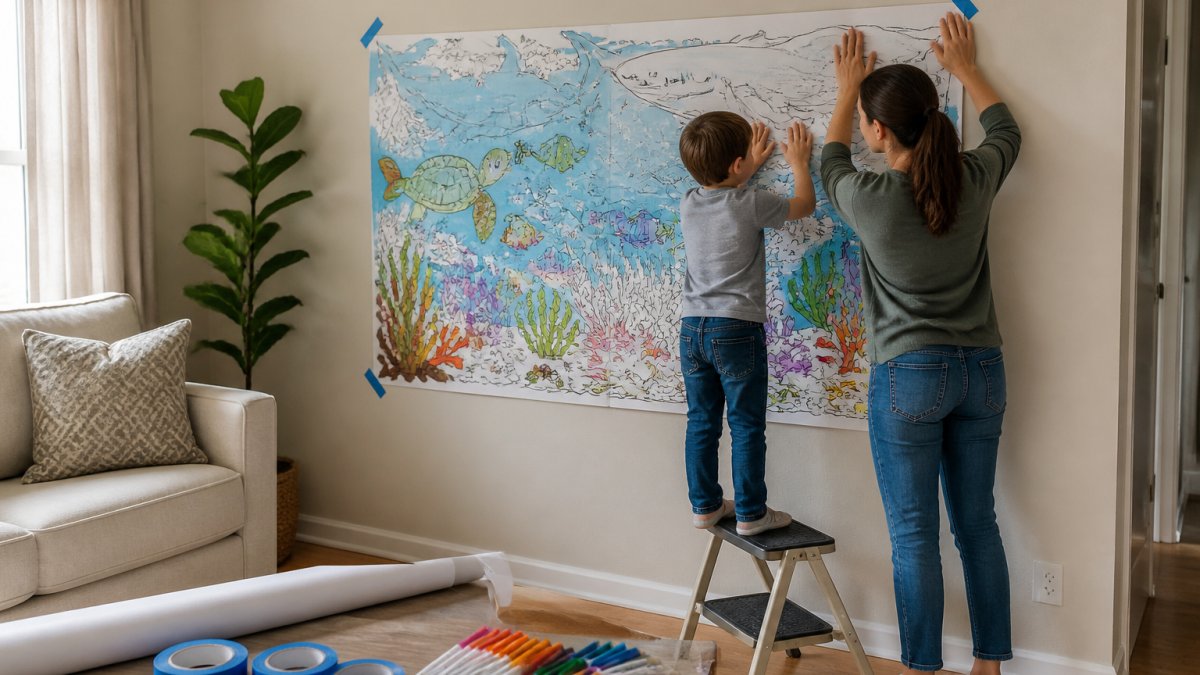
- Clean the wall. Wipe dust and grease with a dry cloth. Adhesive fails on dirty paint.
- Roll the poster flat. Lay it face down for an hour so it relaxes. A rolled sheet fights you the whole way up.
- Measure your space. Mark the top corners with a pencil so both sides sit level.
- Test with painter's tape. Tape the top two corners and step back. Adjust before you commit.
- Add your real mount. Swap in adhesive strips, putty, or clips at each corner.
- Press and hold. Apply firm pressure for 30 seconds at every contact point.
- Check the tension. Smooth from the center out so the paper sits flat.
Positioning and Alignment Tips for a Level Display
Center the poster at eye level for kids, not adults. Use a level or phone app to check the top edge. Mark both corners first, then tape one side, then the other. For multiple sheets, keep a consistent gap so the wall reads as one display.
How to Keep Coloring Posters Flat on the Wall
Curling is the number one complaint we hear, and it almost always starts with the roll.
To keep coloring posters flat on the wall, reverse the roll before hanging. Roll the sheet the opposite way, face out, and let it rest for an hour.
Happy Birthday Coloring Banner →
- Weight the bottom corners with a small piece of tape
- Avoid hanging near heat vents or direct sun
- Store unused sheets flat, never rolled tight
If a corner still lifts, a single binder clip at the bottom solves it without more adhesive.
Climate, Humidity, and Long-Term Preservation
Humidity is the quiet enemy of paper on a wall. In damp rooms, paper swells, ripples, and pulls away from tape; in dry rooms, it shrinks and cracks along fold lines. Avoiding the bathroom is not enough if you want the finished poster to survive as a keepsake.
Reading the Room Before You Hang
Paper is hygroscopic, absorbing and releasing moisture from the air. A typical home swings between 30 and 50 percent relative humidity across the seasons.
Keep posters away from bathrooms, kitchens, and laundry rooms, which swing in moisture all day. A hallway or bedroom wall holds steadier. A simple hygrometer costs less than a roll of tape and tells you whether your wall is safe.
A few practical rules:
- Avoid walls directly above or beside a heat vent or radiator
- Keep posters at least three feet from a shower or sink
- In dry winter months, a small room humidifier near the display wall helps
Sealing a Finished Coloring Poster
Once the coloring is done, the paper is most vulnerable. Crayon and marker sit on the surface, not in it, so they smudge, fade, and transfer with handling. Sealing is the step almost no one mentions.
A few options, from lightest to most protective:
- Fixative spray. A matte workable fixative for dry media locks crayon and colored pencil without changing the look. Apply in thin coats outdoors or in a ventilated space, holding the can about 12 inches away. Two light passes beat one heavy coat.
- Clear acrylic sealer. Better for marker and mixed media. Choose a matte finish to avoid glare. Test on a corner first, because some markers bleed under solvent-based sealers.
- Lamination. A local print shop can laminate a 30 by 50 inch sheet, but lamination traps moisture and can wrinkle large formats. Only consider it if the poster will be handled heavily.
Let any sealed poster cure flat for 24 hours before hanging or storing.
Framing and Flat Storage
A finished 30 by 50 inch coloring banner makes a keepsake, and framing is the most durable way to preserve it. Standard poster frames that size are widely available, and a mat keeps the paper off the glass, preventing condensation from transferring ink.

If framing is not in the budget, flat storage is the next best thing:
- Sandwich the poster between two sheets of acid-free tissue or glassine
- Slide it into a large flat envelope or a rigid portfolio
- Store it flat, never rolled tight, in a cool, dry closet
Avoid cardboard alone as a backing. It is acidic and will yellow the paper over years.
That is where a good sheet earns its keep twice. Our Happy Birthday Coloring Banner rolls out on the party table, gets colored by every guest, then hangs on the wall as the decoration. It is 30 by 50 inches, made in the USA, and shipped from Utah. The same idea works for a Congratulations Coloring Banner or a Celebrate Coloring Banner for any gathering.


Removing Posters Without Damage and What to Do Next
Slow is the whole trick. Pull tape at a 45-degree angle, close to the wall, a few inches at a time; rushing is what lifts paint.
- Warm the adhesive first with a hair dryer on low
- Support the paper with one hand as you peel
- Roll leftover putty off with your thumb, do not scrub
Once it is down, the sheet is not trash. Fold it flat, slide it into a large envelope, and label the date. Many families frame the best ones or mail them to grandparents.
That is where a good sheet earns its keep twice. Our Happy Birthday Coloring Banner rolls out on the party table, gets colored by every guest, then hangs on the wall as the decoration. The same idea works for a Congratulations Coloring Banner or a Celebrate Coloring Banner for any gathering.
Frequently Asked Questions
What is the best way to hang large posters on my wall without a frame?
For a 30"x50" coloring poster, the safest approach is painter's tape along the top edge combined with poster putty or Command strips at the corners. Painter's tape holds the top without leaving residue on drywall, and the putty keeps the bottom from curling. Avoid double-sided tape on painted walls unless you plan to leave the poster up permanently. This combination gives you a secure, damage-free mount that works on most interior surfaces.
Can I use painter's tape to hang giant coloring sheets?
Yes. Painter's tape is one of the best options for temporary display of large format coloring sheets because it peels off cleanly without stripping paint. Use a strip along the top edge and press firmly for 10-15 seconds. For heavier paper weight or longer display, add poster putty at the bottom corners. Avoid masking tape or duct tape, which can leave tack and residue on drywall.
How do you mount a large poster so it stays flat?
Start by rolling the poster in the opposite direction of its curl and letting it rest for a few hours, or place it under a flat surface overnight. Once on the wall, secure the top edge with painter's tape, then use poster putty or small Command strips along the bottom and sides. This creates even tension across the paper and prevents curling. For very large sheets, binder clips along the bottom edge add weight that keeps the paper flat.
What are the best adhesives for temporary poster displays?
For temporary display on painted drywall, painter's tape and poster putty are the safest choices because they release without damaging wall integrity. Command strips hold more weight and work well for larger formats. Double-sided tape is stronger but can pull paint when removed. Test any adhesive on a small hidden spot first, especially on freshly painted walls or wallpaper. Match the adhesive to your surface type and the poster's paper weight.
Hanging a giant sheet should not cost you a security deposit or an afternoon of patching. With the right tape, a level line, and a little patience, your wall stays clean and the poster stays flat. Cherry Creek Lane makes huge table-sized coloring sheets, giant crosswords, and wall-sized calendars built for exactly this kind of family fun, all made in the USA and shipped from Utah. Shop Coloring Sheets and turn your next wall into a screen-free family project.