

Table of Contents
- Why Playtime Triggers Sibling Arguments (and What to Do First)
- Pre-Play Contracting: Setting Boundaries for Kids During Playtime
- Cooperative Games for Siblings That Reduce Competition
- Conflict Resolution for Siblings: Scripts You Can Use Today
- Neurodivergent-Friendly Strategies for Preventing Sibling Arguments
- Handling Physical Aggression and Big Emotions During Play
- Building Long-Term Sibling Dynamics Through Playtime Routines
- Conclusion
- Frequently Asked Questions
Last Updated: September 19, 2026
Why Playtime Triggers Sibling Arguments (and What to Do First)
Preventing sibling arguments during family playtime starts with understanding why play so often turns into conflict. Playtime is where kids practice sharing, waiting, and losing. Those skills take years to build, so friction is normal, not a sign that something is wrong.
- Limited space, two kids, one small table, instant crowding
- Uneven skills, a 7-year-old finishes while a 3-year-old is still figuring it out
- No clear plan, nobody knows what "done" looks like
- Tiredness or hunger, the real culprit behind most meltdowns
Pre-Play Contracting: Setting Boundaries for Kids During Playtime
Pre-play contracting means agreeing on the rules before play starts, while everyone is calm. Setting boundaries for kids during playtime works far better before the crayons are open than in the middle of a tug-of-war.
How to Run a 2-Minute Pre-Play Huddle
Gather everyone for a quick huddle. Keep it under two minutes so young kids stay tuned in.
- Name the activity. "We're doing the giant word search together."
- State two rules. "We share the markers. We use kind words."
- Assign roles or zones. "You take the left side, you take the right."
- Ask for a repeat-back. "What are our two rules?"
- Agree on the signal. "If someone needs a break, they say 'pause.'"
Age-Appropriate Rules That Actually Stick
Rules fail when they ask too much of a child's stage. Match the rule to the age.

| Age | What They Can Handle | Simple Rule to Use |
|---|---|---|
| 2-3 | One shared item at a time | "My turn, then your turn" |
| 4-5 | Simple turn-taking with a timer | "When the timer rings, we swap" |
| 6-8 | Negotiating and compromise | "Work it out or ask a grown-up" |
| 9+ | Planning and self-managing | "You two pick the plan together" |
Cooperative Games for Siblings That Reduce Competition
Cooperative games for siblings remove the win-lose setup that fuels most fights. When both kids work toward the same goal, there is nothing to lose and no one to blame.
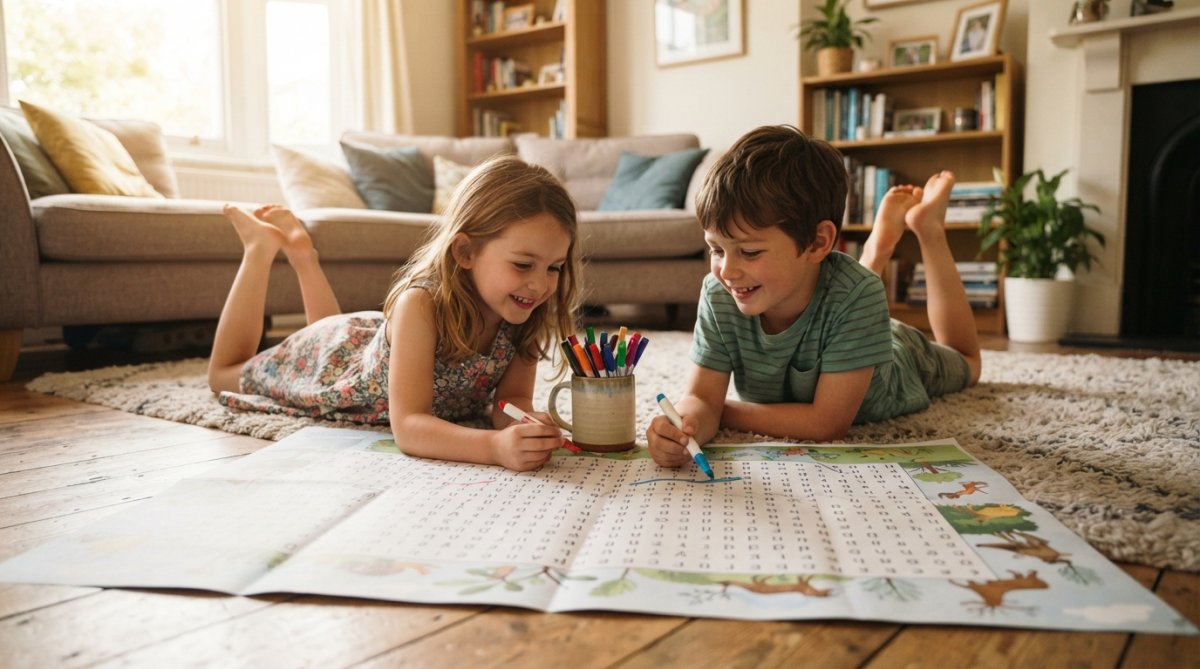
Good options include:
- Shared-canvas coloring, one big sheet, many hands
- Team treasure hunts, everyone hunts for the same list
- Building challenges, one tower, built together
- Co-op board games, players beat the game, not each other
One Giant Sheet, Many Hands: Shared-Space Activities
A single large activity gives kids a shared goal and their own space. Cherry Creek Lane's Board Games Giant Word Search Puzzle measures 30" x 45", so two or three kids can work on one sheet at the same time without crowding. It works with markers, gel pens, colored pencils, or crayons, and you can lay it flat on the table or hang it on the wall.
Conflict Resolution for Siblings: Scripts You Can Use Today
Conflict resolution for siblings works best when you hand kids words to use. Most children know they are upset. They just do not know what to say next. The trick is matching the script to the playtime situation and to the child's age, because a line that lands with a 7-year-old will bounce right off a 3-year-old.
When to Step In and When to Stay Out
Stay out of small squabbles that kids can solve themselves. Step in when someone is unsafe, when the same fight keeps repeating, or when one child is clearly overwhelmed.
- Stay out: mild disagreements, brief whining, a fair trade in progress
- Step in: hitting, name-calling that will not stop, or a younger child in distress
Playtime-Specific Scripts by Scenario
General scripts fail because playtime conflicts come in a few predictable shapes. Here is what to say for each one.
The toy grab (one child takes what the other is holding):
- "Hands off. Tell her what you want."
- "You want the blue car. Ask, 'Can I have a turn when you're done?'"
- "She said not yet. What can you play with while you wait?"
The turn-taking standoff (both want the same item at the same time):
- "You both want it. What is a fair way to decide?"
- "Do you want the timer, or do you want to pick who goes first?"
- "One minute each. Who is setting the timer?"
The game-rule dispute (someone changes or breaks the rules):
- "Whose rule is this? Did we agree on it before we started?"
- "If you two cannot agree on the rule, the game pauses until you do."
- "Do you want to play by the box rules or make your own rules together?"
The sore loser (meltdown after losing):
- "Losing is hard. You can be mad and still be a good sport."
- "What do we say when the game ends?"
- "Do you want to play again, or take a break first?"
Age-Appropriate Intervention
The same fight needs a different response depending on the child's stage. This is the part most guides skip.
Board Games Giant Word Search Puzzle →
| Age | What They Can Do Alone | How You Intervene |
|---|---|---|
| 2-3 | Almost nothing, impulse control is still forming | Stay close, narrate the turn, physically guide hands |
| 4-5 | Simple turn-taking with a timer and a reminder | Prompt the script, then step back and watch |
| 6-8 | Negotiate and compromise with a nudge | Ask questions, let them propose the solution |
| 9+ | Plan, self-manage, and repair after conflict | Stay out unless safety is at risk; debrief afterward |
Scripts to try:
- "Use your words. Tell your brother what you need."
- "You both want the red marker. What is a fair way to decide?"
- "Let's take a buddy break and come back in two minutes."
Neurodivergent-Friendly Strategies for Preventing Sibling Arguments
Some kids need a different setup to keep the peace. Children with ADHD, autism, or sensory processing differences often find open-ended play overwhelming, and that overwhelm looks a lot like aggression. The key insight most guides miss: a child who melts down during play is often overstimulated, not defiant. Lower the input and the conflict usually drops with it.
Match the Strategy to the Need
If the driver is sensory overload (covers ears, squints, gets agitated in noisy rooms):
- Offer noise-reducing headphones or a quiet corner during loud games
- Reduce visual clutter, one activity out at a time, not five
- Use softer lighting and fewer competing sounds
- Build in a sensory break before the child hits their limit, not after
If the driver is impulsivity (grabs, interrupts, acts before thinking):
- Put the desired item physically out of reach between turns
- Use a visual timer the child can see counting down
- Give a fidget or squeeze ball to occupy hands during waiting
- Keep turns short, 30 to 60 seconds rather than several minutes
If the driver is difficulty reading social cues (misses that a sibling is upset, does not notice escalating tone):
- Make feelings explicit and named out loud: "Your sister's face means she is frustrated."
- Use visual emotion cards or a feelings chart during play
- Practice scripts ahead of time, when everyone is calm
- Role-play the exact scenario before it happens
If the driver is need for predictability (melts down when plans change mid-play):
- Show the plan visually before play starts, a simple picture sequence works
- Give a five-minute and a two-minute warning before transitions
- Keep the same play routine in the same order each day
- Announce changes before they happen, never mid-activity
Playtime-Specific Adjustments
- Defined personal space: tape off each child's zone on the table or floor so bodies stay separate
- Shorter play blocks: 15 minutes, then a break, works better than an open-ended session
- Predictable endings: give a five-minute warning before cleanup so the stop is not a surprise
- One shared goal, separate tools: a single large activity with individual markers or pencils reduces competition over supplies
- A designated calm-down spot: a beanbag or corner the child can go to without it being framed as punishment
What to Say When Overwhelm Hits
- "Your body is telling you it needs a break. Let's go."
- "Too much noise? Headphones are on the shelf."
- "We can come back when your body is ready."
The goal is to teach the child to notice their own rising signals and act before the meltdown, not to punish the meltdown after it happens. Over time, that self-awareness becomes the skill that prevents the fight in the first place.
Handling Physical Aggression and Big Emotions During Play
Physical aggression needs an immediate, calm response. Stop the action first, then deal with feelings.
- Separate safely. Move kids apart without yelling.
- Name the feeling. "You're really mad that he took your marker."
- Set the limit. "Hitting is not okay, even when you're mad."
- Offer a tool. "Next time, say 'stop' or come get me."
- Reconnect. Once calm, help them repair and return to play.
Building Long-Term Sibling Dynamics Through Playtime Routines
Strong sibling dynamics come from repetition, not one perfect afternoon. Routines teach kids what to expect, and predictable play lowers the odds of a fight.
Build a simple rhythm:
- Same time each day for a shared activity
- Rotate who picks the game or sheet
- End on a win, stop while it is still fun
- Praise the good moments out loud
Conclusion
Sibling arguments during play are normal, but they do not have to run your afternoons. A two-minute huddle, age-matched rules, and shared activities cut most fights before they start.
Frequently Asked Questions
How can I encourage my children to play together without fighting?
Start with a short pre-play huddle where everyone agrees on one shared rule, like 'we take turns picking the next word' or 'no grabbing markers.' Choose open-ended activities that don't have a single winner, such as a giant coloring sheet or a wall-sized word search, so there's no scoreboard to fight over. Give each child their own small zone on the shared project. When tension rises, redirect to a different part of the activity rather than ending playtime entirely.
What are the best ways to intervene when siblings start arguing during a game?
Pause the activity before voices escalate. Get down to eye level and ask each child to describe what happened in one sentence. Repeat back what you heard so both feel acknowledged. Then ask them to suggest one solution together. If they can't agree, offer two choices you can live with. Keep your tone neutral and avoid assigning blame, since taking sides fuels the next round. After they resume, stay nearby for a few minutes to reinforce cooperative behavior.
How do I set boundaries for cooperative play without constant nagging?
Write down three or four family rules together during a calm moment, not mid-argument. Keep them short and positive, like 'ask before you borrow' or 'hands to yourself.' Post them where play happens. When a rule is broken, apply the same consequence every time, such as a two-minute buddy break to reset. Consistency matters more than severity. Review the rules before big play sessions or when new friends join, and praise kids when you catch them following the rules without reminders.
What are some screen-free activities that reduce sibling competition?
Large-format activities that invite parallel or shared work tend to lower rivalry. A giant word search measuring 30 by 45 inches gives each child room to search without crowding. Table-sized coloring sheets let siblings work side by side on the same picture with different colors. Wall-sized calendars let them add stickers or drawings to a shared family project. These formats remove the win-lose structure of board games and give kids a common goal instead of opposing ones.