

Table of Contents
- Why 10-Year-Olds Need Screen-Free Time
- Indoor Hobbies for 10 Year Olds That Stick
- Collaborative Family Activities for Mixed Ages
- How to Limit Screen Time for 10 Year Olds Without a Fight
- Budget-Friendly vs. Investment Activities
- Screen-Free Activities That Work for Neurodivergent Kids
- Socialization for Older Kids Without Screens
- Conclusion: Start With One Screen-Free Afternoon
- Frequently Asked Questions
Last Updated: September 22, 2026
Why 10-Year-Olds Need Screen-Free Time
Ten is the age when kids want more independence, and screens are the easiest way to give it, but a 10-year-old who spends the afternoon scrolling misses the hands-on learning and unstructured time that build problem-solving skills and self-regulation. This guide breaks down seven screen-free activities for 10 year olds that hold their attention, plus transition strategies that make putting the tablet down less of a fight.
Indoor Hobbies for 10 Year Olds That Stick
Indoor hobbies for 10 year olds work best when they offer a real challenge and a visible result, skill acquisition, not just passing time.
Building and Making: Hands-On Projects
Building projects tap into constructive play and critical thinking. Model kits, cardboard engineering, friendship bracelets, and simple woodworking all give a 10-year-old something to show for their effort. Pick a project just above their current skill level: too easy and they quit from boredom, too hard and they quit from frustration.
Quiet Solo Hobbies for Independent Play
Solo hobbies build executive function and self-regulation because there's no one else to manage the pace. Reading, drawing, journaling, and puzzle books all fit, and giant crossword and word search sheets are especially good because they combine quiet focus with a visible finish.
Collaborative Family Activities for Mixed Ages
Collaborative family activities solve a real problem: siblings at different ages rarely want the same thing at once. A single shared project gives everyone a role instead of a rivalry.
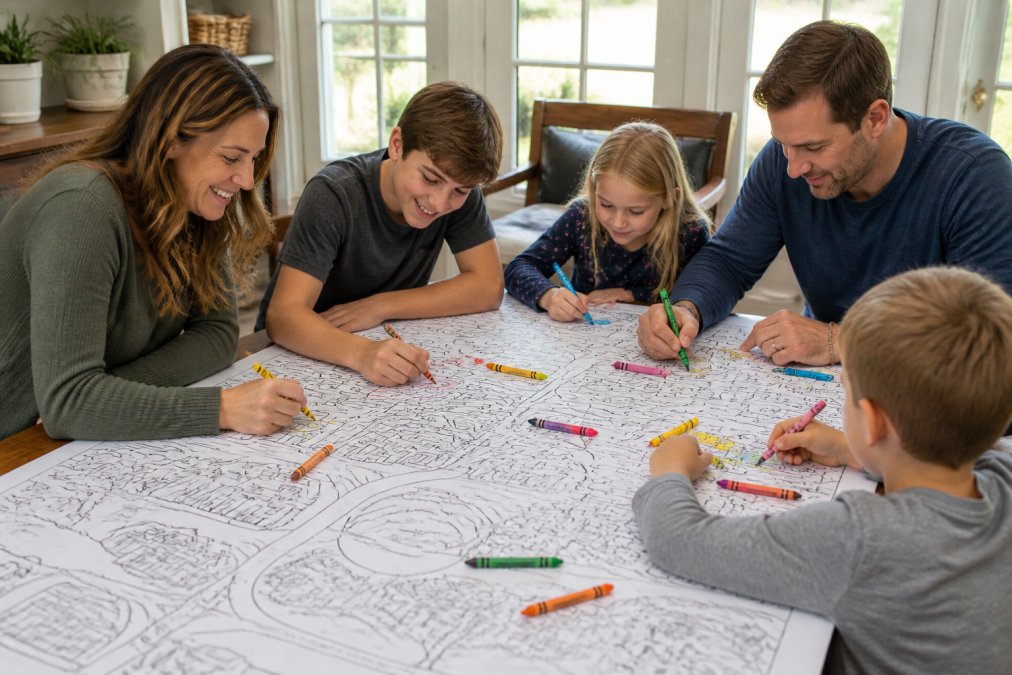
Giant Coloring Sheets and Table-Sized Projects
Giant coloring sheets turn any table or wall into a shared canvas. A 30"x50" sheet is big enough that a 10-year-old, a 7-year-old, and a grandparent can all work on the same page without crowding each other.
How to Limit Screen Time for 10 Year Olds Without a Fight
How to limit screen time for 10 year olds comes down to one principle: replace, don't just remove. Taking a screen away without offering something better reads as punishment; offering a genuinely interesting alternative reads as a choice. But most attempts fail at the transition itself. Ten-year-olds want autonomy and control, yet their prefrontal cortex is years away from reliably overriding a rewarding stimulus, which is why "just turn it off" backfires.
Why the Transition Fails (and What to Do Instead)
A screen delivers what psychologists call variable reward, the next video or level might be the best one yet, which is what makes stopping so hard. A 10-year-old melting down at the cutoff isn't being defiant; they're responding to an unpredictable reward schedule designed to hold attention. The fix: make the ending predictable and the alternative more concrete than the screen.
Transition Strategies That Actually Work
Transition strategies fail when they rely on willpower alone. Structure beats willpower every time.
- Set the end point before the activity starts. Agree on the number of episodes or the level before the device is unlocked, so the ending is the child's own decision, not yours.
- Give a warning. A two-stage warning (ten minutes, then two) respects their autonomy and prevents the meltdown that comes from surprise.
- Have the alternative ready and visible. A sheet already on the table beats a vague "go find something to do." The alternative must be more concrete than the screen, a specific project, not a category of activity.
- Start small. One screen-free afternoon per week is a realistic first step. Going from daily screens to a screen-free week in one move almost always collapses by day three.
- Join them for the first few minutes. Your presence makes the new activity feel like a treat, not a sentence. Once they're absorbed, step back, hovering past ten minutes turns it into supervision.
- Name the feeling, not the behavior. "It's hard to stop when the game is still going" lands better than "you're addicted to that thing." Kids who feel understood resist less.
- Protect the routine, not the rule. A predictable screen-free window (say, Saturday afternoons) is easier to hold than a rule that changes based on mood or behavior.
What to Say in the Moment
Scripts matter more than principles when the tablet is already in hand:
- "You've got two more minutes, then we're switching to the puzzle on the table."
- "I know it's hard to stop. Let's pause it together and come back to it tomorrow."
- "You pick: coloring sheet or the cardboard build?"
The First Two Weeks Are the Hardest
Expect resistance to peak around days three to five, then drop. Most families find that by the second week, the child stops asking for the screen during the screen-free window and treats it as routine. If resistance is still intense after two weeks, the alternative is probably too passive or too easy, a bored 10-year-old fights harder than an engaged one.
Budget-Friendly vs. Investment Activities
Screen-free activities fall into two spending tiers, and both have a place. Budget-friendly options like library books, cardboard projects, and homemade obstacle courses cost little and work for trying things out. Investment activities like a quality art set cost more upfront but get used for years. Building a personal library remains one of the most rewarding long-term investments, especially when children engage in fun reading activities that turn quiet afternoons into immersive adventures.
| Activity Type | Upfront Cost | Reusability | Best For |
|---|---|---|---|
| Library books and puzzles | Low | Medium | Testing new interests |
| Cardboard and craft scraps | Low | Low | Rainy-day boredom busters |
| Giant coloring sheets | Moderate | High | Mixed-age family gatherings |
| Quality art supplies | Higher | High | Kids with a confirmed interest |
| Seasonal activity bundles | Moderate | High | Building yearly traditions |
Screen-Free Activities That Work for Neurodivergent Kids
Most activity lists assume a neurotypical kid who can self-start, tolerate ambiguity, and shift tasks on command. For a 10-year-old with ADHD, autism, or sensory processing differences, those assumptions are where the afternoon falls apart. This section covers not just what to do, but how to set it up so it works.
Full Year Activity Calendar BUNDLE →
Why Standard Activity Advice Breaks Down
Three patterns show up again and again:
- Task initiation is the bottleneck, not interest. A child may want to build the model but can't get from "sitting on the couch" to "opening the box" without a concrete first step.
- Open-ended prompts overwhelm. "Go draw something" offers infinite choices, which for many kids is worse than no choice. A defined task with a visible endpoint is easier to start.
- Sensory load matters as much as the activity. Strong glue fumes, scratchy glitter, or a chaotic group setting can end the afternoon before it starts.
What to Look For in an Activity
Neurodivergent-friendly activities share a few traits: clear structure, predictable steps, and sensory engagement that doesn't overwhelm. Run any idea through these filters:
- Defined start and finish. A puzzle with a known number of pieces, a coloring sheet with a clear border, or a recipe with numbered steps all give the brain a finish line. Open-ended crafts often don't.
- Low transition cost. Activities that pause and resume without losing progress (a large coloring sheet, a building project, a journal) fit more easily into a day with other demands.
- Predictable sensory input. Crayons and colored pencils are usually easier than strong-fume markers; a single large sheet beats a pile of small materials that scatter.
- Movement built in. Large-format projects let a child stand, reach, and shift position rather than sitting rigidly, that matters for kids who regulate through movement.
- A visible endpoint. "Done" should be obvious. A finished sheet, a completed row, or a built model gives the brain the closure it needs to move on.
Activities That Tend to Work
Large-format projects fit this framework well. A big coloring sheet gives a clear task, a defined space, and a visible endpoint, and the size helps kids who need gross motor movement. The Year of Coloring Pages Bundle offers twelve themed sheets, one per month, a predictable rhythm many neurodivergent kids find calming.

Other categories worth trying:
- Repetitive, rhythmic tasks, friendship bracelets, simple weaving, sorting. The repetition itself can be regulating.
- Building with a clear goal, model kits, LEGO sets with instructions, cardboard builds with a drawn plan. Instructions remove the open-ended decision load.
- Physical chores framed as challenges, timed room tidies, obstacle courses, carrying tasks. Movement plus a clear finish line.
- Audio-supported activities, drawing or building while listening to an audiobook or music helps kids who need background stimulation to stay on task.
Setting Up for Success
A few setup moves make more difference than the activity choice itself:
- Preview the plan. Tell the child what's happening and in what order. Surprises are harder for kids who rely on predictability.
- Reduce choices to two. "Coloring sheet or bracelet?" beats "what do you want to do?"
- Set out materials before you invite them in. The screen-to-activity transition is easier when the activity is already visible and ready.
- Build in a movement break. Ten minutes of activity, then a stretch or walk, then back to it. Many kids sustain focus longer in shorter blocks.
- Let them stop at a natural break. Forcing completion past the point of regulation usually ends the activity for good.
A Note on Individual Variation
"Neurodivergent" covers a wide range. A child with ADHD and a child with sensory processing differences may need opposite setups, one more stimulation, the other less. Treat the framework above as a starting point, not a prescription, and adjust based on what you observe. If an activity consistently ends in frustration, the issue is usually the setup, not the child.
Socialization for Older Kids Without Screens
Ten-year-olds still want to see their friends, and screens are often the easiest way to do it. The fix is a shared offline task. Group projects, board games, and collaborative coloring create the same social connection without a screen in the middle.
Conclusion: Start With One Screen-Free Afternoon
The hardest part of cutting back on screens isn't finding activities, it's the first transition, when the tablet goes down and nothing has taken its place yet. Pick one afternoon this week, put a giant coloring sheet or puzzle on the table, and sit down with your 10-year-old for the first ten minutes.
Frequently Asked Questions
How do I entertain my 10-year-old without screen time?
Start with activities that match their interests: building projects, cooking challenges, outdoor exploration, or large-format creative projects like giant coloring sheets. The key is offering choices rather than instructions. Set out two or three options and let your child pick. Ten-year-olds respond better when they feel ownership over the decision. Rotate activities weekly to prevent boredom and keep a simple list on the fridge so they can see what is available.
What are some productive indoor hobbies for 10 year olds at home?
Good indoor hobbies for this age include model building, drawing and coloring, puzzle-solving, cooking or baking, and crafting. Table-sized coloring sheets work well because they combine creative expression with fine motor skill practice. Crosswords and word searches build critical thinking. The best hobby is one your child returns to without prompting, so try a few and pay attention to which ones hold their attention longest.
How do I limit screen time for 10 year olds without constant arguments?
Replace screen time rather than just removing it. If you take away a tablet without offering an alternative, resistance is guaranteed. Set clear daily limits, then have a screen-free activity ready before the limit hits. Transition strategies like a 10-minute warning and a physical activity waiting on the table reduce conflict. Consistency matters more than perfection. A predictable routine helps 10-year-olds manage the shift because they know what comes next.
What collaborative family activities work for kids of different ages?
Large-format projects work best for mixed ages because everyone can participate at their own level. A giant coloring sheet measuring 30 by 50 inches gives a 7-year-old and a 12-year-old room to work side by side without competing for space. Other options include family board games, group cooking, building challenges, and outdoor scavenger hunts. The activity should have no single winner and no age-based advantage.
Are screen-free activities good for neurodivergent 10-year-olds?
Many neurodivergent kids thrive with hands-on, screen-free activities because they offer sensory engagement and clear structure without the overstimulation of digital media. Coloring, puzzles, and building projects provide predictable, repetitive motion that supports self-regulation. Choose activities with defined boundaries, like a coloring sheet with clear sections, rather than open-ended tasks that can feel overwhelming. Let your child set the pace and take breaks as needed.