

Table of Contents
- Screen-Free Alternatives to Video Games: Why They Matter
- Creative Indoor Activities for Children: Beyond the Controller
- How to Engage Siblings of Different Ages Without Screens
- The Transition Period: Helping Kids Move Away from Video Games
- Budget-Friendly DIY vs. Commercial Screen-Free Alternatives
- Neurodivergent-Friendly Play Strategies for Screen-Free Time
- Building a Screen-Free Routine That Sticks
- Conclusion: Small Swaps, Big Connection
- Frequently Asked Questions
Last Updated: October 2, 2026
Screen-Free Alternatives to Video Games: Why They Matter
Screen-free alternatives to video games are hands-on activities, games, and creative projects that entertain children without a screen. This guide from Cherry Creek Lane covers the swaps that actually hold a child's attention.
The case for making the switch is straightforward. The American Academy of Pediatrics family media guidance recommends consistent screen time limits and prioritizing hands-on play, and many parents find that the hours after school disappear into a controller faster than they expected. Meanwhile, pediatric guidance continues to emphasize that tactile play builds fine motor skills and sustained attention in ways passive entertainment does not.
Below, we'll show you how to move your family from controllers to tabletop games, sensory bins, and creative projects, whether you're swapping one evening a week or building a full screen-free routine.
Creative Indoor Activities for Children: Beyond the Controller
Creative indoor activities for children work best when they invite more than one person to participate at once. The biggest mistake parents make is buying a solo activity to replace a social one, video games are often social, so the replacement should be too.
| Activity | Best Age Range | Setup Time | Group Size |
|---|---|---|---|
| Sensory bins | 2-6 | 5 minutes | 1-3 kids |
| Giant word search | 6+ | Under 1 minute | 2-6 people |
| Board games | 5+ | 2 minutes | 2-4 players |
| Audio stories | 3+ | None | Any |
| Scavenger hunts | 4+ | 10 minutes | 2+ kids |
How to Engage Siblings of Different Ages Without Screens
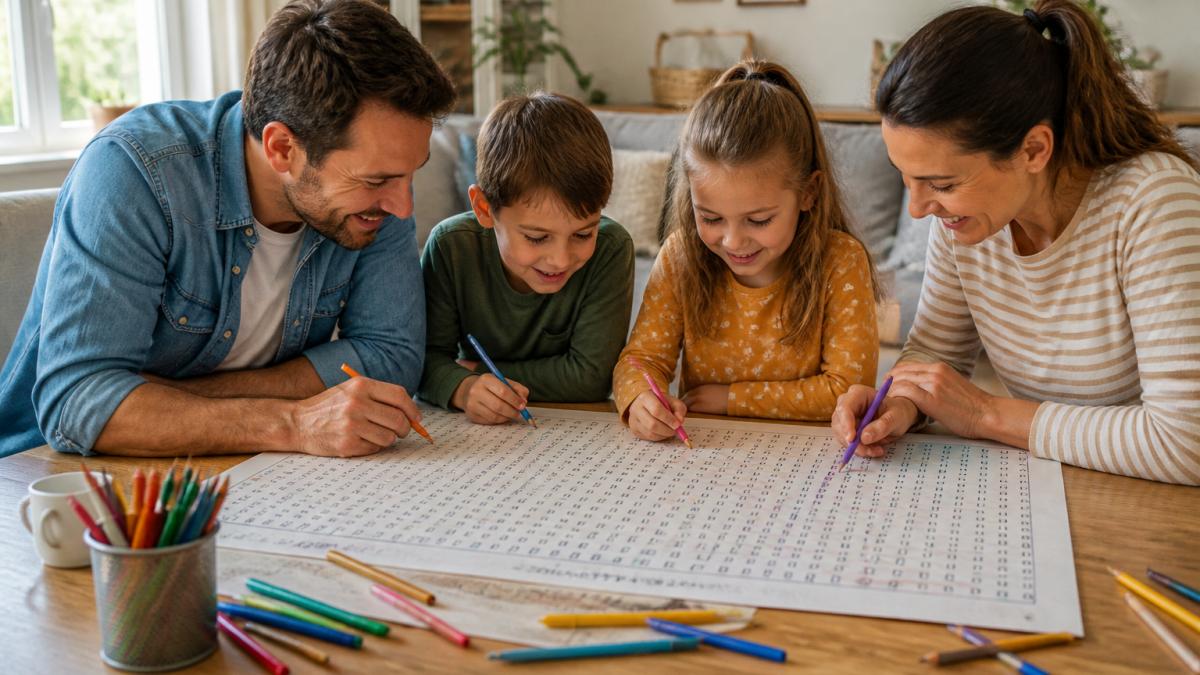
Engaging siblings of different ages without screens comes down to choosing activities with no single "correct" difficulty level. A seven-year-old and a three-year-old can both color the same giant sheet, each at their own pace.
Open-ended activities are the answer. A word search works because the older child hunts for words while the younger one colors letters; a scavenger hunt works because you can give each child a different list. The activity stays shared even when skill levels don't match.

- Assign roles instead of turns: one child reads clues, another finds objects
- Use a shared canvas so nobody "owns" a piece
- Set a family goal rather than a winner, like finishing a section together
- Keep a mix of structured play and unstructured play in the same session
The Transition Period: Helping Kids Move Away from Video Games
The transition period is the two-to-three-week stretch when a new routine feels worse than the old one. Expect resistance, and don't read it as failure. Most guides skip this, which is why so many families quit in week one, the activity list was never the hard part.
Why the Pushback Happens
Video games deliver a predictable loop, input, feedback, reward, repeat, with the reward arriving in seconds. A board game, puzzle, or coloring sheet delivers the same loop on a much slower clock.
A second mechanism is anticipatory grief. Kids who play a favorite game daily aren't just losing an activity; they're losing a social space, a mastery space, and a routine.
A Week-by-Week Frame
- Week 1, Substitution. Keep the same time slot the game occupied. Swap in one activity, not a menu. Keep sessions under 45 minutes. Expect enthusiasm to hold for two or three days, then drop.
- Week 2, The dip. This is the window most families quit. Enthusiasm bottoms out around day four to day seven. Do not add new rules or new activities here; hold the slot steady and let the routine carry the weight.
- Week 3, Ownership. Let the child pick the theme, the seating, or the order of activities. Choice is what converts a parent's rule into the child's routine.
- Week 4, Normalization. The slot now exists without negotiation. This is the point to consider adding a second screen-free block.
What Backfires
- Announcing a permanent ban. A permanent rule invites a permanent power struggle; a four-week trial invites participation.
- Removing the game without replacing the social function. If the child played with friends online, the replacement needs a social element, a sibling, a parent, or a friend over.
- Stacking the first week with new purchases. Novelty masks whether the routine is working. Save the new puzzle or themed sheet for week two, when the dip hits.
- Negotiating mid-session. If the child asks to quit at minute ten, finish the current round or section, then end, ending on a completed unit teaches that the activity has a natural close.
Language That Helps
Frame the change as a trial with a defined end, not a verdict. "We're trying four weeks of no controllers after school, then we'll talk about it" lands differently than "no more video games." The first gives the child a role; the second gives them an opponent.
When to Adjust the Plan
If a child is genuinely distressed rather than annoyed, crying that doesn't resolve, refusing to eat or sleep, withdrawing from siblings, the pace is too fast. Drop to one screen-free evening per week and hold for a month before adding a second. The goal is a routine that survives, not one that starts fast.
Budget-Friendly DIY vs. Commercial Screen-Free Alternatives
DIY options cost less upfront, but commercial products often win on durability and reuse. The honest trade-off is cost per activity versus cost per hour of use, and most families never run that math, ending up with a closet of half-used craft supplies and a shelf of untouched games.
The Real Cost of DIY
A printed coloring page looks free. It isn't. Once you account for ink, paper, and tape to assemble pages large enough for two kids to share, the per-session cost climbs fast, and the assembled version usually falls apart before the activity ends.
DIY wins on one axis that matters: novelty. If your child burns through activities in a single sitting and never returns, DIY is the correct choice. You are paying for one-time engagement, and that is what DIY delivers.
Where Commercial Earns Its Price
Commercial products win on cost per hour of use. A large-format sheet built for markers and crayons survives repeated sessions, multiple kids, and being rolled up and stored.
Board Games Giant Word Search Puzzle →
Durability also changes the social math. A single large sheet laid across a table lets two to six people work at once without turn-taking fights, the exact problem small printed pages can't solve.
A Simple Decision Rule
- Try it DIY first if the activity is new to your family and you don't yet know whether it will stick.
- Buy the durable version once you've seen a child return to the same activity three or more times.
- Buy for the group, DIY for the individual. Shared, table-sized activities justify the investment because the cost is divided across everyone using them. Solo activities rarely do.
- Match the material to the medium. Crayons, markers, gel pens, and colored pencils each behave differently on different surfaces. A sheet designed for all four outlasts a stack of printer paper, however carefully taped.
The Middle Path
You don't have to choose one lane. Many families run a hybrid: durable, reusable pieces for the activities that anchor the weekly routine, and DIY for the rotating novelty slot. That keeps recurring costs low while protecting the one or two activities your kids actually look forward to.
What to Look For in a Durable Option
- Sized for more than one person to use at once
- Compatible with the drawing tools you already own
- Themed so a child can pick a subject they already care about
- Flat enough to store without creasing
- Reusable across siblings and across years
That last point is the one parents underestimate. An activity that survives one child is a purchase; an activity that survives three is an investment.
Neurodivergent-Friendly Play Strategies for Screen-Free Time
Neurodivergent kids often need different entry points into screen-free play, and generic activity lists miss this. The key is reducing sensory load and offering clear, predictable structure.
What works: activities with a defined start and end, quiet materials, and a visual schedule showing what comes next. What backfires: surprise transitions, crowded group activities, and anything with a loud timer. Let the child choose the theme, keep sessions short, and build in movement breaks. Some kids focus better standing at a wall-mounted activity than sitting at a table, which is exactly where a hangable word search helps.

Building a Screen-Free Routine That Sticks
A screen-free routine sticks when it's tied to an existing habit, not willpower. Anchor the new activity to something that already happens daily, like the after-school routine or the hour before dinner.
Start with a fixed slot, keep supplies visible and reachable, and rotate activities before boredom sets in. A monthly themed coloring sheet subscription removes the guesswork, since a new theme arrives without planning.
- Pick one recurring time slot and defend it
- Store activities where kids can reach them without asking
- Rotate every two to three weeks
- Let kids vote on the next theme
Conclusion: Small Swaps, Big Connection
The hardest part of cutting back on video games isn't finding activities. It's surviving the transition period without giving up.
Cherry Creek Lane makes that first swap easy with giant, table-sized word searches, coloring sheets, and wall-sized calendars built for family time.
Get started with Cherry Creek Lane and turn one screen-free evening into a tradition your kids remember.
Frequently Asked Questions
What are the best screen-free alternatives to video games for kids?
The best screen-free alternatives to video games are ones that match your child's interests and energy level. Tactile play like sensory bins, giant puzzles, and coloring sheets work well for quiet time. For active kids, scavenger hunts and indoor obstacle courses burn energy. Audio stories and podcasts for kids offer passive entertainment without a screen. The key is having a variety of low-prep options ready so boredom doesn't send them back to the controller.
How do I reduce my child's video game time without a meltdown?
Start with a transition period rather than quitting cold turkey. Announce screen-free blocks in advance, use a visual timer, and have an activity already set up before the console goes off. The first few days are the hardest. Pair the change with something novel, like a giant word search puzzle or a new board game, so the alternative feels like a treat rather than a punishment. Consistency matters more than perfection.
How can I engage siblings of different ages in the same screen-free activity?
Choose open-ended activities that let each child work at their own level. A 30"x43.5" giant word search puzzle lets a 5-year-old hunt for short words while an older sibling tackles longer ones, all on the same sheet. Sensory bins with scoops and containers work for toddlers and tweens alike. The trick is picking something with no single 'right' way to play, so no one feels left behind or bored.
Are there educational alternatives to video games that kids actually enjoy?
Yes. Giant word searches, crossword puzzles, and themed coloring sheets build fine motor skills, vocabulary, and problem-solving without feeling like schoolwork. Audio stories and podcasts for kids support listening comprehension. Scavenger hunts teach mapping and observation. The educational value sticks when the activity feels like play, so let kids choose the theme, whether that's dinosaurs, space, or animals.
What if my family gets busy and we can't keep up with a screen-free routine?
Screen-free time doesn't have to be every day to work. Many families pick two or three evenings a week and protect those. If you subscribe to a monthly activity box or coloring sheet service, check whether you can pause during busy seasons without losing money. Having a few low-prep activities stored away means you can pull one out on short notice when the schedule opens up.