

Table of Contents
- Why Mixed Age Play Works for Siblings
- How to Foster Sibling Connection Through Play
- Cooperative Board Games for Families That Work Across Ages
- Top Educational Games for Mixed Age Siblings
- Adapting Rules for Younger Players and Accessibility
- Storage, Organization, and Budget-Friendly DIY Alternatives
- Frequently Asked Questions
Last Updated: September 16, 2026
Why Mixed Age Play Works for Siblings
The best educational games for mixed age siblings do more than keep kids busy: they turn a wide age gap into an advantage. When a 4-year-old and an 8-year-old share the same table, the older child practices explaining and leading while the younger one stretches toward skills just out of reach. At Cherry Creek Lane, we hear from parents every week about how a single shared activity can quiet the usual "that's not fair" arguments.
That range of ability is the point, not the problem. Multi-generational and mixed-age play gives every child a role, from reading clues aloud to coloring a shared border.
Developmental Milestones and Peer Mentoring
Mixed-age play works because it matches different developmental milestones at the same time. Younger children pick up vocabulary, turn-taking, and fine motor skills by watching and copying. Older siblings reinforce their own learning by teaching, a pattern educators call peer mentoring or peer-led learning.
The benefit runs both directions. A child who explains a rule to a younger sibling has to understand it deeply first. That is why age-appropriate challenges matter: the task should be hard enough for the older child to stay interested and simple enough for the younger one to join.
How to Foster Sibling Connection Through Play
Fostering sibling connection through play comes down to choosing activities with shared goals instead of winners and losers. A cooperative task, like filling in one giant puzzle together, removes the scoreboard that usually triggers conflict. The table becomes a team project rather than a competition.
A common mistake is handing each child a separate activity to avoid squabbles. That keeps the peace but skips the bonding. Shared play builds the social-emotional learning skills siblings need: patience, negotiation, and reading another person's mood.
Turn-Taking and Conflict Resolution Strategies
Turn-taking and conflict resolution are skills, and games are a low-stakes place to practice them. Most parenting practitioners find that the parent's job is not to eliminate conflict but to coach kids through it while the stakes are still low. Try these approaches when tensions rise:
- Assign rotating roles so each child gets a turn as leader
- Set a visible timer so "my turn" has a clear, fair end
- Let the older child explain the rules, then let the younger one set one house rule
- Step in only to coach, not to referee, so kids practice solving it themselves
- Keep a "pause" option so a frustrated child can rejoin without losing face
A Stage-by-Stage Mediation Script
Most sibling disputes during gameplay follow a predictable arc. Naming the stage tells you how much to intervene.
Stage 1, The grab. One child takes a marker, a piece, or a turn out of order. Don't adjudicate who had it first. Redirect to the mechanism: "Whose turn is it on the timer?" The timer, not the parent, becomes the authority.
Stage 2, The rule dispute. The older child invokes a rule the younger one doesn't understand. Ask the older child to explain the rule in one sentence the younger one can repeat back. If the younger child can't repeat it, the rule is too complex for the game as played, simplify it.
Stage 3, The scoreboard spiral. One child is clearly losing and starts sabotaging or quitting. This is the moment to switch from competitive framing to cooperative framing. Reframe the goal: "Can we finish the whole board before dinner?" The opponent disappears; the clock becomes the shared rival.
Stage 4, The meltdown. A child is crying or shutting down. Stop the game. Don't negotiate in the middle of a meltdown. Offer the pause option, let the child rejoin when regulated, and don't make rejoining feel like losing.
Age-Gap-Specific Adjustments
A 2-year gap and a 5-year gap need different handling.
- 2-year gap (e.g., 5 and 7): The younger child can often handle the real rules with minor tweaks. Keep the same goal and shrink the task, fewer words to find, shorter turns.
- 4-year gap (e.g., 4 and 8): The older child will dominate any speed-based game. Remove the clock entirely and make the task about coverage, not speed. The older child's advantage becomes helping the younger one finish, not beating them.
- 5+ year gap (e.g., 3 and 9): Give the older child a genuinely separate role, clue-reader, rule-keeper, or referee-in-training, so their skill is used for the group rather than against the younger child. The younger child gets a simplified task on the same shared surface.
Skipping conflict resolution turns a shared game into a power struggle. If an older sibling always wins, the younger one learns to quit before trying, and the activity stops being fun for everyone.
Board Games Giant Word Search Puzzle →
When you do have to step in, narrate the fix out loud so both kids hear the reasoning: "We're using the timer because it's fair to everyone, not because I'm picking a side." Kids copy the language you use, and the language is what they'll reuse when you're not in the room.
Cooperative Board Games for Families That Work Across Ages
Cooperative board games for families are the most reliable format for mixed age siblings because everyone plays against the game, not each other. The group wins or loses together, which flips the dynamic from rivalry to teamwork.

Look for games with simple mechanics and flexible difficulty.
Top Educational Games for Mixed Age Siblings
The best educational games for mixed age siblings share three traits: a shared goal, flexible difficulty, and enough physical space that no one feels crowded. Large-format activities top the list because a 30" x 45" or 30" x 50" surface gives two or three kids room to work side by side without bumping elbows. Establishing this physical boundary creates a calm environment that naturally extends to the quiet focus required for engaging stories for siblings.
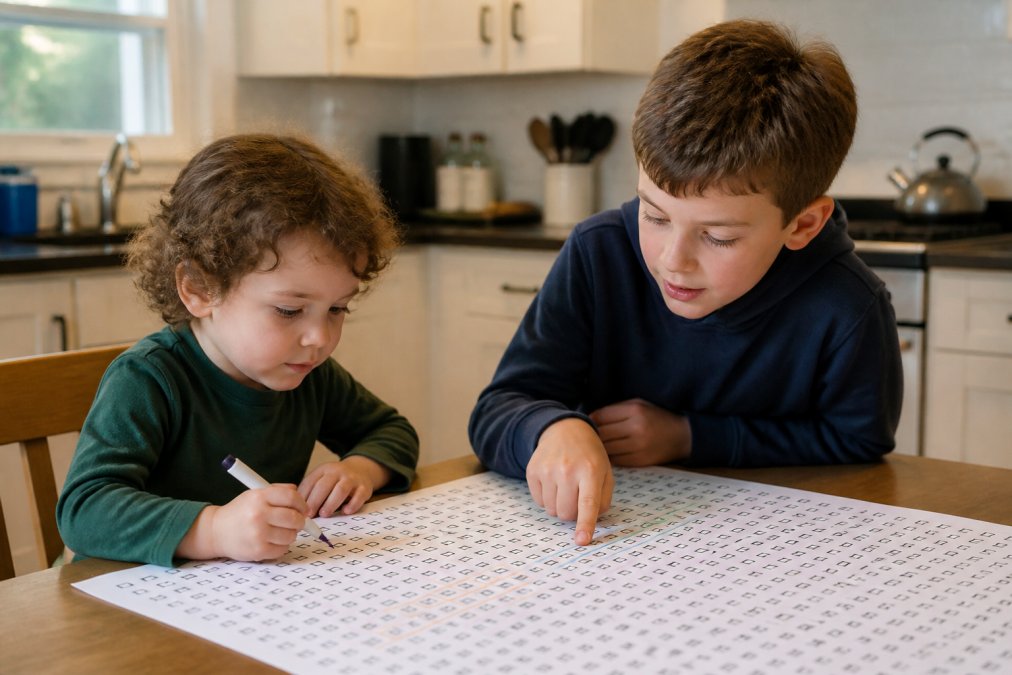
Giant Word Search Puzzle
The Board Games Giant Word Search Puzzle is our top pick for a wide age gap. It measures 30" x 45" and features a color-in letter design, so younger kids can color while older ones hunt for words. Lay it on the table or hang it on the wall.
Table Size Coloring Sheets for Skill Building
Table size coloring sheets build fine motor skills, focus, and early literacy in one activity. The ABC 123 Table Size Coloring Sheet measures 30" x 50" and turns any table into a giant learning page. For pre-readers, the Alphabet Table Size Coloring Sheet pairs letters with animals.


How to Choose by Age Gap
| Activity | Best Age Range | Skill Focus | Shared or Solo | Best For Age Gap |
|---|---|---|---|---|
| Giant Word Search Puzzle | 6+ with a younger coloring partner | Literacy, pattern recognition | Shared | 3-4 years |
| ABC 123 Coloring Sheet | 3-6 | Fine motor, early math | Shared | 1-2 years |
| Alphabet Coloring Sheet | 3-6 | Letter recognition | Shared | 1-2 years |
| Trace & Color Sheets | 4-8 | Handwriting, spelling | Shared | 2-3 years |
| Coloring Club subscription | All ages | Creativity, focus | Shared | Any gap |
What to Skip
Not every popular game works for mixed ages, and a few common picks actively backfire:
- Speed-based card games. The older child wins every round. The younger child learns to dread the game before they've built the skill.
- Games with heavy reading and no pictures. A 4-year-old who can't read is locked out of the whole activity, not just the hard parts.
- Games with elimination. Knocking a player out early leaves the younger child watching instead of playing, which is the opposite of the goal.
- Games with a single fixed difficulty. If the rulebook has one setting, you'll spend the whole game negotiating house rules instead of playing.
Give the older child the "hard" clues and the younger one the easy ones. Splitting the word search by difficulty keeps both engaged without a single argument over territory.
The pattern across every good pick: the shared surface stays the same, and the difficulty scales inside it. When the surface changes, the kids separate. When only the task changes, they stay together.
Adapting Rules for Younger Players and Accessibility
Adapting rules for younger players keeps a game playable when skill levels differ sharply. The fix is usually to change the task, not the goal. Let a younger child find shorter words, color instead of write, or team up with an adult as a partner.
Storage, Organization, and Budget-Friendly DIY Alternatives
Storage and organization keep a mixed-age collection usable instead of crumpled in a drawer. The Year of Coloring Pages Bundle ships rolled in a 32" mailing tube, which doubles as storage between uses. Roll sheets rather than folding them, and label the tube by theme.
| Approach | Upfront Cost | Best For | Reusable |
|---|---|---|---|
| Single table sheet | Low | Trying one theme | No |
| Year bundle | Higher, 20% off retail | Year-round holidays | No |
| Coloring Club | Monthly | Fresh sheets, no contract | No |
| Laminate a sheet | Low | Repeated dry-erase use | Yes |
Frequently Asked Questions
What are the benefits of mixed-age play for siblings?
Mixed-age play builds developmental milestones like turn-taking, peer mentoring, and social-emotional learning. Older siblings practice leadership and patience while younger ones observe advanced problem-solving and cognitive development. This dynamic also strengthens family bonding because children learn to navigate different skill levels together rather than competing in age-segregated groups.
How do you choose games that work for children of different ages?
Look for games with open-ended mechanics and adjustable rules. Cooperative board games for families are ideal because they remove the pressure of a single winner. Giant coloring sheets and word searches also work well since each child can engage at their own level. Focus on age-appropriate challenges that allow for rule modification without losing the game's core structure.
How can I encourage siblings to play together without fighting?
Set clear turn-taking expectations before you start and choose collaborative play activities where everyone contributes to a shared goal. Conflict resolution strategies like assigning roles (one child sorts pieces, another draws) reduce competition. If tension rises, pause the game and let each child pick a small part of the activity to lead. This keeps engagement levels high and frustration low.