

Table of Contents
- Why Keeping Kids Busy Together Matters
- Engaging Siblings of Different Ages at Once
- Collaborative Play Ideas for Kids That Actually Work
- Long-Duration Activities for Siblings
- Managing Conflict and Building Cooperation
- Budget-Friendly DIY Materials and Setup Tips
- Neurodivergent-Friendly Activity Approaches
- Conclusion
Last Updated: August 25, 2026
Why Keeping Kids Busy Together Matters
The challenge most parents face is finding activities that work for multiple children at different developmental stages simultaneously. A single coloring book rarely satisfies a 3-year-old and a 7-year-old in the same room. You need something that invites collaboration without forcing it, and something that doesn't require constant referee duties.
How to keep kids busy together becomes essential strategy. Screen-free, collaborative activities build shared experiences that strengthen sibling bonds, develop problem-solving skills, and give you uninterrupted blocks of time to work, cook, or simply breathe.
When kids have enough space to work side by side, when materials invite creative expression rather than demand perfection, and when activities scale naturally across ages, conflict drops and engagement deepens. Whether you're managing siblings two years apart or five years apart, these strategies deliver hours of genuine engagement.
Engaging Siblings of Different Ages at Once
When children are spread across different developmental stages, the traditional advice of "pick an age-appropriate activity" falls apart. The solution is to choose activities with built-in flexibility so each child can engage at their own level while working in the same space.
The most effective approach focuses on activities where complexity is optional. A giant coloring sheet works for a 3-year-old scribbling freely and a 7-year-old creating detailed scenes. Similarly, puzzles with large pieces accommodate younger children while offering challenge to older siblings through sorting and pattern recognition.

Independent play within shared space creates the magic. When kids aren't dependent on you to facilitate their interaction, they're free to engage at their own pace. A 5-year-old might work on a word search independently while a 9-year-old tackles harder puzzles nearby. Neither needs constant direction.
Remove the pressure for them to do the exact same thing in the exact same way. Give them the same materials, the same table, and let their different ages handle it differently. A younger child colors freely while an older sibling creates more structured designs. Both benefit from the same massive canvas.
Collaborative Play Ideas for Kids That Actually Work
Arts and Crafts Projects
Giant coloring sheets invite multiple children to work simultaneously without fighting over space. A 30" x 50" coloring sheet gives each child genuine room to create their own section while working together on the same project (apa.org).
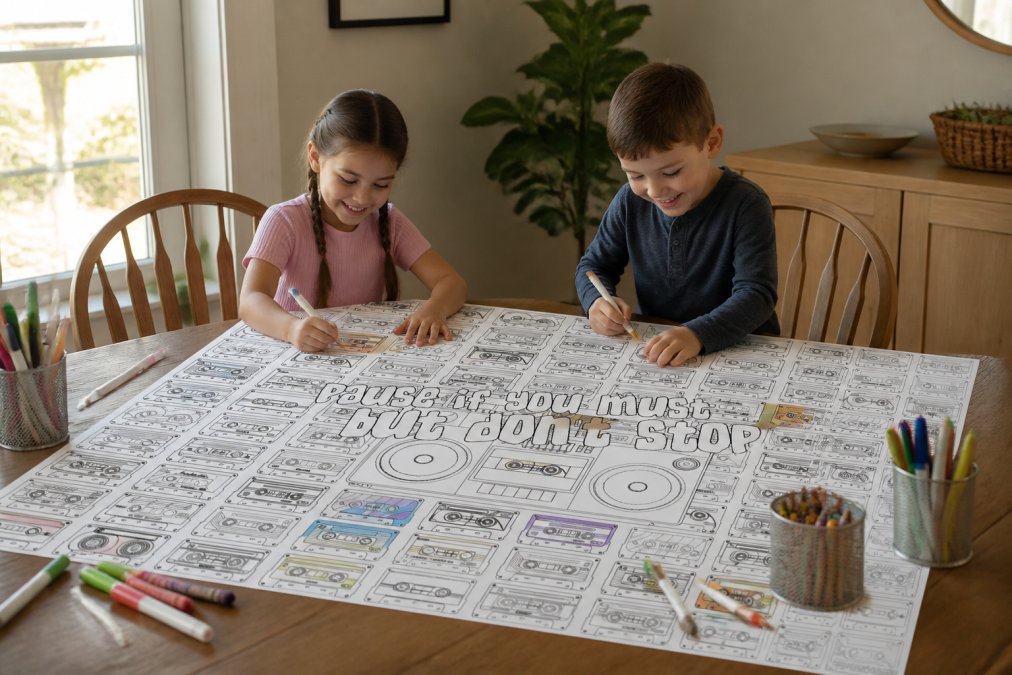
Tape the sheet to a table or hang it on a wall, set out markers or colored pencils, and you're done. No assembly required, no complicated rules. The activity requires almost zero parental intervention once it starts. There's no "right way" to color. A younger child's bold strokes and an older child's detailed work both belong on the same sheet.
Cherry Creek Lane's Together Achieve More Table Size Coloring Sheet ($19.99) accommodates multiple children without crowding, and the themed design gives kids something to respond to creatively while leaving open space for their own ideas.
For year-round variety, the Year of Coloring Pages Bundle ($239.88) provides 12 seasonal and holiday-themed sheets. This transforms coloring into an ongoing family tradition and creates natural conversation starters throughout the year.

Puzzles and Word Games
Puzzles work powerfully for collaborative engagement when you choose those with large pieces and clear visual appeal. Standard jigsaw puzzles with 500+ pieces create frustration when multiple children are involved. Instead, look for puzzles with 50-150 pieces or large-format puzzles designed for group participation.
Word searches and crosswords scale beautifully across ages because they're fundamentally about problem-solving rather than fine motor control. A 6-year-old can find words; an 11-year-old can work through a crossword. They're using the same materials but engaging differently.
The Board Games Giant Word Search Puzzle ($19.99) from Cherry Creek Lane measures 30" x 44.5", eliminating the common problem of multiple children crowding around a small puzzle book. Each child has their own space to search and mark answers. The giant format also makes it easier for younger children to see and interact with the puzzle.
Puzzles build patience and focus in ways coloring doesn't (peer-reviewed research). There's a tangible goal and natural closure, giving kids a sense of accomplishment.
Role-Playing and Imaginative Play
Imaginative play requires minimal materials but maximum space. Provide a loose framework that invites collaboration. A pile of blankets and pillows becomes a fort that both a 4-year-old and an 8-year-old can inhabit together, each finding different ways to use the space.
The advantage of role-playing over structured games is flexibility. There are no rules to argue about, no winner and loser. A younger child can participate fully even if their understanding of the narrative is simpler. An older child can drive the plot forward while the younger one enjoys the sensory and social elements.
Thirty minutes of unstructured imaginative play often produces more genuine engagement and cooperation than activities with more formal structure (apa.org).
Long-Duration Activities for Siblings
Indoor Physical Movement Activities
Kids with pent-up energy don't settle into quiet activities. Channel energy into structured movement that allows engagement and learning.
Dance parties work for any age range. Put on music, clear a space, and let kids move however feels right. A 3-year-old bounces and spins; a 10-year-old might create choreography. They're doing the same activity but expressing it through their own developmental lens.
Obstacle courses built from household items, pillows, chairs, and blankets invite physical problem-solving. Younger children navigate at their own pace; older children can time themselves or create variations. Setup takes 10 minutes; engagement lasts 30-45 minutes. organize toy clutter.
Yoga or stretching routines designed for kids provide movement with built-in structure. Everyone does the same movements, but there's no performance pressure.
Quiet Time and Independent Play Structures
Not every moment needs to be collaborative. Independent play within shared space is crucial for maintaining peace.
Reading time works when each child has age-appropriate books and a comfortable spot. They're in the same room, quiet, and engaged with something suited to their level. Set a timer so there's a clear endpoint.
Individual creative projects allow parallel play. Each child works on their own coloring sheet or puzzle independently, reducing conflict while maintaining shared space.
Audiobooks or podcasts designed for kids create shared listening experiences. Everyone hears the same story, but each child imagines it their own way.
Structure matters. Unstructured "go play independently" often devolves into boredom and conflict. Structured independent time with clear activities, time limits, and defined endpoints keeps kids engaged.
Managing Conflict and Building Cooperation
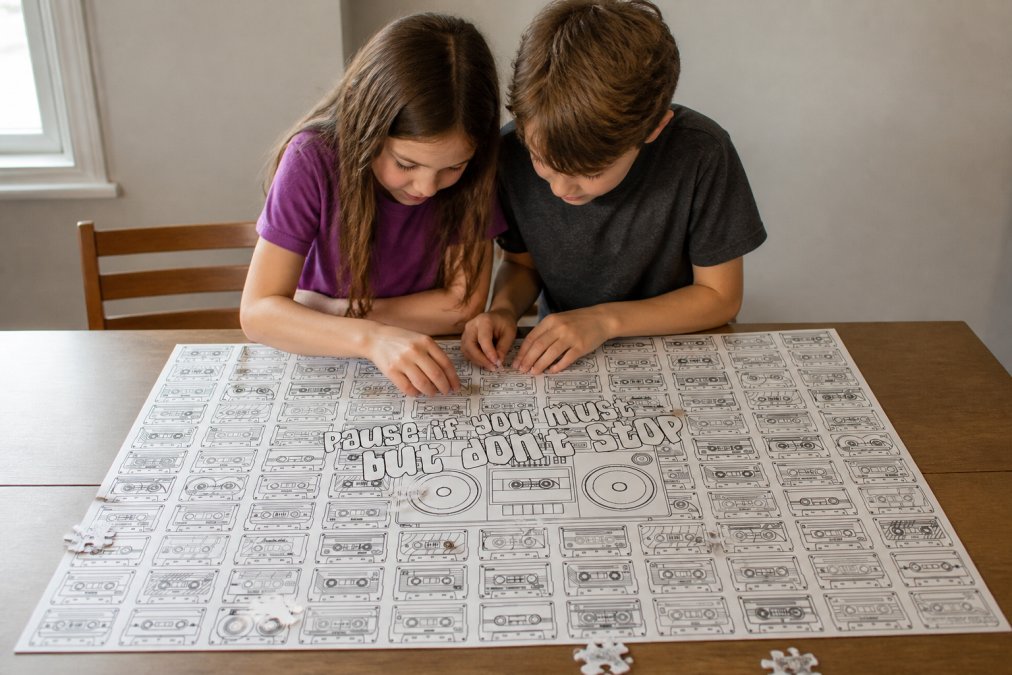
Conflict is inevitable when multiple children share space and materials. The question isn't how to eliminate it, it's how to structure activities so conflict is less likely.
Space matters enormously. When kids are crowded, they fight. A giant coloring sheet eliminates the most common conflict: "She's taking up all the space." When each child has their own section, the physical dispute disappears.
Clear material boundaries prevent disputes over supplies. Give each child their own marker set or clearly designate which markers belong to whom. This removes constant negotiation about who gets which color.
Time-based turns work for activities where taking turns is necessary. "You get 10 minutes with the markers, then it's your sister's turn." A visual timer makes this concrete and reduces arguments about fairness.
Collaboration frameworks guide interaction without forcing it. "You find all the words with animals; your brother finds all the words with colors" creates a shared goal with distinct roles.
When conflict arises, the best response is often environmental. Instead of lecturing about sharing, add more materials. Instead of punishing arguing, separate them briefly into independent activities.
Budget-Friendly DIY Materials and Setup Tips
Giant commercial coloring sheets represent one approach to keeping kids busy together. For families wanting to create similar activities with materials already at home, DIY options exist.
Tape several sheets of printer paper together to create a large coloring surface. The limitation is size; you'll struggle to create anything larger than a few feet across, which reduces the space advantage that makes large sheets effective.
The practical reality is that DIY approaches save money upfront but require more setup time and produce less durable results. For occasional use, DIY works fine. For regular, reliable activity, commercial products designed specifically for this purpose deliver better results with less parental effort.
The actual cost difference is smaller than it appears. A 30" x 50" coloring sheet costs $19.99, roughly the same as several sheets of printer paper, markers, and tape. When you factor in setup time and durability, the commercial option often represents better value.
For families wanting year-round variety without monthly purchases, the Year of Coloring Pages Bundle ($239.88) works out to about $20 per sheet, the same price as individual purchases but with the convenience of everything arriving on a schedule.
Neurodivergent-Friendly Activity Approaches
Children with ADHD, autism, sensory processing differences, or other neurodivergent traits often struggle with typical "keep the kids busy" suggestions. Activities that work beautifully for neurotypical children can be overwhelming or understimulating for neurodivergent kids.
Sensory regulation matters. Some children need heavy input involving pressure, movement, or tactile sensation. Others are sensory-sensitive and need calm, low-stimulation environments. Giant coloring sheets work across this spectrum because kids can choose their own pressure level, color intensity, and pacing.
Clear structure reduces anxiety. Open-ended "go play" instructions create paralysis for many neurodivergent children. Instead, specific activities with defined endpoints work better. "Color this sheet for 20 minutes" is clearer than "keep yourself entertained."
Repetition is valuable, not a limitation. Many neurodivergent children thrive on repetitive activities. Monthly themed coloring sheet subscriptions can be beneficial for this reason.
Quiet, low-demand activities often suit neurodivergent kids better than high-interaction games. Puzzles, coloring, and word searches don't require social negotiation or rapid decision-making.
Avoiding time pressure helps. Many neurodivergent children struggle with transitions and time awareness. Activities without strict time limits, or with clear visual timers, reduce anxiety and increase engagement.
Conclusion
Keeping kids busy together isn't about finding the perfect activity, it's about designing conditions where engagement happens naturally. Space matters. Materials matter. Structure matters. Most of all, giving yourself permission to prioritize screen-free time together matters.
The activities that work best are the ones you'll actually use repeatedly. Cherry Creek Lane's giant coloring sheets and word search puzzles have become go-to tools for thousands of families. They're durable enough for regular use, large enough to accommodate multiple children without crowding, and simple enough that setup takes seconds. Shop Coloring Sheets today and start building those screen-free moments your family will remember.

Frequently Asked Questions
Will a giant coloring sheet actually keep kids of different ages engaged together, or will they just fight over space?
Giant coloring sheets work because they offer enough space for multiple children to color simultaneously without crowding. Kids ages 3 and 7 can work on different sections of the same sheet, with the younger child focusing on larger areas and the older child tackling finer details. The key is setting clear zones before starting: "You color the top, your brother colors the bottom." This structure prevents conflict and lets both children feel ownership of the project. Pairing the activity with collaborative themes (like a family scene everyone helps complete) reinforces teamwork rather than competition.
What makes premium giant coloring sheets worth the cost compared to free printable pages taped together?
Premium giant sheets like those from Cherry Creek Lane are designed specifically for durability and quality. They withstand markers, crayons, and colored pencils without tearing, bleeding through, or falling apart after one use. Printable pages taped together create weak seams where tape shows, pages separate, and the overall experience feels temporary. Giant sheets are pre-sized (typically 30" x 50"), ready to use immediately, and made in the USA with materials that hold up to real family use. For families seeking hours of engagement rather than a one-time activity, the investment pays for itself in durability and ease of setup.
Can mixed-age groups use the same puzzles and coloring sheets, or do I need separate products for each child?
The same large-format products work for mixed-age groups when you assign age-appropriate roles. A 3-year-old can place large puzzle pieces while a 7-year-old handles smaller pieces and reads clues from word searches. With coloring sheets, younger children can color freely in one section while older siblings tackle more detailed patterns or even create their own designs. This collaborative approach builds problem-solving skills and allows siblings to support each other. Choose activities with enough visual interest and complexity that older children stay engaged while remaining accessible for younger ones.
How long can kids realistically stay engaged with a single giant coloring sheet or puzzle?
Most children stay engaged with a large coloring sheet for 45 minutes to 2 hours, depending on age and interest level. Giant puzzles and word searches typically hold attention for 1-3 hours because they involve problem-solving and variety. To extend engagement, rotate between different activity types: start with coloring, move to a puzzle, then try a word search. Breaking activities into 30-minute chunks with short movement breaks also helps maintain focus. Themed sheets (seasonal, holiday, educational topics) add novelty and give kids a reason to return to the activity multiple times.
This article was written using GrandRanker