

Table of Contents
- Why Screen Free Activities Matter for Kids
- Indoor Activities for Kids Without Screens
- Collaborative Art Projects for Families
- Outdoor Play and Nature Exploration
- How to Reduce Screen Time for Children
- Low-Prep and Neurodivergent-Friendly Options
- How to Pick the Best Screen Free Activities for Your Family
- Frequently Asked Questions
Last Updated: September 11, 2026
Why Screen Free Activities Matter for Kids
The best screen free activities for kids hold attention long enough that nobody asks for a tablet. This guide from Cherry Creek Lane covers seven approaches, sorted by prep time, mess level, and adult involvement.
The pressure is real. The American Academy of Pediatrics guidance on children and media recommends consistent limits on screen time and prioritizes sleep, physical activity, and face-to-face interaction. What that looks like in practice varies by household. The activities below are built around a simple principle: engagement beats restriction. A child deep in a fort or halfway through a giant coloring sheet is not white-knuckling their way through screen withdrawal. They are busy.
Indoor Activities for Kids Without Screens
Indoor activities for kids without screens work best when they change the shape of the room. A couch pushed aside and a blanket over two chairs reads as an event; the same blanket on the floor reads as laundry.
Fort Building and Cozy Reading Nooks
Fort building is the highest-return indoor activity because the setup is the activity. Kids spend 20 minutes engineering, then 30 to 60 minutes playing inside what they built. Blankets, couch cushions, a rope, and two chairs cover most builds.
A common mistake is building the fort for them. Let it lean, let it collapse once, the rebuild is where problem-solving happens.
Sensory Bins and Quiet Time Play
Sensory bins are shallow containers filled with a base material (rice, dried beans, water beads, kinetic sand) plus scoops, cups, and small figures. They build fine motor skills and give kids a quiet time activity they can run alone.
The tradeoff is cleanup: dry rice on a hard floor takes two minutes with a dustpan, but twenty on carpet. Put a shower curtain or large towel underneath first.
Collaborative Art Projects for Families
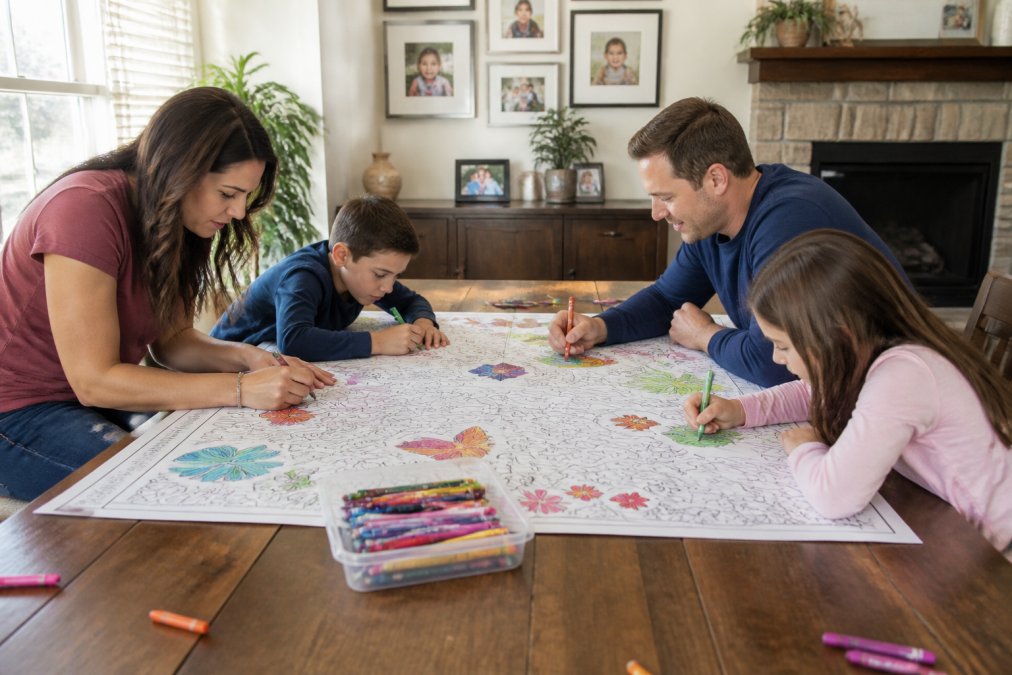
Collaborative art projects for families solve a specific problem: siblings of different ages rarely want to do the same thing at once. A shared canvas changes that, when the project is bigger than one child, working side by side stops being a compromise and becomes the point.
Giant Coloring Sheets for All Ages
Giant coloring sheets are oversized paper canvases, typically 30 by 50 inches, designed to cover a table or a stretch of wall. That scale makes them work for mixed ages: a three-year-old scribbles in one corner while a seven-year-old works a detailed section, and neither infringes on the other's territory.
Cherry Creek Lane offers table-sized sheets at exactly that 30 by 50 inch size, and the format handles crayons, colored pencils, markers, or paint. The USA-made labeling standards from the Federal Trade Commission require that "Made in the USA" claims be backed by verifiable domestic production, which matters if you are buying a gift and want to know what you are getting.
For families who want a recurring option, the Year of Coloring Pages Bundle ships 12 sheets covering a full calendar of holidays and seasons. For a single themed project, the World Coloring Map turns geography into a group activity.

Family Tree and Map Coloring Projects
Two themes outperform everything else for mixed ages: family and geography. A Family Tree Table Size Coloring Sheet gives kids a place to record names, favorites, and details about relatives, turning coloring into a conversation with grandparents. The Map Collection #1 Table Size Coloring Sheet packs four regional maps onto one page, and you can cut them apart so each child gets their own.
Outdoor Play and Nature Exploration
Outdoor play and nature exploration deliver what indoor activities cannot: gross motor development, spatial awareness, and unstructured problem-solving that only shows up when the environment is not designed for you. What gets kids out the door and keeps them there is a specific task with a visible finish line. active play gear.
Age-Appropriate Outdoor Activities
The right outdoor activity changes fast with age:
- Toddlers (1-3): Parallel play near a parent. A bucket and dirt, a bubble wand, or a hunt for "three things that are round." Sessions run 15-25 minutes.
- Preschool (3-5): Simple rules they can hold in their head. Color hunts, puddle stomping, chasing bubbles, and "find five leaves and line them up by size." Expect 30-45 minutes.
- Early elementary (6-8): Games with a score or a goal. Chalk-and-cone obstacle courses, timed scavenger hunts, and bug or bird identification. 45-90 minutes is realistic.
- Tweens (9-12): Independence and mastery. Geocaching, bike routes, fort-building in a wooded area, and mapping a neighborhood walk. They will stay out for hours if a friend is involved.
A common pattern is planning for the oldest child and losing the youngest within ten minutes. Pick the activity for the youngest kid and let the older ones add difficulty on their own.
Scavenger Hunts and Nature Games That Need No Prep
A scavenger hunt is the lowest-prep entry point. Write or draw six things on paper (a smooth rock, something yellow, a leaf with three points, a sound you can hear, a bug, something that smells good) and hand it over. No printing, no materials to buy, and it works in a backyard, a park, or a single block of sidewalk.
Variations that extend the same idea:
- Color hunt: Find one object for each color of the rainbow, in order.
- Texture hunt: Something rough, smooth, fuzzy, wet, and bumpy.
- Sound map: Sit still for five minutes and draw every sound you hear on a blank page.
- Shadow tracing: Trace a child's shadow with chalk in the morning, then again at noon and late afternoon, and compare the shapes.
- Rainy-day version: Do the same hunt from a covered porch or through a window, listing what you can see and hear.
Nature-based learning does not need a curriculum. Sorting leaves by shape teaches classification; tracking a shadow across the driveway teaches observation. For kids who resist structured activities, framing the walk as a hunt rather than a lesson is usually the difference between ten minutes and an hour.
Safety and Weather Basics
The practical barriers to outdoor play are usually heat, cold, and daylight, not motivation:
- Heat: Aim for early morning or after dinner in summer. Bring water, and pick shade over sun for the first 20 minutes.
- Cold: Layers beat one heavy coat. Set a shorter time limit and warm up indoors between rounds.
- Daylight: In winter, a 20-minute walk right after school beats an hour planned for after dinner.
- Boundaries: For independent outdoor play, agree on a visible boundary (the end of the block, the far fence) before kids go out, and check in at a set time.
Bringing the Outdoors Back Inside
Not every day allows a full outdoor session. A table-sized coloring sheet with a nature or map theme keeps the outdoor thread going on a rainy afternoon, sorting, labeling, and coloring the same kinds of things they would have hunted for outside. The World Coloring Map and the Map Collection #1 Table Size Coloring Sheet both work well as an indoor follow-up to a walk.
How to Reduce Screen Time for Children
How to reduce screen time for children comes down to one thing: replacing screen time with something better, not just removing it. Restrictions without alternatives produce boredom, and boredom produces negotiation. Families who succeed treat screen reduction as a logistics problem, not a willpower problem.
Set Up a Family Screen Time Plan
A workable screen time plan has three parts, and skipping any one causes it to collapse within a week:
- Define the windows. Pick specific times when screens are allowed (after homework, weekend mornings) rather than a daily minute count nobody tracks.
- Define the zones. Bedrooms and the dinner table are the two that matter most. The CDC guidance on children's sleep and daily routines ties consistent routines to better sleep outcomes, and screens at bedtime work against that.
- Define the swap. For every window you close, name the activity that fills it. "No screens after 6" fails. "No screens after 6, that's when we do the puzzle or the coloring sheet" holds.
Write it down and put it somewhere visible. A plan in a parent's head is one kids will argue with; a plan on the refrigerator is one they can read.
What to Say in the Moment
The plan handles the routine. The hard part is the moment a child asks for a screen and you say no. Scripts that work better than "because I said so":
- Offer the swap, not the refusal. "Screens are done. Do you want the fort or the coloring sheet?" Two choices beats an open-ended no.
- Name the next thing, not the last thing. "After lunch we're going outside" gives the child something to move toward instead of something taken away.
- Hold the boundary once, then stop talking. Repeating the rule invites negotiation. State it, then redirect to the activity.
- Use a timer for the transition. "When the timer goes off, screens are done" moves the decision off the parent and onto an object, which most kids accept more easily.
The first three days are usually the hardest and the fourth is noticeably easier. Expecting that dip makes it easier to ride out.
Handling the Common Failure Modes
Most screen-time plans fail because of one of these, not the child:
- The alternative takes longer to set up than the screen. If pulling out the craft supplies takes ten minutes, the tablet wins. Keep at least one zero-setup option within reach.
- The plan has no exception for sick days or travel. Build in a clear "screens are fine when you're sick or on a long drive" rule so the system does not collapse the first time it is inconvenient.
- Both parents are not on the same page. Kids find the gap immediately. Agree on the windows and zones together before announcing them.
- The basket or shelf is empty. A boredom busters basket that has not been rotated in a month stops working. Refresh it every two to three weeks.
- The parent is on a screen. This is the one nobody likes to hear, but it is the most consistent predictor of whether the plan holds. Modeling matters more than the rule itself.
Create a Boredom Busters Basket
A boredom busters basket is a single container stocked with low-prep, self-directed activities kids can pull from without asking, removing the negotiation step entirely.
Stock it with items that need no adult setup:
- Playing cards and dice
- A stack of blank paper and colored pencils
- Small puzzles and brain teasers
- A giant crossword or word search sheet
- Sidewalk chalk
- A notebook for drawing or list-making
Rotate the contents every few weeks. Novelty does most of the work, and a basket that never changes stops being interesting by the third rainy day.
Low-Prep and Neurodivergent-Friendly Options
Low-prep activities and neurodivergent-friendly options overlap more than most lists admit. Both prioritize clear expectations, minimal transitions, and a defined endpoint. Kids who struggle with open-ended "go play" instructions often do fine with a task that has obvious boundaries.
Here is how the main activity types compare on the dimensions that decide whether a parent will use them again:
| Activity | Prep Time | Mess Level | Adult Involvement | Best For |
|---|---|---|---|---|
| Giant coloring sheets | Under 1 min | Low | Optional | Mixed ages, parallel play |
| Fort building | 5-10 min | Medium | Setup only | Independent play, ages 4+ |
| Sensory bins | 5 min | High on carpet | Low | Quiet time, sensory seekers |
| Scavenger hunt | 2 min | None | Low | Outdoor, active kids |
| Family calendar coloring | Under 1 min | Low | Optional | Routine-building, planning |
The pattern is consistent: activities with a visible structure and a clear finish line hold attention longest. A Winter Activity Calendar Coloring Banner is a three-month calendar with activity ideas printed on it, so kids see exactly what the project is and when it ends. The Full Year Activity Calendar BUNDLE covers all four seasons in one purchase.


How to Pick the Best Screen Free Activities for Your Family
Choosing well means matching the activity to your actual constraints, not an idealized household. Answer these four questions before you buy or plan anything:
- How much time do you have for setup? Under five minutes rules out anything involving mixing, cutting, or assembling.
- How many kids, and what ages? Mixed-age groups need activities with a shared surface and no single correct output.
- What is your tolerance for cleanup? Be honest. A high-mess activity you avoid using is worse than a low-mess one you actually pull out.
- How much do you want to be involved? Some activities are designed for parallel play. Others need a parent in the middle of them.
If you want one starting point that scores well on all four, a table-sized coloring sheet is the safest first purchase. It sets up in seconds, scales across ages, cleans up by rolling, and works whether you sit down with them or not. Cherry Creek Lane makes these in the United States and ships them from Utah, and the sheets are perfect for markers and colored pencils.
For families building a rotation, the strongest setup is one indoor anchor (a coloring sheet or fort), one outdoor default (a scavenger hunt), and one quiet-time option (a sensory bin). Three activities cover most situations where screen time becomes the fallback.
Screen-free time falls apart when the alternative takes more effort than handing over a device. The fix is having something already on the table, ready to go, that works for every age in the house at once. Cherry Creek Lane offers table-sized coloring sheets, puzzles, and wall-sized activity calendars designed for exactly that: 30 by 50 inch sheets that cover a whole table, hold up to crayons, markers, and colored pencils, and give kids of different ages a shared project with no setup and no cleanup fight. Everything is made in the USA and shipped from Utah, and the monthly themed subscription keeps a fresh sheet arriving without you planning a thing. Browse the collection and pick a first sheet for your table.
Frequently Asked Questions
How to entertain kids without screens?
Keep a rotation of hands-on options ready: giant coloring sheets, fort building supplies, sensory bins, and backyard scavenger hunts. The best screen free activities are open-ended and use household items, so kids can start without waiting for you to set up. Try a family coloring banner on the table and let kids add to it all week. Rotating activities every few days keeps boredom busters fresh without buying anything new.
What is the 3-3-3 rule for kids' screen time?
The 3-3-3 rule is a simple family guideline: no screens for the first 3 hours after waking, no screens within 3 hours of bedtime, and no screens during the 3 main meal times. It gives structure without a strict timer. Pair it with screen free activities like coloring, puzzles, or outdoor exploration so kids have something to do during those windows instead of just losing access.
What are some low-prep screen free activities for toddlers and older kids?
Low-prep options include giant coloring sheets, cardboard box forts, kitchen sensory bins with dry rice or beans, and chalk drawing outside. For mixed ages, a table-sized coloring sheet works because toddlers can scribble on one section while older kids color detailed areas. Keep a bin of crayons, markers, and paper within reach so kids can start independently with minimal setup from you.
How do I transition my children away from digital devices?
Start with a predictable routine rather than removing screens all at once. Replace one screen block per day with a hands-on activity, such as a collaborative art project or a nature walk. Set clear times for device use and stick to them. Having engaging alternatives ready, like a giant coloring sheet or a family activity calendar, gives kids something to move toward instead of just losing screen time.
What are the benefits of screen-free time for child development?
Screen-free time supports fine motor skills through coloring and building, gross motor development through active play, and social-emotional learning through collaborative games. Kids practice problem-solving and critical thinking when they build forts or plan a scavenger hunt. Unplugged play also strengthens family bonding and gives children space for imaginative play and creative expression without digital input.