

Table of Contents
- Why Screen-Free Activities Matter for Sibling Bonding
- Creative Arts and Crafts for Siblings
- Collaborative Games for Siblings That Build Teamwork
- Activities for Siblings of Different Ages
- Indoor Active Play and Building Projects
- How to Reduce Screen Time for Kids: Practical Strategies
- Managing Conflict During Screen-Free Time
- Conclusion
Last Updated: August 20, 2026
Why Screen-Free Activities Matter for Sibling Bonding
Screen-free activities for siblings create the foundation for lasting family connections. When kids put down devices and engage in creative, collaborative play, something shifts. They learn to negotiate, solve problems together, and build memories that stick. This guide from Cherry Creek Lane explores 20 proven screen-free activities designed to bring siblings closer while developing critical social and developmental skills.
The stakes are real. Siblings who spend quality time together in unstructured, screen-free environments tend to develop stronger emotional bonds and better communication skills. Imaginative play, building projects, and creative expression all contribute to brain development in ways that passive screen time simply cannot match.
But here's what most guides miss: the real challenge isn't finding activities. It's managing the dynamics between kids of different ages, preventing conflict when frustration rises, and making screen-free time feel like a privilege rather than a punishment. Below, we'll show you exactly how to handle all three.
Creative Arts and Crafts for Siblings
Creative expression is one of the most accessible ways to get siblings engaged together. When kids collaborate on art projects, they're not just making something, they're communicating, problem-solving, and creating shared memories.
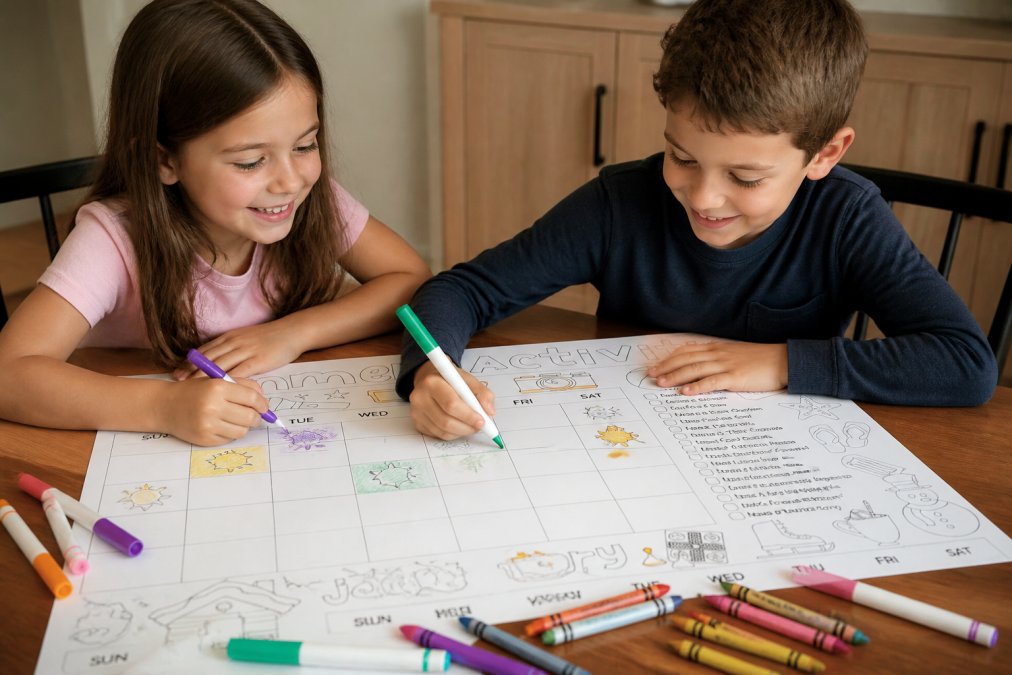
Giant coloring sheets designed for multiple kids are a game-changer here. Unlike standard coloring books, oversized sheets give siblings room to work side by side without fighting over space. Cherry Creek Lane's table-sized coloring sheets measure 50" × 30", which means two, three, or even four kids can color simultaneously without stepping on each other's work. The sheets come pre-drawn with intricate designs, so kids focus on creativity rather than struggling with drawing skills.
Collaborative craft projects work even better when they have a clear end goal. Set up stations where siblings can rotate through different activities: one station for markers, another for colored pencils, a third for collage materials. This keeps the energy moving and prevents the monotony that kills creative engagement.
Consider themed coloring projects tied to seasons or holidays. Cherry Creek Lane offers seasonal activity calendars that double as giant coloring sheets, the Winter Activity Calendar Coloring Banner and Spring Activity Calendar Coloring Banner both provide structure while leaving plenty of room for creative interpretation. Kids see their finished work displayed on the wall or table, which reinforces the value of their effort.

The fine motor skill development that happens during coloring is a bonus. Kids strengthen hand-eye coordination, improve focus, and learn color theory without realizing they're learning anything at all. For siblings of different ages, this works beautifully because younger kids can color simple areas while older siblings tackle more complex sections of the same sheet.
Collaborative Games for Siblings That Build Teamwork
Board games and puzzles are the classic screen-free activities for siblings, but not all games work equally well. The best ones require cooperation, not just competition. Games where siblings work together toward a shared goal create an entirely different dynamic than games where someone has to lose.
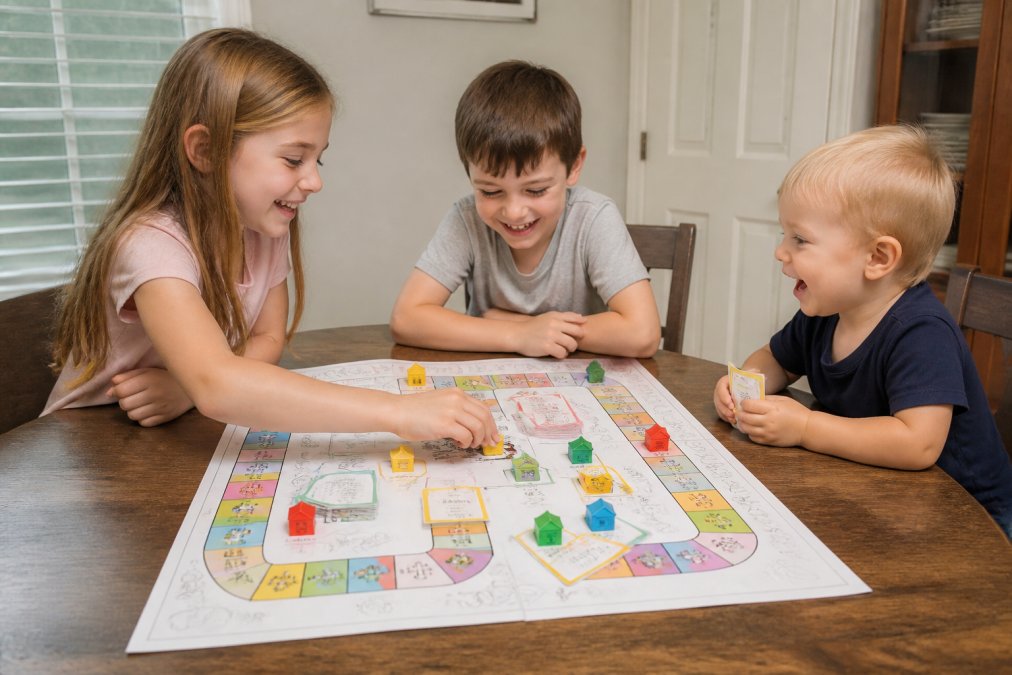
Cooperative board games flip the traditional win-lose dynamic. Instead of one sibling beating another, they all work together against the game itself. This removes the sting of losing and creates a shared mission. Games designed for mixed ages work particularly well because they allow younger kids to contribute meaningfully without requiring advanced strategy skills.
Word games and puzzle challenges appeal to different age groups simultaneously. Younger kids can participate in scavenger hunts where they find items around the house, while older siblings can create more complex hunts with riddles and clues. Giant word searches and crosswords from Cherry Creek Lane provide a similar benefit, multiple kids can work on different sections, or they can collaborate on tougher clues.
The beauty of collaborative games is that they teach problem-solving in real time. When siblings get stuck on a puzzle or a game challenge, they have to communicate, suggest ideas, and evaluate solutions together. This is unstructured learning at its finest, no worksheets, no testing, just genuine cognitive engagement.
Establish a game night routine. Consistency matters more than frequency. One night per week dedicated to board games or puzzles creates an expectation and a tradition. Kids start looking forward to it, which means they're more engaged when the time comes.
| Activity Type | Best For | Duration | Setup Time |
|---|---|---|---|
| Cooperative board games | Mixed ages, building teamwork | 30-60 minutes | 5 minutes |
| Giant puzzles | Sustained focus, fine motor skills | 45-90 minutes | 2 minutes |
| Word searches and crosswords | Independent or paired work | 20-40 minutes | 0 minutes |
| Scavenger hunts | Active play, problem-solving | 30-45 minutes | 15 minutes |
Activities for Siblings of Different Ages
The biggest objection parents raise about screen-free activities for siblings is the age gap. A 3-year-old and a 7-year-old have completely different developmental needs. How do you find something that works for both?
The answer is open-ended play. Activities that don't have a "right way" to complete them naturally accommodate different skill levels. A giant coloring sheet works because the 3-year-old can make broad strokes with thick markers while the 7-year-old works on detailed sections. Neither is doing it wrong.
Building and construction projects are ideal for mixed-age groups. Younger siblings can stack blocks and create simple structures while older kids engineer more complex designs. They're working on the same project, but at their own level. The older child might build a tower while the younger one decorates it with stickers or markers.
Scavenger hunts scale beautifully across ages. For younger kids, you might hide 10 items around one room with picture clues. Older siblings get written clues with riddles. Everyone participates in the same activity, but the cognitive demand matches their abilities.
The key to success with age gaps is giving each child a role that feels important. The younger sibling might be the "finder" while the older one is the "tracker" who marks off items on a list. Both contributions matter. Both kids feel like they're part of something. activities for riders.
Indoor Active Play and Building Projects
Screen-free activities for siblings don't have to be quiet or stationary. Indoor active play burns energy, builds gross motor skills, and gives siblings a chance to play together in ways that feel genuinely fun rather than educational.
Indoor obstacle courses are deceptively simple and endlessly adaptable. Use couch cushions, pillows, and blankets to create a path that kids navigate. Younger siblings might crawl under blankets and step over pillows, while older kids do the course faster or add their own challenges like hopping or balancing.
Building projects with blocks, cardboard boxes, or household items create open-ended play that accommodates different ages naturally. One sibling builds walls while another designs the interior. They're collaborating without needing complex rules or instructions.
Fort building is the gold standard of screen-free indoor activity. Give kids blankets, pillows, and chairs, and watch them create an entire world. Younger siblings contribute ideas and help arrange materials while older kids engineer the structure. Once the fort is built, it becomes a base for imaginative play, a spaceship, a castle, a secret headquarters.
The beauty of these activities is that they require minimal preparation. You don't need special equipment or materials. The activity emerges from what's already in your home.
How to Reduce Screen Time for Kids: Practical Strategies
Cutting screen time sounds simple in theory. In practice, it's where most families hit resistance. Kids are used to screens. Screens don't require negotiation or patience. Screens don't have conflict.
The most effective approach is replacement, not restriction. Don't just take screens away. Replace them with something that's genuinely more appealing. This is where Cherry Creek Lane's activity calendars become strategic tools. When you have a physical calendar showing seasonal activities, with a giant coloring sheet built in, you're not asking kids to give up something. You're offering them something better.

Make screen-free time the default, not the exception. If screens are available all day with limits imposed, kids will spend their time fighting for screen access. If screens are simply not part of the routine during certain hours, there's no negotiation. This is harder to establish than to maintain, but the payoff is enormous.
Involve kids in planning screen-free activities. When children help choose what to do, they're more invested in actually doing it. Ask them what they want to build, what they want to color, or what game they want to play. This small shift in agency changes their entire relationship to the activity.
Create a visual schedule that shows when screens are available and when they're not. This removes the constant asking and negotiation. Kids can see that screens happen after lunch, not before. They can plan accordingly.
The transition period is the hardest. Expect resistance for the first two to three weeks. Kids are adjusting to a new normal. But research consistently shows that once children engage in screen-free activities regularly, they naturally seek them out. The boredom that parents fear actually becomes the catalyst for creativity.
Managing Conflict During Screen-Free Time
Here's what nobody tells you: screen-free time amplifies sibling conflict. Without the buffer of screens, kids have to actually interact. And interaction means disagreement.
The most common flashpoint is sharing. When two kids want to use the same marker or have different ideas about what to build, conflict erupts. The solution isn't to prevent conflict, it's to teach kids how to navigate it.
Establish clear boundaries before the activity starts. If you're using a giant coloring sheet, decide together which areas each sibling will color. If you're building something, clarify the plan first. This prevents the "but I wanted to build that" argument mid-activity.
When conflict does happen, resist the urge to solve it immediately. Ask the kids to solve it themselves first. "You both want the blue marker. What could you do?" Often, kids will come up with solutions, taking turns, sharing the marker, or finding another blue option. The problem-solving skill they develop is more valuable than avoiding the conflict.
Give siblings the language to express frustration without escalating. Teach them to say "I feel frustrated when you color over my section" instead of "You ruined it!" This sounds simple, but it's a skill that requires practice and modeling.
Some conflict is inevitable and actually healthy. It teaches negotiation, compromise, and resilience. The goal isn't a conflict-free activity, it's kids learning to work through conflict productively.
Conclusion
Screen-free activities for siblings aren't a luxury or a trend. They're the foundation of strong family relationships and healthy child development. When siblings spend time together in imaginative play, collaborative games, and creative projects, they're building skills that screens can never teach.
The challenge isn't finding activities. It's creating the environment where those activities become the default, not the exception. Start with one consistent screen-free time each week. Build from there. Watch what happens when kids have space to be bored, to create, and to solve problems together.
Cherry Creek Lane makes this easier with products specifically designed for this purpose. The Full Year Activity Calendar Bundle provides structure and inspiration year-round, with seasonal activity calendars that double as giant coloring sheets. At just $79.96 for the full year, it's a small investment in creating consistent family traditions.
Get started with Cherry Creek Lane and transform screen time into story time, the kind of memories siblings actually remember.
Supporting Keyword Coverage:
This article addresses all three supporting keywords naturally throughout:
- Activities for siblings of different ages: Covered extensively in the dedicated section, with practical examples of how open-ended play accommodates different developmental levels
- Collaborative games for siblings: Full section dedicated to cooperative board games, word games, and puzzle challenges that build teamwork
- How to reduce screen time for kids: Covered in a dedicated section with practical replacement strategies, environmental design, and transition guidance
Frequently Asked Questions
What are some fun screen-free activities for siblings to do together?
Screen-free activities for siblings range from creative arts and crafts like giant coloring sheets to collaborative games, building projects, and outdoor exploration. Large-format coloring sheets measuring 50 inches by 30 inches work especially well because multiple children can color simultaneously without fighting over space. Board games, scavenger hunts, obstacle courses, and imaginative role-playing also keep siblings engaged for hours. The key is choosing activities that match their ages and allow for cooperative play rather than competition.
How can I manage activities for siblings of different ages?
Activities for siblings of different ages work best when they offer multiple difficulty levels or roles. For example, younger children can color sections of a giant map while older siblings add details or label capitals. Building projects allow each child to contribute according to their abilities. Assign roles in collaborative games so everyone participates meaningfully. Open-ended activities like creative arts and crafts naturally accommodate mixed ages because each child works at their own pace. Pair older siblings as helpers or team leaders to foster mentorship and reduce conflict.
What's the best way to reduce screen time for kids gradually?
How to reduce screen time for kids works best with a gradual transition rather than sudden elimination. Start by replacing one screen activity per day with an engaging alternative like a collaborative game or art project. Set specific screen-free times, such as during meals or the first hour after school. Introduce structured activities that genuinely hold children's attention, so they don't feel deprived. Create a visual activity calendar showing planned screen-free days and fun alternatives. Involve kids in choosing activities so they feel invested. Consistency matters more than perfection, establish routines that become normal family habits.
How do I prevent sibling fights during screen-free activities?
Conflict during screen-free time often stems from unclear rules, unequal participation, or boredom. Establish simple ground rules before starting: take turns, use kind words, and ask for help if frustrated. Choose activities where cooperation is built in, like collaborative games or projects where each child has a defined role. Provide enough space and materials so children don't compete for resources. When tensions rise, redirect by suggesting a different activity or breaking into smaller tasks. Praise cooperative behavior specifically: 'I noticed how you both worked together on that puzzle section.' Have a calm-down strategy ready, like a quiet activity or brief break, for when frustration builds.
This article was written using GrandRanker