

Table of Contents
- Why Screen-Free Time Builds Creative Thinking
- Screen-Free Activity Ideas for Kids by Age
- How to Set Up a Home Art Station That Gets Used
- Creative Boredom Busters for Children Who Say There's Nothing to Do
- How to Encourage Creativity in Children Without Screens: Step-by-Step
- Creative Strategies for Neurodivergent Kids and Mixed-Age Groups
- Budget-Friendly vs. Investment Creative Setups
- Common Mistakes That Kill Creative Confidence
- Frequently Asked Questions
Last Updated: September 26, 2026
Why Screen-Free Time Builds Creative Thinking
Creative thinking is the ability to generate original ideas, connect unrelated concepts, and solve problems in flexible ways. It grows through practice, not instruction. Screen-free time gives children the mental space to build that muscle.
Screen-Free Activity Ideas for Kids by Age
The best screen-free activity ideas match a child's stage of development. A 3-year-old and a 10-year-old need very different setups, so here's how to pick activities that hold attention at each age.
Ages 2 to 4: Sensory Play and Simple Making
Toddlers and preschoolers learn through their senses, hands-on learning, not instructions.
Try these:
- Finger painting on a large sheet of paper
- Playdough with cookie cutters and rolling pins
- Sorting buttons, pasta, or blocks by color
- Scribbling with chunky crayons on big paper
- Water play with cups and sponges
Ages 5 to 8: Open-Ended Projects and Storytelling
This age loves imaginative play and storytelling. Open-ended play beats any kit with one "right" answer.
Ideas that work:
- Build a cardboard city from delivery boxes
- Write and illustrate a comic strip
- Act out a story with stuffed animals
- Make a collage from old magazines
- Design a "restaurant menu" and play server
Ages 9 to 12: Independent Projects and Creative Challenges
Older kids want ownership. Give them a challenge, then step back.
Try:
- Design a board game with real rules
- Start a sketchbook with a daily prompt
- Build a stop-motion scene with toys
- Write a short mystery story
- Plan and cook a family meal
How to Set Up a Home Art Station That Gets Used
A home art station only works if kids can reach it. Supplies in a sealed bin on a high shelf mean an empty station.
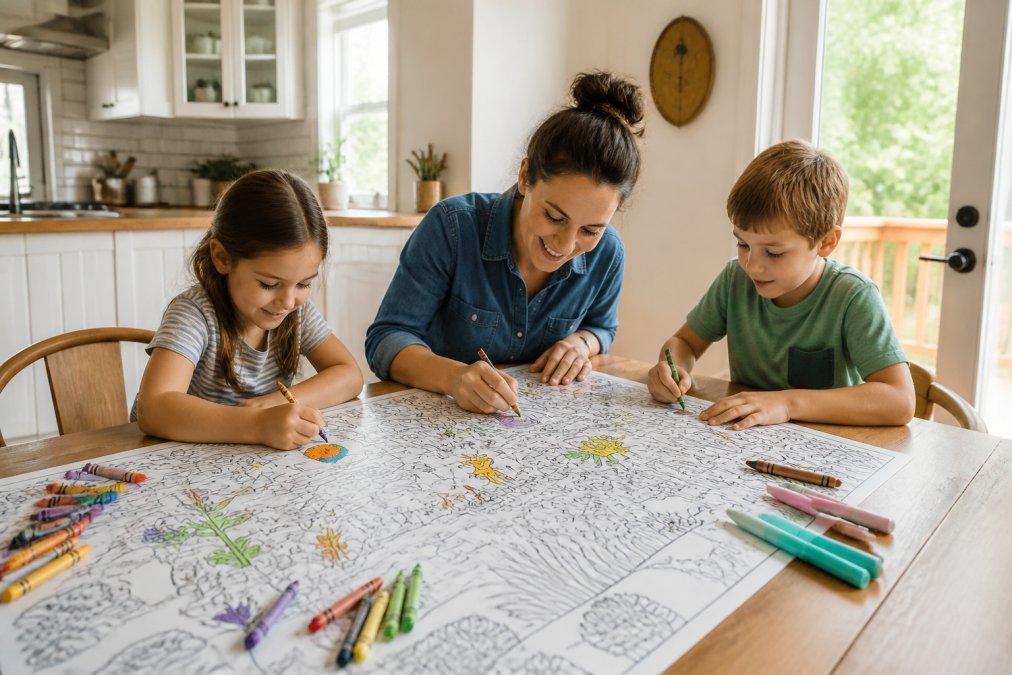
Keep it simple:
- One bin for drawing tools
- One tray for paper and sheets
- One spot for finished work
- A washable mat or old tablecloth underneath
Creative Boredom Busters for Children Who Say There's Nothing to Do
Creative boredom busters for children work best with zero setup. When a child says "I'm bored," you want an answer ready, not a trip to the store.
For a kid who needs to move:
- Build the tallest tower you can from couch cushions
- Create an obstacle course in the hallway
- Choreograph a dance to one song
For a kid who needs to make:
- Draw your dream house, room by room
- Make up a new animal, name it, and describe its habitat
- Fold a paper fortune teller with your own fortunes
For a kid who needs to connect:
- Write a letter to a grandparent
- Interview a family member about their childhood
- Plan a treasure map of the backyard for a sibling
For a kid who needs to think:
- Invent a board game with three rules
- Design a menu for a pretend restaurant
- Solve a riddle you make up yourself
What Actually Happens During the Boredom Threshold
Here's the counterintuitive part: boredom is useful. Child development experts describe a "boredom threshold," where a child stops waiting to be entertained and starts creating their own fun. Most kids hit it within 10 to 15 minutes if you don't rescue them too soon.
A few mechanics make the threshold easier to cross:
- Visible materials shorten the scan. Supplies in a closed bin stretch the scanning phase; supplies on a shelf at eye level collapse it.
- A single starting object beats a list of options. Too many choices restarts the scan, one basket of blocks, one stack of paper, one box of crayons.
- Your presence without your direction helps. Sitting nearby and working on your own thing signals this is a normal way to spend time, not a punishment.
- Movement resets the clock. A kid who's been still for 20 minutes often needs five minutes of jumping before the creative phase can start.
Age-Specific Boredom Scripts
What you say matters as much as what you offer. Lines that work at each stage:
Coloring Club Month-to-Month Plan →
- Ages 2 to 4: "Show me something you can build with these." Toddlers need a verb, not a project.
- Ages 5 to 8: "You have 20 minutes. Make something that didn't exist before." A time box turns a vague ask into a game.
- Ages 9 to 12: "I need your help solving this, what would you try?" Older kids engage when they feel like the expert.
How to Encourage Creativity in Children Without Screens: Step-by-Step
Learning how to encourage creativity in children without screens comes down to four repeatable steps. None require special talent or expensive gear, just consistency.
Step 1: Set a Predictable Screen-Free Window
Pick a daily block, like after dinner or Saturday morning, and keep it the same every day. Predictable routines reduce pushback because kids know what's coming. Start with 30 minutes, then add time as it becomes normal.
Step 2: Offer Materials Instead of Instructions
Hand over supplies, not a plan. "Here's clay and a tray" beats "make a clay bowl." Open-ended play lets kids own the outcome.
Step 3: Let Boredom Do Its Work
Resist the urge to fix boredom. Wait. The first few minutes feel slow, then imagination takes over.
Step 4: Create Together Without Taking Over
Sit down and make something yourself. Don't correct their work or suggest improvements. Your presence matters more than your input.
| Step | What You Do | Time Per Day | What to Watch For |
|---|---|---|---|
| 1. Screen-free window | Set a fixed daily block | 30 min | Pushback fades in 1-2 weeks |
| 2. Offer materials | Put supplies out, no rules | 5 min setup | Kids start without prompting |
| 3. Let boredom work | Wait before stepping in | 10-15 min | Ideas appear after the lull |
| 4. Create together | Make your own thing | 15-20 min | Less "I can't do it" talk |
Creative Strategies for Neurodivergent Kids and Mixed-Age Groups
Standard advice doesn't always fit every kid. Neurodivergent children often need clearer structure and lower sensory load. Mixed-age groups need activities that scale.
For neurodivergent kids:
- Offer one material at a time to reduce overwhelm
- Use visual timers so transitions feel predictable
- Allow movement breaks during creative time
- Skip "finished" expectations; process matters more
Budget-Friendly vs. Investment Creative Setups
You don't need a craft room, and "budget-friendly" versus "investment" aren't the only options, most families land in the middle. Here's a three-tier breakdown with real numbers so you can pick a starting point instead of guessing.
Tier 1: The Zero-to-Low-Cost Setup (Under $25)
This tier works for families testing whether a screen-free habit will stick, or households where supplies get lost, broken, or shared.
- Printer paper and a flattened cardboard box as a canvas
- A basic 24-pack of crayons and a two-pack of glue sticks
- Recycled jars, lids, fabric scraps, and cardboard tubes
- Library books for drawing prompts (free with a library card)
- A shoebox as a supply bin
Tier 2: The Mid-Range Setup ($25 to $75)
This is where most families settle once creative time is a regular part of the week, the money goes toward materials that survive repeated use.
- A washable tablecloth or silicone mat (roughly $10 to $15)
- A set of washable markers that actually come out of fabric (roughly $8 to $12)
- A low shelf or rolling cart so supplies stay visible (roughly $15 to $30)
- One large-format coloring sheet or poster that multiple kids can share (roughly $15 to $25)
- A sketchbook per child (roughly $5 to $10)
Tier 3: The Investment Setup ($75 and Up)
This tier makes sense for families with multiple kids, homeschoolers, or anyone running creative time several days a week. The payoff is shared use and lower per-session cost over time.
- A dedicated low table sized for the kids (roughly $50 to $150)
- Long-lasting art supplies, quality colored pencils, watercolor pans, real brushes
- Large-format coloring sheets and puzzles that hold up to markers and repeated handling
- Open storage that keeps supplies visible without looking like a mess
- A drying rack or clip line for finished work
How to Decide Which Tier You're In
Ask three questions:
- How often does creative time actually happen? Once a week or less, stay in Tier 1. Three or more times a week, Tier 2 pays for itself.
- How many kids share the supplies? One child can stay lean. Two or more, and durability matters more than unit price.
- What breaks first? If you're replacing markers every month, you're already spending Tier 2 money on Tier 1 supplies. Move up.
Common Mistakes That Kill Creative Confidence
The fastest way to shut down creativity is to correct it. Kids stop taking risks when every project gets "fixed."
Watch for these mistakes:
- Directing every step. "Make the sky blue" tells a child there's one right answer.
- Praising only the result. "What a pretty picture" skips the effort. Try "tell me about this part."
- Cleaning up too fast. If work disappears by dinner, kids learn it doesn't matter.
- Comparing siblings. "Your sister's is so neat" ends the session.
- Filling every quiet moment. Constant entertainment leaves no room for creative flow.
Frequently Asked Questions
What can kids do instead of screens?
Keep a rotating set of open-ended materials within reach: paper, markers, clay, building blocks, dress-up clothes, and large coloring sheets. Rotate what is visible every week or two so the supplies feel new. A table-sized coloring sheet, for example, gives siblings a shared project that holds attention for an hour or more. The goal is to make hands-on options easier to reach than a tablet, so screen-free activity ideas for kids become the default rather than the fallback.
How does reducing screen time impact a child's creative thinking?
Screens deliver finished content, so children practice receiving rather than making. When that input drops, kids face unstructured time, and that discomfort is what pushes them toward imaginative play, storytelling, and building. Many parents notice that after the first few days of pushback, children start inventing games, drawing without prompts, and playing longer without direction. The shift is not instant, but the pattern is consistent: less passive input, more self-directed output.
What are simple ways to set up a creative space at home?
You do not need a spare room. A low shelf or rolling cart with paper, crayons, markers, tape, and scissors works for most families. Put it where kids already spend time, not in a basement or closed-off room. Add a flat surface they can spread out on, and protect it with a large coloring sheet or butcher paper. If supplies are visible and reachable, kids use them without asking. If everything lives in a closet, the station stays unused.
How do you handle resistance when removing screens?
Expect complaints for the first week, and do not treat them as failure. Name the boundary once, calmly, and hold it: screens are off during this window. Then point to one concrete option, like a puzzle on the table or a coloring sheet on the wall, without negotiating. Boredom is part of the process, not a problem to solve. Most children move from protesting to playing within 15 to 20 minutes when the alternative is visible and the boundary is steady.