

Table of Contents
- Why a Screen-Free Family Game Night Is Worth the Effort
- What You'll Need Before You Start
- Step-by-Step: How to Plan a Themed Family Game Night
- Family Game Night Rules for All Ages
- Best Large Puzzles for Families: Giant Options That Keep Everyone Engaged
- Overcoming Resistance and Keeping Kids Engaged
- Budget-Friendly DIY Game Creation and Rotation Ideas
- Post-Game Reflection: Turning Play Into Connection
- Frequently Asked Questions
Last Updated: September 24, 2026
Why a Screen-Free Family Game Night Is Worth the Effort
A screen-free family game night is a scheduled block of time when the whole household puts away phones, tablets, and televisions to play board games, card games, or puzzles together. The point is not to ban technology forever. It is to protect one evening a week for face-to-face interaction, and that single change does more for family bonding than most parents expect.

The case for trying it is straightforward. The American Academy of Pediatrics guidance on children and media has long encouraged families to set consistent limits on screen time and to prioritize shared, interactive activities instead. When screens step aside, conversation fills the gap. Kids practice turn-taking, active listening, and patience. Grandparents get a seat at the table instead of watching from the sidelines.
At Cherry Creek Lane, we hear the same story from parents and teachers: the hardest part is starting, not sustaining. Once game night becomes a routine, kids ask for it. Below, we break down exactly how to organize a screen-free family game night, from supplies and age-appropriate game picks to conflict resolution and post-game reflection.
What You'll Need Before You Start
Setting up takes about 15 minutes. You need a clear table, a few household supplies, and games that fit the ages in your home. Skip the elaborate planning. A simple setup that actually happens beats a perfect one that never does.
Essential Supplies for Game Night
Gather these basics before the first session:
- A large, flat surface: dining table or cleared floor space
- Snacks and water within reach to reduce mid-game interruptions
- A basket or bin for phones, kept in another room
- Markers, crayons, or colored pencils for coloring and puzzle activities
- A timer for turn limits and cleanup
- A small notebook for scores and rotation notes
A common mistake is leaving phones on the table "just in case." Out of sight matters. Put the basket in a hallway or closet so nobody is tempted to check notifications.
Choosing Age-Appropriate Games for Mixed Ages
The trick with mixed ages is to pick activities with adjustable difficulty rather than separate games per child. Cooperative play works especially well here because everyone wins or loses as a team, which removes the age gap as a source of friction.
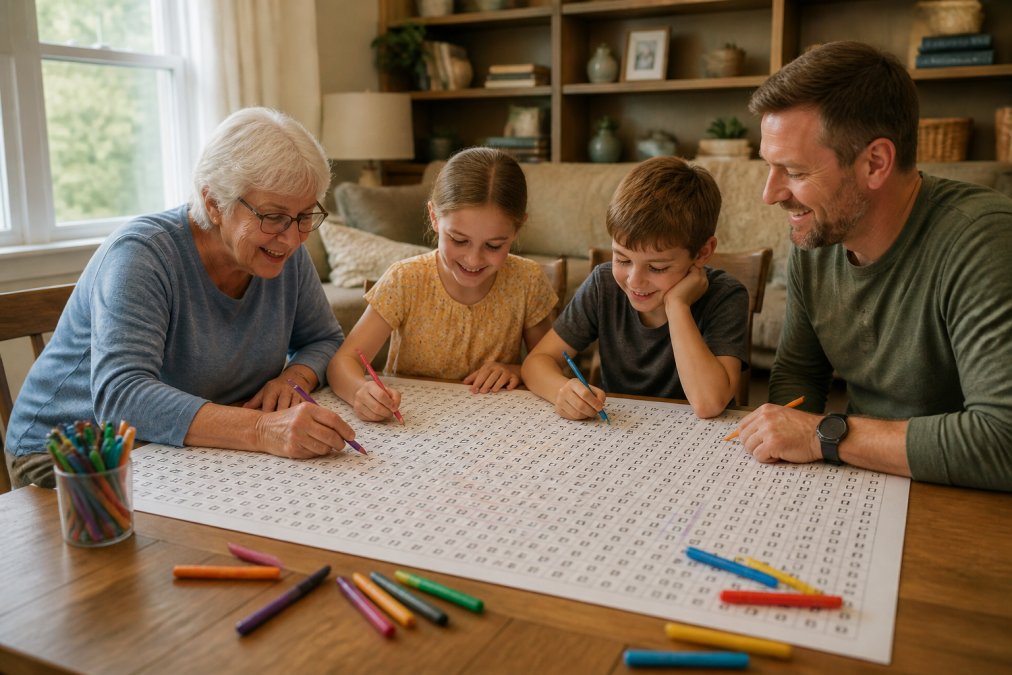
For families spanning toddlers to teens, large-format activities solve the "everyone crowded around a tiny board" problem. Giant puzzles and table-sized coloring sheets let a 3-year-old and a 7-year-old work side by side without fighting over space, and a grandparent can join without hunching over.
Step-by-Step: How to Plan a Themed Family Game Night
A themed family game night works best when you plan it in five short steps. The theme gives the evening a shape and makes it feel like an event rather than just "no screens tonight."
- Pick a theme. Choose something the family already loves: camping, a holiday, a favorite book, or a season. Themes make decorating and game selection easier.
- Set the date and time. Block 90 minutes on a recurring night. Consistency builds the routine faster than a one-off.
- Choose 2-3 activities. One anchor activity plus two shorter games. Rotate them so nobody gets bored.
- Prepare the space. Clear the table, set out supplies, and stash devices out of sight.
- Add a small ritual. A special snack, a playlist, or a "theme costume" element signals that game night has begun.
Once the steps are done, the evening mostly runs itself. Your job shifts from planner to participant.
Family Game Night Rules for All Ages
Family game night rules for all ages should be short, visible, and agreed on together. Write three to five rules on a card and keep it on the table. Rules that kids help create get followed far more often than rules handed down from above.
A workable starter set:
- Everyone plays at least one round before opting out
- No phones at the table, including adults
- Take turns without interrupting
- Cheering is fine; teasing is not
- Cleanup is a team job
Managing Competition and Sportsmanship
Sportsmanship is a skill, and like any skill it improves with practice and positive reinforcement. Model it yourself first. When you lose, say so cheerfully and congratulate the winner out loud. Kids copy what they see far more than what they're told.
Watch for the moment a game tips from fun into frustration. If a child is melting down, pause the game and reset rather than pushing through. A five-minute break usually saves the whole evening.
Board Games Giant Word Search Puzzle →
Conflict Resolution Strategies During Play
Conflict resolution during play comes down to naming the problem, hearing both sides, and agreeing on a fix before resuming. Most disputes at the table are about fairness, turn order, or a rule disagreement, and all three have simple solutions.
Try this sequence when tensions rise:
- Pause the game. Stop the clock.
- Ask each child to state what happened without blame.
- Restate the rule that applies, or make a new one together.
- Agree on a redo or a fresh start.
- Resume play and move on quickly.
The goal is not to determine who was right. It is to keep the game going and teach kids that disagreements can be settled without quitting.
Best Large Puzzles for Families: Giant Options That Keep Everyone Engaged
The best large puzzles for families are oversized, table-sized formats that let multiple people work at once without crowding. A giant word search or crossword spread across the table turns a solo activity into a shared one, and the scale itself keeps younger kids interested longer than a standard puzzle book.
Overcoming Resistance and Keeping Kids Engaged
Resistance usually fades within two or three sessions. The first time you announce a screen-free night, expect groans. The fix is not to argue about it. Set the expectation, keep the first session short, and let the fun do the persuading.
A few tactics that work:
- Start with 45 minutes, not two hours
- Let kids pick the theme or the snack
- Include a game they already love alongside a new one
- End on a high note, before anyone is tired
Adapting Game Night for Neurodivergent Children
Many families find that small adjustments make game night work for neurodivergent kids. Reduce sensory load by lowering lights or limiting background noise. Post the rules where they're visible. Use a visual timer so transitions are predictable. Offer a quiet exit option, like a coloring sheet at the end of the table, for a child who needs a break without leaving the room.
Budget-Friendly DIY Game Creation and Rotation Ideas
You can build a full rotation of game-night activities without buying much. Most households already have paper, markers, and a printer. The DIY route works especially well for seasonal themes or for testing whether a format lands before you invest in a larger version.
Try these low-cost options:
- Hand-drawn word searches. Write a grid and hide the family's names, favorite foods, or pet names inside it.
- Story dice. Tape words to six sides of a wooden block. Roll and build a story together.
- Treasure hunt cards. Hide five clues around the house with a small prize at the end.
- Paper puzzles. Cut a family photo into pieces and race to reassemble it.
Post-Game Reflection: Turning Play Into Connection
Post-game reflection is the step most families skip, and it is the one that turns a fun evening into a lasting tradition. Spend five minutes at the end asking a few simple questions. The answers tell you what to keep and what to change.
Ask:
- What was your favorite part tonight?
- What should we play next time?
- Did anything feel unfair?
Frequently Asked Questions
How do I organize a family game night that works for kids of different ages?
Choose games with flexible rules that let younger players participate at their own level. Giant puzzles and word searches work well because each person can work on a section at their own pace. Rotate between cooperative games and light competition so no one feels left out. Set a simple family game night rule: everyone plays at least one round, and older kids can help younger ones with turn-taking. Keep sessions to 45-60 minutes for younger children and extend for older ones if everyone is still engaged.
What supplies do I need for a screen-free family game night?
Start with a mix of board games, card games, and large-format puzzles suited to your family's ages. Keep crayons, markers, and colored pencils on hand for coloring-based activities. A timer helps keep rounds moving. Snacks and a clear table are practical must-haves. Giant table-sized coloring sheets and word searches from brands like Cherry Creek Lane work well because they lay flat on the table and keep multiple kids engaged at once without fighting over space.
How do I plan a themed family game night?
Pick a theme your family enjoys, such as a holiday, season, or favorite movie. Match your games and activities to that theme. For example, a Halloween theme could include a giant monster coloring sheet and a spooky word search. Set the atmosphere with simple decorations and themed snacks. Send invitations or announce the theme a few days ahead so everyone can get excited. Themed nights add novelty and give kids something to look forward to each month.
What are the benefits of screen-free family activities?
Screen-free activities build family bonding, improve communication, and give kids practice with social skills like turn-taking and active listening. They also create downtime for everyone to recharge without digital stimulation. Research on family routines shows that shared activities like game nights support cognitive development and memory building in children. For parents, these moments offer a break from screens and a chance to connect through play, teamwork, and conversation.