

Table of Contents
- Why Large Format Puzzles Are the Ultimate Screen-Free Family Activity
- Top Large Format Puzzles for Every Family Dynamic
- The Benefits of Jigsaw Puzzles for Families: More Than Just Fun
- Best Puzzle Piece Sizes for Different Ages: A Parent's Cheat Sheet
- How to Plan a Multi-Generational Puzzle Night
- What You'll Need
- Step 1: Pick the Theme Together [Time: 10 minutes]
- Step 2: Set Up the Surface [Time: 10 minutes]
- Step 3: Assign Roles [Time: 5 minutes]
- Step 4: Work in Shifts [Time: 45 minutes]
- Step 5: Leave It Out [Time: 20 minutes]
- What You'll Need
- Step 1: Pick the Theme Together [Time: 10 minutes]
- Step 2: Set Up the Surface [Time: 10 minutes]
- Step 3: Assign Roles [Time: 5 minutes]
- Step 4: Work in Shifts [Time: 45 minutes]
- Step 5: Leave It Out [Time: 20 minutes]
- Accessibility and Inclusion: Puzzles for Neurodivergent Family Members
- Puzzle Maintenance and Preservation: Making Your Investment Last
- Frequently Asked Questions
Last Updated: September 14, 2026
Why Large Format Puzzles Are the Ultimate Screen-Free Family Activity
Large format puzzles for family bonding solve a problem most households quietly struggle with: everyone in the same room, nobody actually together, which is exactly why large format puzzles for family bonding work so well. Parents and grandparents tell us the dinner table has become a charging station and conversation has shrunk to logistics. A giant puzzle changes that: hands have something to do, which makes talking easier, and there's a shared goal that needs no screen or subscription.
The Science of Shared Attention
Shared attention is when two or more people focus on the same object at once while remaining aware of each other (Attention, Joint Attention, and Social Cognition). A puzzle is a shared-attention machine: everyone looks at the same 30" x 45" surface, comments on the same section, and passes pieces back and forth. Unlike a board game, there's no turn order and no winner, so nobody is eliminated or waits.
Top Large Format Puzzles for Every Family Dynamic
The best large format puzzle for a family is the one whose theme matches the people around it. Cherry Creek Lane's giant word searches measure 30" x 45", run $19.99 each, are made in the USA, and ship from Utah. Lay one flat on the table or hang it on the wall, then hand out markers, gel pens, colored pencils, or crayons. Every design has color-in letters, so the puzzle becomes art your family finishes together.
| Puzzle | Theme | Best For | Price |
|---|---|---|---|
| Board Games Giant Word Search | Classic tabletop games | Mixed-age groups, game night families | $19.99 |
| National Parks Giant Word Search | Parks and landmarks | Adventure-loving families, road trip planners | $19.99 |
| Camping Giant Word Search | Outdoor gear and campsites | Campers, scout troops, cabin weekends | $19.99 |
| Around The World Giant Word Search | Global landmarks | Geography-minded kids, homeschooling | $19.99 |
| Bugs Giant Word Search | Insects and critters | Curious younger kids, science units | $19.99 |
| Basketball Giant Word Search | Courts and teams | Sports households, teen siblings | $19.99 |
| Hockey Giant Word Search | Rinks and players | Hockey families, winter break | $19.99 |
| Cereal Giant Word Search | Breakfast favorites | Silly-humor kids, low-key afternoons | $19.99 |
| Easter Giant Word Search | Spring and holiday themes | Holiday gatherings, classroom parties | $19.99 |
| Book Of Mormon Giant Word Search | Scripture themes | Faith-centered family nights | $19.99 |
Board Games Giant Word Search Puzzle: The Crowd-Pleaser
Start here if you're unsure which theme fits. Board game vocabulary spans generations, so a grandparent and a seven-year-old both recognize the words, and color-in letters keep younger kids busy. It's the safest first family puzzle night pick because nobody needs background knowledge.

National Parks Giant Word Search Puzzle: For Adventure-Loving Families
Families who plan trips around parks will find this one doubles as a conversation starter. As kids hunt for park names, they ask which ones you've visited and which are next. Pair it with a wall map and it becomes a geography lesson nobody calls a lesson.
Camping Giant Word Search Puzzle: The Outdoor Enthusiast's Choice
This theme works well for cabin weekends and rainy camping days, when everyone is stuck indoors and screen time climbs. Hang it on a bunk room wall and leave it up all weekend.
The Benefits of Jigsaw Puzzles for Families: More Than Just Fun
The benefits of puzzles for families come down to three things: sustained attention, cooperative problem-solving, and fine motor skills. Sorting and placing pieces builds small-hand coordination in younger children, while hunting a matching edge keeps older kids and adults equally focused (Improving Motor Skills in Early Childhood through Goal-Oriented Play Activity). With no elimination and no scoreboard, the activity produces cooperation rather than competition.
That last point matters most for bonding. In competitive games, communication is strategic: you hold information back, bluff, and watch for mistakes. In cooperative play, information flows freely because helping someone else helps the group. A puzzle is cooperative by design: no hidden hand, no advantage to withholding a piece, no penalty for asking where something goes.
Why the No-Winner Format Changes How Families Talk
On family game nights, the most verbal or competitive player often dominates while quieter members disengage. Puzzles interrupt that pattern:
- Parallel talk replaces performance. Because everyone looks at the same surface rather than at each other, conversation happens sideways. Many people, kids included, find it easier to talk with busy hands and no one waiting on an answer.
- Contribution is visible but not ranked. A child who finds three pieces has genuinely helped, and everyone sees it. No scoreboard turns that help into a ranking.
- Mistakes are cheap. A piece in the wrong spot costs nothing and can be quietly corrected, a useful low-stakes error loop for kids who get frustrated when they lose.
- The task absorbs silence. A lull isn't awkward when there's work in front of everyone. Families that struggle to fill quiet moments find the puzzle does it for them.
The Attention Piece
Sustained attention, holding focus on one task for an extended period, builds with practice, and a puzzle asks for it without demanding it (pubmed.ncbi.nlm.nih.gov). A child can work ten minutes, drift off, and return without breaking the activity for anyone else. That self-paced structure holds kids longer than a board game with fixed turns.
Fine motor work is the quieter benefit. Large format pieces lower the difficulty so the practice stays achievable rather than frustrating.
What This Looks Like Over Time
One puzzle night won't change a family's communication habits, but the default tends to shift. When the table is where people work side by side without competing, it becomes an easier place to sit. Families who keep an activity out for a week or two often report the table gets used more.
Best Puzzle Piece Sizes for Different Ages: A Parent's Cheat Sheet
The right piece size depends on hand size and patience, not just age. Large format activities are easier to grip and harder to lose, making them the safer default for households with toddlers or anyone in reading glasses.
How to Plan a Multi-Generational Puzzle Night
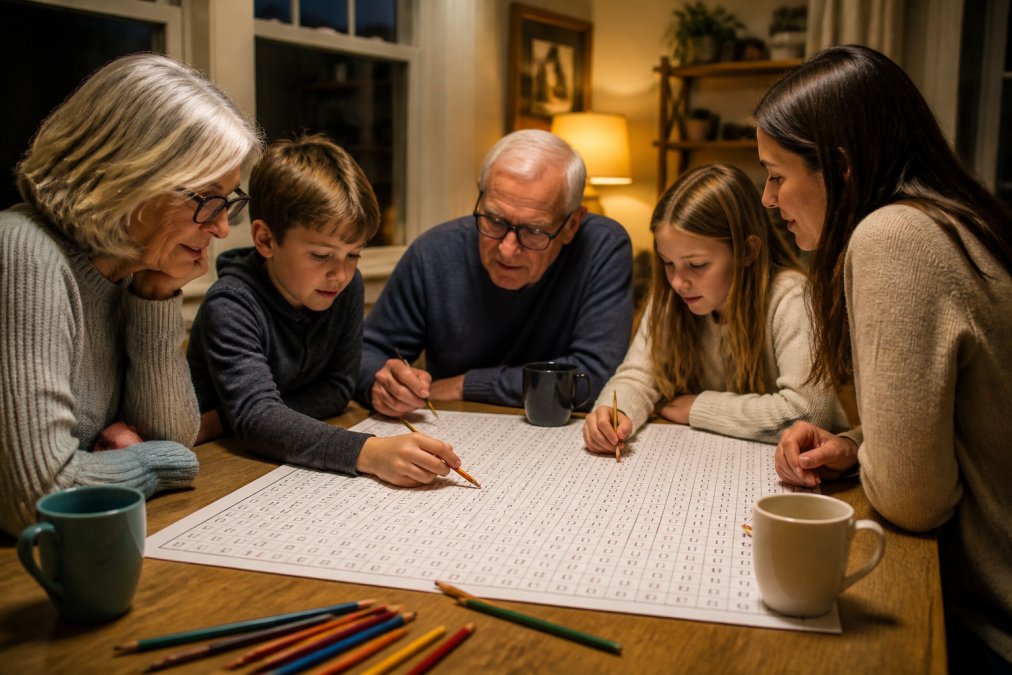
A multi-generational puzzle night works when every age has a job. Grandparents sort edges, teens handle detailed sections, younger kids hunt colors and shapes, and someone owns the snack table. Nobody has to be good at puzzles to belong.
The hard part isn't the roles, it's the table. A two-year-old, a fifteen-year-old, and a seventy-five-year-old have different reach, patience, and grip strength, and one flat surface doesn't fit all three. The strategies below manage that shared space so no one gets squeezed out.
Total Time: 90 minutes Difficulty: Beginner
What You'll Need
- One large format puzzle (30" x 45" or larger)
- Colored pencils, markers, gel pens, or crayons
- A clear table or an empty wall section
- Sorting trays or shallow bowls
- Good lighting, ideally glare-free
- A stool or booster so shorter family members can reach the table edge
- A small side table for the youngest participants
Step 1: Pick the Theme Together [Time: 10 minutes]
Let each family member vote on a theme. Ownership matters more than the theme itself.
Expected Result: Everyone has a stake in finishing it.
Step 2: Set Up the Surface [Time: 10 minutes]
Clear the table or tape the puzzle to the wall. Keep the puzzle mat or tray nearby so you can roll it up mid-project.
Expected Result: A dedicated surface that doesn't have to be cleared for dinner.
Step 3: Assign Roles [Time: 5 minutes]
Sorters, edge-finders, color-hunters, and a designated photographer. Rotate roles each week.
Expected Result: No one sits idle, and no one dominates.
Step 4: Work in Shifts [Time: 45 minutes]
Aim for 45 minutes of active puzzling, then a break. Longer sessions lose younger kids.
Expected Result: Kids stay engaged rather than drifting off.
Step 5: Leave It Out [Time: 20 minutes]
Don't finish in one night. Leaving the puzzle up turns one activity into a week-long family project.
Expected Result: A reason to gather again tomorrow.
Making One Table Work for Toddlers, Teens, and Seniors
The single-table setup breaks down predictably: a toddler mouths the activity, a teen gets bored once the easy sections are gone, and a grandparent can't lean across a 45-inch surface. Each has a workaround.
For toddlers and preschoolers: Give them their own zone. A small side table with duplicate or spare pieces, or a separate large format puzzle, keeps them at the table without risking the main project. The goal is presence, not contribution; a booster seat so they can see over the edge matters more than what they're working on.
For teens: Teens disengage when a task feels babyish. Give them the hardest section, least color variation, most similar shapes, or the densest word list, and frame it as the part needing the most skill. No leaderboard means no way to lose, so no reason to opt out.
For seniors: Reach limits more than ability. Position the puzzle so their section is directly in front of them, and rotate seats between sessions so no one is stuck at the far end. Glare-free lighting matters more for older eyes, and a matte surface reduces reflections. Large format activities with high-contrast printing are easier to distinguish than fine-detail standard pieces.
For mixed mobility: If someone uses a wheelchair or has limited standing tolerance, a wall-mounted puzzle at seated eye level works better than a table. The same puzzle that lies flat one session can be taped up the next.
Managing the Pace
Different ages finish at different speeds, and that mismatch starts frustration. Two rules help:
- Never finish it without everyone. If the puzzle is close to done and younger kids are asleep, leave the last section for the next session. The finish is the shared payoff.
- Let the puzzle change hands. Rotate who works which section each session so no one owns a zone permanently. Ownership creates turf, and turf creates conflict.
A Note on Session Length
Ninety minutes is a reasonable target for a mixed-age group, but the real signal is attention, not the clock. When the youngest drifts, that's the cue to break. Ending on a high note makes everyone willing to come back.
What You'll Need
- One large format puzzle (30" x 45" or larger)
- Colored pencils, markers, gel pens, or crayons
- A clear table or an empty wall section
- Sorting trays or shallow bowls
- Good lighting, ideally glare-free
Step 1: Pick the Theme Together [Time: 10 minutes]
Let each family member vote on a theme. Ownership matters more than the theme itself.
Expected Result: Everyone has a stake in finishing it.
Step 2: Set Up the Surface [Time: 10 minutes]
Clear the table or tape the puzzle to the wall. Keep the puzzle mat or tray nearby so you can roll it up mid-project.
Expected Result: A dedicated surface that doesn't have to be cleared for dinner.
Step 3: Assign Roles [Time: 5 minutes]
Sorters, edge-finders, color-hunters, and a designated photographer. Rotate roles each week.
Expected Result: No one sits idle, and no one dominates.
Step 4: Work in Shifts [Time: 45 minutes]
Aim for 45 minutes of active puzzling, then a break. Longer sessions lose younger kids.
Expected Result: Kids stay engaged rather than drifting off.
Step 5: Leave It Out [Time: 20 minutes]
Don't finish in one night. Leaving the puzzle up turns one activity into a week-long family project.
Expected Result: A reason to gather again tomorrow.
Accessibility and Inclusion: Puzzles for Neurodivergent Family Members
Large format activities suit many neurodivergent family members because the task is visual, tactile, and self-paced. There's no timer, no verbal demand, and no eye contact required, making parallel activity a comfortable way to be together. For visual impairment, large format activities and high-contrast artwork matter more than piece count. For sensory sensitivity, choose a matte, glare-free surface and skip scented markers.
Puzzle Maintenance and Preservation: Making Your Investment Last
A finished activity lasts decades if you handle two things correctly: the surface it sits on and how you store it. Work on a clean, dry surface and keep drinks in lidded cups. For word searches and coloring sheets, let the finished piece dry flat before moving it, since marker and gel pen ink can transfer while wet.
- Before assembly: Wipe the table, and use a mat if the surface gets shared
- During assembly: Keep items in shallow trays rather than loose piles on the floor
- After finishing: Let ink dry completely, then press flat under a board for a day
- Long-term storage: Roll in a mat or store flat between two rigid boards
- Display: Frame it, or mount it on a wall with removable adhesive
Family traditions rarely come from big events. They come from the thing still on the table on a Tuesday night, half finished, waiting for someone to sit down. Cherry Creek Lane makes giant table-sized word search puzzles, coloring sheets, and wall-sized calendars designed for exactly that, all made in the USA and shipped from Utah, built to hold up to markers, crayons, and repeated use. Get started with Cherry Creek Lane and turn one cleared table into a tradition your kids will remember.

Frequently Asked Questions
What are large format puzzles?
Large format puzzles are oversized activities, like giant word searches or jigsaw puzzles, that measure 30 by 45 inches or more. They are designed to be spread out on a table or floor, allowing multiple people to work on them at once. Unlike standard puzzles, these large-scale versions encourage collaborative assembly and are perfect for family bonding, as they naturally accommodate several participants without crowding.
Are large piece puzzles better for families?
Large format activities offer distinct advantages for families, especially those with younger children or grandparents. They are easier to handle, creating a more inclusive experience and allowing everyone to participate comfortably. For families seeking screen-free family activities, large format activities provide a shared challenge that keeps everyone engaged.
How do puzzles help with family bonding?
Activities foster family bonding by creating a shared goal that requires cooperation and communication. Working together on a large format activity encourages teamwork, patience, and celebration of small victories. The activity promotes social interaction and screen-free time, allowing family members to connect without digital distractions. The benefits of large format activities for families include lasting memories built around a common task.
What is the best piece count for a family puzzle night?
The ideal activity depends on the ages and experience levels in your family. If you have younger children, consider a giant word search puzzle, which has no loose pieces and can be worked on collectively. The goal is to choose an activity that keeps everyone engaged without causing frustration.
Are giant coloring sheets a good alternative to puzzles?
Yes, giant coloring sheets are an excellent alternative, especially for families who prefer a more open-ended creative activity. Like large format puzzles, they encourage collaborative assembly and screen-free time. They are particularly great for younger children or those who may find puzzles challenging. Both options promote family bonding and can be enjoyed side by side, offering variety for different family preferences.