

Table of Contents
- Why Creative Indoor Activities Matter for Homeschooling Families
- Screen-Free Homeschooling Activities That Build Learning
- Hands-On Learning Activities for Homeschoolers
- Engaging Siblings of Different Ages in the Same Activity
- Giant Coloring Sheets and Maps: Educational Play That Works
- Budget-Conscious vs. Resource-Heavy Activity Options
- Neurodivergent-Friendly Indoor Activities
- Educational Documentaries and Literacy Building
Last Updated: August 29, 2026
Why Creative Indoor Activities Matter for Homeschooling Families
Creative indoor activities for homeschooling families do more than fill time. They build critical thinking, develop fine motor skills, strengthen family bonds, and create lasting memories. The difference between busywork and genuine learning comes down to intentionality: an activity that feels like play but teaches something real is worth its weight in gold for homeschooling parents juggling multiple ages and learning levels.
This guide covers 15 proven creative indoor activities for homeschooling families, organized by learning outcome and age compatibility. You'll find screen-free options that work for mixed-age groups, budget-conscious alternatives to expensive kits, and activities specifically designed for neurodivergent learners.
Screen-Free Homeschooling Activities That Build Learning
Screen-free homeschooling activities reclaim time for deep focus that builds competence. When kids aren't waiting for notifications, their brains settle into the work. Research shows hands-on learning activities for homeschoolers produce better retention than passive consumption: kids who color a map remember capitals better than kids who watch videos about them (peer-reviewed research).
Gameschooling and Board Games for Skill Building
Gameschooling uses board games as curriculum delivery. Games teach math through resource management, history through themed gameplay, and critical thinking through every decision. Ticket to Ride teaches geography and probability. Catan teaches negotiation and math. Splendor teaches economics and planning.
Start with games that match your kids' ages but allow everyone to play together. Many modern board games include variant rules for younger players, letting you keep everyone at the same table. Games create natural pause points, unlike screens, they have clear endings that help build healthy habits.
Art and Creative Expression Projects
Art is where abstract concepts become concrete. A child drawing a historical event internalizes details differently than one reading about it. Creative expression projects work best when open-ended: "Draw what you learned about the Civil War" produces more learning than coloring worksheets.
Combine art with other subjects. Illustrate writing assignments. Create visual timelines of historical events. Design posters about scientific concepts. These hybrid projects build both artistic skill and subject mastery simultaneously. Supplies don't need to be fancy, markers, colored pencils, watercolors, and paper are enough.
Sensory Play and Discovery Bins
Sensory bins engage kids of multiple ages by offering different levels of exploration. A younger child scoops and pours; an older child sorts by properties, counts, or creates patterns. A bin filled with dried beans, measuring cups, and funnels teaches volume and spatial reasoning (apa.org). Setup takes 15 minutes; engagement lasts an hour.
Rotate contents monthly and change themes with the season. Kids return to familiar bins with fresh eyes when contents change.
Hands-On Learning Activities for Homeschoolers
Hands-on learning activities create the bridge between abstract concepts and lived experience. When a child measures ingredients while baking, they're learning fractions. When they build a tower that doesn't fall, they're learning physics. The learning emerges naturally from the task.
Kitchen Chemistry and Practical Math
The kitchen is a natural classroom for both chemistry and math. Baking teaches ratios and precision. Simple experiments like vinegar and baking soda volcanoes or crystal growing produce immediate, visible results. Cooking projects that require real math, doubling recipes, halving recipes, adjusting cooking times, teach proportional reasoning (nctm.org). The motivation is intrinsic because kids eat the result.
Indoor Scavenger Hunts and Exploration
Indoor scavenger hunts work for mixed-age groups when designed with multiple difficulty levels. Give younger kids picture clues; give older kids riddles. Create thematic hunts that reinforce what you're studying: a history unit becomes a hunt for items representing different time periods; a geography unit becomes a hunt for countries on a map.
Scavenger hunts build observation skills, reading comprehension, and spatial awareness. Set a time limit to add urgency. Create a scorecard so kids track progress.
Building and Construction Activities
Building activities teach spatial reasoning, problem-solving, and persistence. Open-ended building is better than instruction-based building. Instead of following kit instructions, give kids challenges: "Build the tallest structure that won't fall over" or "Build a bridge that can hold this book."
Mix building materials to increase complexity. Combine blocks with cardboard tubes. Mix LEGO with wooden blocks. Document the building process with photos and have kids explain why their structure works.
Engaging Siblings of Different Ages in the Same Activity
The secret to engaging multiple ages is building in multiple entry points. Design activities where younger kids engage at a basic level and older kids engage at a complex level, but they're doing the same activity. A giant coloring sheet works because a 5-year-old can color large areas with markers while a 10-year-old adds fine details and shading.
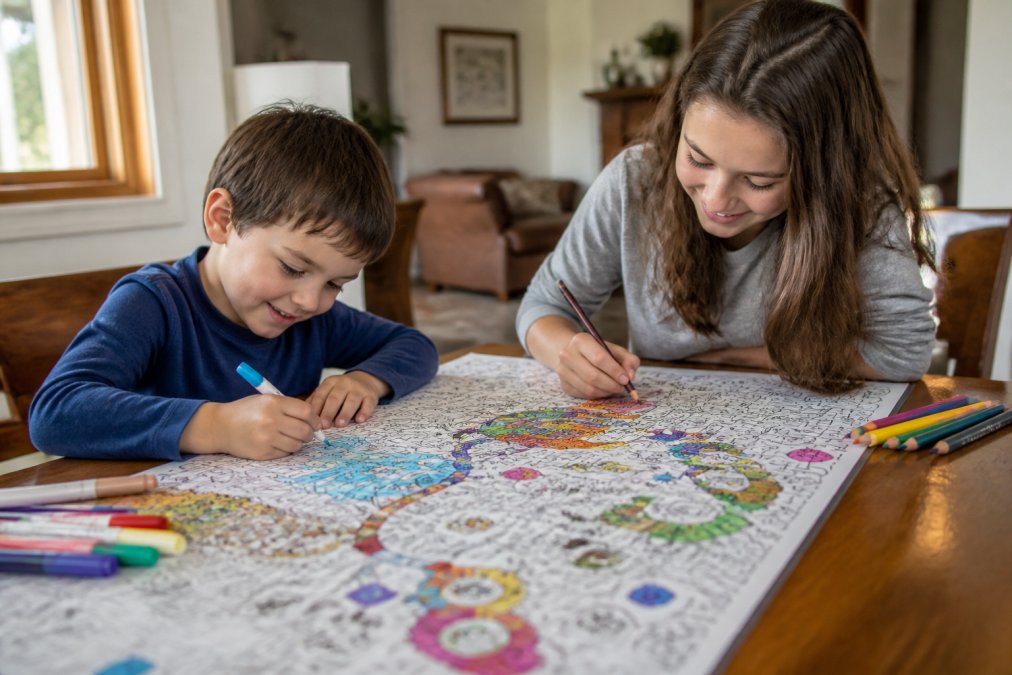
Table-based activities work better than floor-based ones for mixed-age groups. Everyone can see what everyone else is doing. Create roles within activities: in a building project, the younger child gathers materials while the older child designs. In a cooking project, the younger child measures dry ingredients while the older child handles the stove. Everyone contributes meaningfully.
Giant Coloring Sheets and Maps: Educational Play That Works
Giant coloring sheets transform a simple activity into something special. When a coloring sheet measures 30 by 50 inches, multiple kids can work simultaneously without running out of space. The scale changes everything.

Educational play through giant coloring sheets works because the format encourages learning. A map becomes geography study when a child finds and colors each country. A timeline becomes history study when a child illustrates each era. A scientific diagram becomes biology study when a child labels and colors each part.
Geography Coloring Maps for Mixed-Age Learning
Geography maps are the most versatile giant coloring sheets for homeschooling families. A world map works for elementary through high school. A child coloring the world map internalizes where countries are located and notices patterns in geography, coastlines, and mountain ranges.
Pair maps with curriculum. While studying a particular region, have kids color that region and research facts about it. Cherry Creek Lane offers the World Coloring Map and the United States & Capitals Coloring Map, both measuring 30 by 50 inches, allowing multiple children to work simultaneously.

Extend map coloring by adding research. Have kids write facts about each country or state they color. Create a legend showing what different colors represent.
Themed Activity Calendars for Year-Round Planning
Activity calendars serve double duty: they plan your year and become a coloring project. A monthly calendar with activity suggestions gives families structure while leaving room for flexibility. Themed calendars work better than generic ones, a fall calendar has autumn-specific suggestions; a winter calendar includes holiday activities.
The coloring component makes planning fun rather than administrative. Parents and kids color the calendar together and discuss which activities appeal to them. Cherry Creek Lane's Full Year Activity Calendar BUNDLE at $79.96 covers all four seasons. Individual seasonal calendars like the Spring Activity Calendar Coloring Banner at $19.99 work if you prefer to start mid-year.


Use calendars as launching points for family discussions. "Which activities do we want to try this month?" turns planning into a collaborative process.
Budget-Conscious vs. Resource-Heavy Activity Options
The best creative indoor activities for homeschooling families cost almost nothing. Budget-conscious activities use household items: scavenger hunts cost nothing, building with cardboard boxes costs nothing, cooking projects use ingredients you already have.
Resource-heavy activities invest in quality materials used repeatedly. Quality art supplies last longer and produce better results. Educational games are expensive upfront but provide years of use. Giant coloring sheets made from durable paper withstand repeated use.
The middle ground works best: invest in a few quality tools that get heavy use, and supplement with budget-conscious activities using what you have. A set of quality colored pencils and markers ($30-50) gets used constantly. A giant coloring sheet ($19.99) provides hours of engagement for multiple children. A board game ($25-40) gets played dozens of times.
Calculate cost per hour of engagement. A $20 activity that keeps three kids engaged for 5 hours costs about $1.33 per child per hour.
Neurodivergent-Friendly Indoor Activities
Neurodivergent kids often struggle with overstimulation, transitions, and unstructured time. Creative indoor activities that work for neurodivergent learners share common features: clear boundaries, sensory regulation, and flexible pacing.
Sensory bins work well because they provide controlled sensory input with no time pressure and no "right way" to do it. Building activities appeal to kids who need to move and create structure simultaneously. Giant coloring sheets work because they provide structure without pressure, a child can work for 10 minutes or 2 hours.
Games with clear rules work for kids who need predictability. Avoid activities with strict time limits, complex multi-step instructions, or pressure to produce a "finished" product. Neurodivergent kids thrive when the activity itself is the point.
Educational Documentaries and Literacy Building
Documentaries paired with follow-up activities become part of your curriculum. Watch a documentary about ocean ecosystems, then do an ocean-themed sensory bin. Watch a documentary about ancient Egypt, then create Egyptian art.
Literacy building happens through discussion and documentation. Have kids take notes while watching. Afterward, discuss what they learned. Create a poster or drawing about the topic. Write a summary or review. Pair documentaries with age-appropriate reading on the same topic.
| Activity Type | Best Age Range | Setup Time | Engagement Duration | Ideal Group Size |
|---|---|---|---|---|
| Gameschooling | 6+ | 5 minutes | 30-90 minutes | 2-4 kids |
| Art projects | 4+ | 10 minutes | 30-60 minutes | 1-3 kids |
| Sensory bins | 2+ | 15 minutes | 30-90 minutes | 1-4 kids |
| Kitchen chemistry | 5+ | 20 minutes | 30-45 minutes | 1-2 kids |
| Scavenger hunts | 5+ | 10 minutes | 20-45 minutes | 1-4 kids |
| Building activities | 3+ | 5 minutes | 30-120 minutes | 1-3 kids |
| Giant coloring sheets | 4+ | 2 minutes | 30-180 minutes | 1-4 kids |
| Geography maps | 6+ | 2 minutes | 45-180 minutes | 1-3 kids |
| Activity calendars | 5+ | 5 minutes | 30-90 minutes | Family |
| Board games | 6+ | 5 minutes | 30-90 minutes | 2-4 kids |
Creative indoor activities for homeschooling families don't require elaborate setup or expensive materials. They require intentionality about what you're trying to build: engagement, skill development, family connection, or all three. The activities that work best feel like play to kids but deliver real learning to parents.
Start with one or two activities from this list. Notice which ones your kids return to without prompting. Those are your winners. Build your rotation around those, and add new activities as you find gaps.
At Cherry Creek Lane, we've built our entire product line around this problem: giant, table-sized coloring sheets and activity calendars that bring families together around a single project. Whether you're looking for a rainy-day solution or a curriculum supplement, screen-free creative indoor activities for homeschooling families deliver both engagement and learning. Explore our activity calendars and geography maps to find the right fit for your family's needs. Shop Coloring Sheets today and create the kind of moments your kids will remember.
Frequently Asked Questions
Will a giant coloring sheet keep siblings of different ages engaged at the same time?
Yes. Giant coloring sheets work well for mixed ages because each child can work on different sections simultaneously without competing for space. A 50-inch sheet gives room for multiple children to color independently while still feeling like a shared activity. Younger children can focus on larger areas with bold colors, while older kids tackle intricate details. This setup reduces conflict and keeps everyone engaged for hours.
What makes screen-free homeschooling activities better than digital learning?
Screen-free activities build fine motor skills, encourage creative problem-solving, and foster deeper family connection. Hands-on learning creates stronger memory retention because children actively engage with materials rather than passively consuming content. Plus, these activities naturally promote conversation and collaboration without the distractions of notifications or screen fatigue.
How can I integrate hands-on learning activities into my homeschool curriculum?
Use hands-on activities as curriculum supplements that reinforce core subjects. Kitchen chemistry teaches scientific method and measurement. Coloring maps like the United States & Capitals Coloring Map turn geography lessons into discovery-based learning. Building projects teach spatial reasoning and physics concepts. Board games develop math skills and strategy. The key is aligning activities with your learning objectives so they feel purposeful rather than purely recreational.
Are homemade activities just as good as purchased coloring sheets and calendars?
DIY alternatives can work but come with trade-offs. Printing and taping regular paper together takes time and creates smaller surfaces. Giant coloring sheets from Cherry Creek Lane measure 50 inches by 30 inches, offering significantly more collaborative space and durability for markers and crayons. Professional sheets use high-quality paper that withstands extended use, while printed pages tear easily. For busy homeschooling families, the time saved and extended engagement often justify the investment.
What indoor activities work best for neurodivergent learners?
Neurodivergent children often thrive with sensory-rich, low-pressure activities. Giant coloring sheets provide tactile engagement without rigid expectations. Sensory bins offer exploration without time limits. Building activities allow for repetitive, focused work. Activities with clear visual structure, like unit studies paired with themed coloring calendars, help children understand expectations. Avoid overstimulation by offering quiet spaces and allowing breaks. Many neurodivergent learners excel with hands-on, project-based learning over traditional instruction.
This article was written using GrandRanker