

Table of Contents
- Why Family Traditions for Screen Free Living Matter More Than Ever
- 6 Screen-Free Activities for Siblings of Different Ages
- How to Implement a Digital Detox for Families: A Step-by-Step Plan
- Creative Family Bonding Activities for Weekday Evenings
- Building a Screen-Free Zone: Spaces That Encourage Connection
- Troubleshooting Screen-Free Transitions and Tantrums
- Conclusion: Small Steps Toward a Device-Free Family Culture
- Frequently Asked Questions
Last Updated: September 5, 2026
Why Family Traditions for Screen Free Living Matter More Than Ever
Family traditions for screen free living are the intentional rituals and recurring activities a household uses to replace device time with connection, creativity, and presence. The average child spends a significant portion of their waking hours in front of screens, leaving little room for the unstructured play and face-to-face interaction that builds social-emotional learning and family bonding (aap.org).
The real problem is not the screen itself but the default habit of reaching for it. When you build a tradition, you remove the daily negotiation over screen time limits because the alternative becomes the expected rhythm of the day.
6 Screen-Free Activities for Siblings of Different Ages
The biggest mistake parents make is assuming one activity must fit every child perfectly. Screen-free activities for siblings work best when they offer different entry points for different developmental stages, allowing a toddler to color while a tween searches for words.
A giant word search puzzle laid flat on the dining table is a strong option. A three-year-old can color the large letters while a seven-year-old hunts for the hidden words, each engaged at their own level without fighting over space. This works because it respects the different cognitive and fine-motor skills at play.

Here is how to adapt a shared activity for specific age groups, based on common developmental milestones:
- Toddlers (Ages 1-3): Their engagement is sensory and parallel. They are not ready for rule-based games. For a shared puzzle, their role is to handle the pieces, stack them, or color on the edge of the sheet. The goal is not completion but the experience of being near the family. A bin of dried beans or large, safe objects to sort is a better fit than a structured game.
- Early Elementary (Ages 4-7): This group is developing rule-following and turn-taking. They can handle a simple word search with large, picture-based clues or a matching game. They thrive on being the "helper", give them the job of finding the first letter of each word or holding the dictionary. Their fine motor skills are ready for chunky crayons and markers, not fine-tipped pens.
- Tweens (Ages 8-12): They crave autonomy and mild competition. They can handle complex puzzles, strategy games, and longer projects. For a shared art project, they can take ownership of a complex section or create a legend for the group. They are also capable of leading a younger sibling, which builds their sense of responsibility.
- Teens (Ages 13+): Their primary need is social connection and a sense of competence. They may resist a "family activity" but will engage if it feels like a low-pressure hangout. A complex puzzle they can work on while listening to music, or a collaborative project like building a model, works better than a directed craft. The key is to make their participation optional and not to force a teaching role on them.
A single activity fails not because it is boring, but because it demands a level of skill or patience that one child does not yet have. Design the activity with a "low floor, high ceiling", easy to start, but with room for complexity.
- Sensory play stations: Set up a bin of dried beans for the little one while older siblings build a LEGO scene nearby. This is not separate play; it is parallel play in the same room, which builds a sense of togetherness without requiring interaction.
- Nature exploration: Send everyone outside with a simple checklist; younger kids collect leaves, older kids photograph or sketch them. For teens, add a challenge: identify the species using a field guide app (which is screen-based, but the focus is the outdoor task).
- Creative play with a shared canvas: A single table-sized coloring sheet invites everyone to work on the same project from different sides. For older kids, the challenge is to create a cohesive design; for younger ones, it is to stay inside the lines.
American Academy of Pediatrics guidance on healthy media use highlights that co-viewing and shared activities help children process what they experience, making a shared project more valuable than individual play. The key is to match the complexity of the task to the child's developmental stage, not just their age in years.
How to Implement a Digital Detox for Families: A Step-by-Step Plan
A digital detox for families fails when it is announced as a punishment rather than introduced as an adventure. The goal is not to eliminate screens entirely but to reclaim specific windows of time for family connection. But there is a deeper reason most detoxes fail within two weeks: the parents. You can build the perfect device basket and plan the perfect game night, but if you are still glancing at your phone, the tradition will not stick.
Parents are often more addicted to their devices than their kids are. We use our phones for work, for social connection, for a sense of control, and for a break from the emotional labor of parenting. When you announce a digital detox, you are asking your children to do something you are not prepared to do yourself, breeding resentment and rebellion.
Here is a step-by-step plan that explicitly addresses the parent's role in the detox:
Step 1: Pick a recurring anchor. Choose one evening per week, such as Friday dinner or Sunday afternoon, and declare it device-free. Consistency matters more than frequency. Before you announce it to the kids, have a conversation with your partner (or yourself) about what you will do with your hands and your mind during that time. The urge to check your phone is not about boredom; it is about a lack of a replacement behavior.
Step 2: Create a device basket, and put your phone in it first. Designate a physical spot where every phone and tablet rests during the anchor time. Out of sight reduces the urge to check. When you place your own phone in the basket first, you signal that this rule applies to everyone, not just the children. If you are not willing to put your phone in the basket, do not start this tradition.
Step 3: Prepare a menu of options, for you, not just the kids. Have three or four activities ready, such as a family game, a giant crossword, or a walk around the block. Also plan what you will do when the kids are engaged and you feel the urge to check your email: read a magazine, work on a puzzle yourself, or simply sit and observe your children. The discomfort of doing nothing is a withdrawal symptom; it passes in about 15 minutes.
Step 4: Start small, and schedule a "parent check-in" for the end. Begin with 60 minutes and extend as the habit takes hold. A full weekend detox is overwhelming for most families. After the first session, take five minutes to debrief with your partner. What was the hardest part for you? Did you feel anxious? Did you reach for your phone out of habit? Naming these feelings is the first step to overcoming them. This is not about perfection; it is about awareness.
Step 5: Model the behavior, and apologize when you fail. Parental modeling is the strongest predictor of whether kids embrace unplugging (peer-reviewed research). If you check your phone, they will check theirs. But you will slip up. When you do, say out loud: "I just realized I grabbed my phone out of habit. I am putting it back in the basket." This is not a failure; it is a teaching moment. Your children learn that breaking a habit is a process, not a single event.
A digital detox is not a punishment for your children; it is a gift to yourself. It is a chance to be fully present, to model a healthy relationship with technology, and to remember that your worth is not measured by your inbox. The most successful families treat the detox as a shared challenge, with the parents leading by example and admitting their own struggles.
Creative Family Bonding Activities for Weekday Evenings
Weekday evenings are short, so the activity must be easy to set up and clean up. Creative family bonding activities that involve a single shared object work best because they require no preparation and no per-child materials.
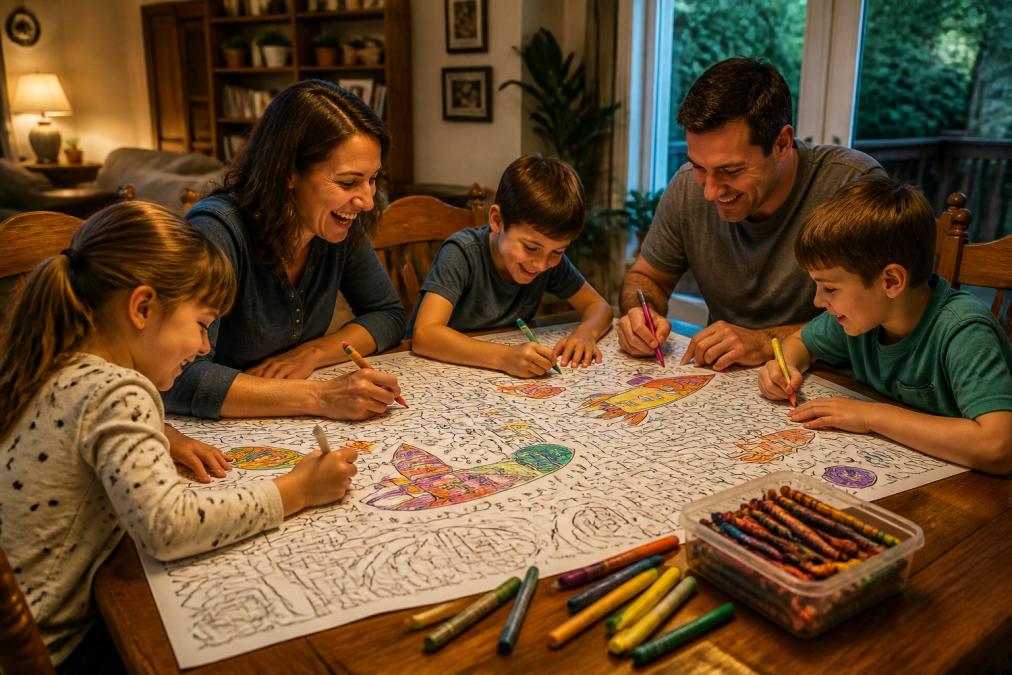
A table-sized coloring sheet from Cherry Creek Lane turns a Tuesday night into a collaborative art project. Each person claims a corner, and the conversation flows while hands stay busy. The same sheet can live on the table for a week, becoming a slow-burning project that kids return to between homework and dinner.
For families that prefer words over art, a giant word search puzzle hung on the wall offers a different kind of engagement. Kids can work on it standing up, burning off energy while they hunt for terms. This works especially well for homeschooling parents managing mixed-age groups, since everyone can participate at their own pace.
Let the project stay out overnight. The visual reminder of a half-finished puzzle or a partially colored scene pulls kids back to the table and away from the tablet without a single reminder from you.
Building a Screen-Free Zone: Spaces That Encourage Connection
A screen-free zone is a physical area in your home where devices are not allowed, designed to make connection the default activity. The goal is not to ban screens everywhere but to create one corner where family culture can breathe.
The dining table is the most natural screen-free zone. When you spread out a giant activity sheet or a puzzle, the table transforms from a place where meals happen into a place where family rituals happen. The kitchen island, a reading nook with a basket of books, or a corner of the living room with a dedicated game shelf all work equally well.
The key is to make the zone inviting. Add a set of markers in a cup, a stack of puzzles, and comfortable seating. Coziness signals that this space offers something better than a screen. When the zone is ready, introduce the rule simply: when we are in this space, we are present with each other. This supports intentional parenting by making the choice visible rather than negotiated.
Troubleshooting Screen-Free Transitions and Tantrums
The transition from a screen to a screen-free activity is the moment when most traditions die. Behavioral regulation is hard for young children, and withdrawal from a stimulating device often produces tears, whining, or outright refusals.
The most effective fix is to give a warning and a choice. Ten minutes before the transition, say, "In ten minutes, we are putting the tablet away and pulling out the giant puzzle. Do you want to start on the letters or the pictures?" The choice gives the child a sense of control and shifts their focus to the upcoming activity.
If the tantrum still comes, do not negotiate. Acknowledge the feeling, hold the boundary, and start the activity yourself. When you begin coloring or searching for words, curiosity usually pulls the child in within a few minutes. Consistency across repeated transitions is what teaches the brain that screen time ends and that something enjoyable follows.
Conclusion: Small Steps Toward a Device-Free Family Culture
Building family traditions for screen free living does not require a radical overhaul of your home. It requires one anchor, one shared activity, and the willingness to repeat it until it becomes the expected rhythm of your week. The families who succeed start small and stay consistent.
At Cherry Creek Lane, we create the tools that make those moments easy. Our giant, table-sized coloring sheets and word search puzzles are made in the USA and shipped from Utah, designed to bring multiple generations around one table with crayons, markers, and conversation. Whether you are looking for a monthly subscription to keep the tradition fresh or a single puzzle for game night, the goal is the same: little moments your kids will actually remember.
Frequently Asked Questions
What are 5 examples of family traditions?
Five simple family traditions for screen free living include a weekly game night with board games or puzzles, a Friday family movie night with homemade popcorn, a Sunday nature walk, a daily device-free dinner conversation ritual, and a monthly creative project like working on a giant table-sized coloring sheet together. The key is consistency and choosing activities everyone genuinely enjoys.
What is the 7 7 7 rule for parents?
The 7-7-7 rule is a simple guideline for intentional parenting. It suggests taking a 7-day vacation (without work or screens), a 7-minute conversation with each child every day, and a 7-date night with your partner each year. It's a framework for prioritizing family connection in a busy schedule.
How do you start a screen-free tradition with toddlers?
Start with short, sensory-based activities that match their attention span. A 10-minute reading ritual before bed, a morning dance party, or a simple 'let's find all the red things' scavenger hunt around the house works well. Consistency matters more than duration. Keep a basket of special books and toys that only come out for your screen-free time to make it feel exciting.
How to engage siblings of different ages in screen-free activities?
Choose activities with open-ended roles. A giant word search puzzle lets older kids hunt for words while younger ones color in the letters. Building a fort works for all ages with different jobs. For creative projects, give each child a specific task that matches their skill level, like tracing for older kids and coloring for younger ones. The goal is shared space, not identical tasks.
What is the 3-6-9-12 rule for screen time?
The 3-6-9-12 rule is a guideline from French psychiatrist Serge Tissot. It recommends no screens before age 3, no handheld consoles before age 6, no internet use before age 9, and supervised internet use starting at age 12. While many families adapt it, the rule is a helpful starting point for setting screen time limits that prioritize developmental benefits and real-world play.
What are the benefits of screen-free family time?
Screen-free family time builds stronger family bonding and improves communication. Kids develop social-emotional learning skills like patience, sharing, and reading non-verbal cues. Creative play and reading strengthen problem-solving and language development. Regular device-free time also helps with behavioral regulation and creates lasting memories of family rituals rather than passive consumption.
The challenge is not finding time away from screens; it is making that time feel more appealing than the screen. Start with one evening, one table, and one giant sheet of paper. Get started with Cherry Creek Lane and give your family the gift of having fun together.
Common Sense Media research on children's media use CDC guidance on physical activity for children
This article was written using GrandRanker