

Table of Contents
- Why Large Age Gaps Change Indoor Play
- Matching Activities to Developmental Stages
- Collaborative Crafts for Mixed-Age Siblings
- Indoor Team-Building Games for Kids of Different Ages
- How to Foster Sibling Connection Without Forcing It
- Digital and Tech-Based Collaborative Play
- Common Mistakes When Planning Indoor Activities
- Frequently Asked Questions
Last Updated: September 12, 2026
Why Large Age Gaps Change Indoor Play
A four-year gap changes everything about a rainy afternoon: the games that thrill a three-year-old bore a nine-year-old within minutes, and the reverse is just as true. This guide from Cherry Creek Lane covers indoor activities for siblings with large age gaps, bridging that gap without splitting into separate rooms. The core problem isn't a shortage of activities, it's that most activity lists assume everyone is roughly the same age.
Parallel play is the developmental stage where young children play beside each other rather than with each other. It's normal for toddlers and is the foundation for later cooperation: when a toddler stacks blocks next to a tween building a model, both work at their own level while sharing space.
The American Academy of Pediatrics guidance on play notes that play is how children build cognitive, physical, and social skills at every stage. That means the goal isn't forcing shared activity. It's designing shared space.
Matching Activities to Developmental Stages
The best mixed-age activity has layers: a simple base task for younger children and an open-ended extension for older ones. Match the activity to the youngest child's ability, then add complexity upward.
A few rules of thumb:
- Toddlers need large materials and short attention windows
- Preschoolers thrive on simple rules and repetition
- School-age kids want a challenge, a role, or a score to beat
- Tweens and teens stay engaged when they're the expert or helper
This matters for sibling dynamics. When the older child becomes the helper rather than the competitor, the power struggle eases.
Collaborative Crafts for Mixed-Age Siblings
Collaborative crafts for mixed-age siblings work best when they're big enough to share and open enough to personalize. A single small coloring page invites a fight over space; a table-sized sheet removes that argument entirely. A toddler can scribble freely in one corner while an older sibling works a detailed section, and nobody's elbow is in anybody's way.
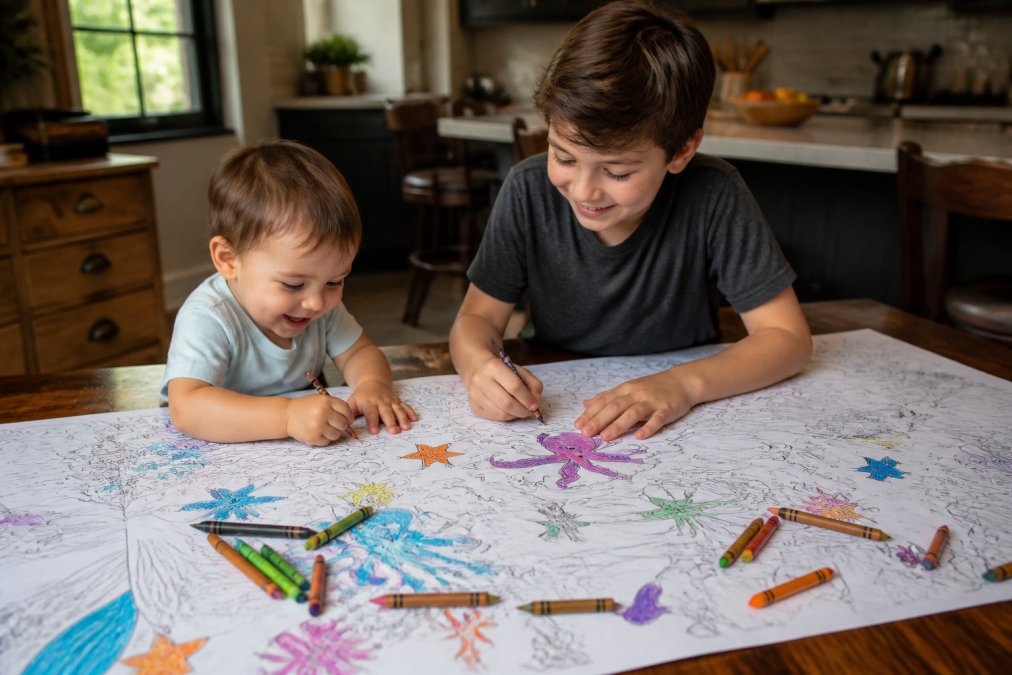
Giant Coloring Sheets That Work for Toddlers and Tweens
A 30"x50" sheet keeps both a three-year-old and a nine-year-old busy because there's room for two completely different approaches on one shared canvas: little hands get bold open shapes, older kids get fine detail and letter practice (healthychildren.org).
Cherry Creek Lane's ABC 123 Table Size Coloring Sheet gives toddlers big letters and numbers to color while older siblings can work on the finer lines. The Zentangle Mandala Table Size Coloring Sheet is the opposite: intricate enough that a tween stays absorbed, with enough open space that a younger sibling can still join in.


For animal-loving pairs, the Jungle Trace & Color Coloring Sheet adds a tracing and writing layer that older kids genuinely enjoy. Each sheet is $19.99 and made in the USA.

Budget-Friendly DIY Kits From What You Already Own
You don't need to buy anything to run a mixed-age craft session. A DIY kit from the recycling bin works fine:
- Cardboard box city: toddlers paint big shapes, older kids cut windows and plan roads
- Collage jar: everyone adds scraps, fabric, and old magazine pages to one shared container
- Tape mural: lay butcher paper on the floor and let each child claim a zone
The trick is one shared project with individual zones. That's how collaborative projects avoid the turf war.
Indoor Team-Building Games for Kids of Different Ages
Indoor team-building games for kids work when every player has a job that matches their level. The mistake most families make is picking a game with one win condition, then asking a toddler and a tween to compete for the same prize, which guarantees the older child either dominates or disengages. The fix is a layered game: one shared objective, two difficulty tracks. Here's how that plays out indoors.
- Blanket fort build. The toddler hauls pillows and holds corners; the older child engineers, which chair anchors the roof, where the blanket sags, how to keep the cat out. Give the older child a clipboard to sketch the build first. One contribution is physical and immediate, the other is planning and problem-solving, so neither feels like the helper.
- Indoor scavenger hunt. Run two clue sets in the same hunt: younger kids get picture cards or color-and-shape prompts ("find something round and blue"), older kids get written riddles or a small cipher. Hide both sets in the same rooms so the pair moves together but each child solves at their own level. Letting the older child read the younger child's picture card aloud turns the age gap into an asset.
- Cooperative board games. Choose titles where players win or lose as a group. The mechanic that matters for mixed ages is asymmetric roles: one player has a simpler action each turn, another a more complex one, and both are needed to beat the board. Treat the age rating as a floor, not a ceiling, a game rated 4+ often still engages a 9-year-old if the puzzle is genuinely hard.
- Story relay. Each person adds one sentence, youngest first. The rule that keeps it fair: the older child cannot undo or "fix" what the younger child said, whatever the toddler invents becomes canon. That forces the older child to build on a premise they didn't choose, the same creative muscle used in writing and improv.
- Obstacle course. Older kids design it, younger kids run it. The design phase keeps the older child engaged, measuring distances, deciding which cushions are safe to jump on, setting a timer, while the running phase gives the younger child a physical outlet. Swap roles on the second run.
A scavenger hunt is the most adaptable of these because you can hide pictures for a toddler and written clues for a tween in the same hunt, and the two tracks never compete for the same object.
The 20-Minute Reset Rule
Mixed-age games fall apart when one child finishes early, so build in a reset point every 20 to 30 minutes. When the timer goes off, everyone stops, drinks water, and the older child picks the next round's twist (a new hiding spot, a harder riddle, a rule change). That prevents the older child from quitting out of boredom and the younger child from melting down when the game ends abruptly.
How to Foster Sibling Connection Without Forcing It
Connection grows from repeated low-pressure moments, not from a parent announcing "now play together nicely." Forced togetherness usually produces resentment.
What works instead:
- Let the older child opt out sometimes, without guilt
- Create rituals, like a Friday coloring session, rather than marathon playdates
- Praise cooperation you catch in the moment, not just the outcome
- Keep activities available rather than scheduled
The Zero to Three resources on sibling relationships explain that sibling bonds build through everyday shared experiences over years, not single big events.
Conflict Resolution Scripts for Shared Play
Give kids actual words to use before a fight starts. A simple script works better than a lecture:
"I'm using this part right now. You can have it when I'm done, or you can use that part." "Let's make a line down the middle so we both have space." "I don't like when you grab. Ask me first."
Practice these when everyone's calm. Kids who have the words use them.
Digital and Tech-Based Collaborative Play
Screens aren't the enemy; solo screens are. The goal is shared-screen indoor activities for siblings with large age gaps, where two kids work on one thing together, a tablet or console can genuinely hold a 4-year-old and a 10-year-old at once. It works because of asymmetric difficulty: a well-designed co-op game gives each player a different, unranked job. One player might steer while the other manages inventory, or read the puzzle while the other moves the character. Neither role is "the baby role", the same principle behind a layered craft project, delivered through a screen.
Here is what actually holds up across a large age gap:
- Local co-op console games. Look for two-player same-screen titles with per-player difficulty and drop-in/drop-out, so the younger child can leave and rejoin without ending the session, that prevents the meltdown when a toddler wanders off mid-level.
- Stop-motion video together. One child moves the figures, one taps the shutter; free phone or tablet apps do this. Give the younger child the physical job (moving the toy) and the older child the technical job (framing the shot, adjusting the speed). The finished video is a shared artifact both kids will want to show someone.
- Family playlist building. Each child picks songs and the older child sequences them, with no vetoes on the younger child's picks. It's a low-stakes way to practice turn-taking that produces something the whole family uses in the car.
- Video-calling a grandparent to show off a finished craft. The older child can run the camera and the younger child can hold the object. Both are on screen, both are talking, and the call has a purpose beyond chatting.
- Collaborative drawing apps. Look for apps that let two people draw on the same canvas from two devices, or one device passed back and forth. The shared canvas removes the "you ruined my drawing" problem because each child works in their own area.
The One-Screen Rule
The single rule that keeps digital play collaborative: one screen, two players, one goal. Separate devices and separate games mean parallel isolation, not shared play; one screen working toward one outcome is the digital equivalent of a table-sized coloring sheet. A common pattern is to set a 30-minute window, pick the game together before the timer starts, and stop when it ends, deciding the stopping rule in advance removes the argument between the older child who wants to keep going and the younger one who wants to restart.
Common Mistakes When Planning Indoor Activities
The biggest mistake is choosing an activity that only suits one child, then expecting the other to tolerate it. That's a recipe for a meltdown, not family bonding.
Other frequent missteps:
- Buying one of everything instead of one shared thing
- Scheduling activities back-to-back with no downtime
- Expecting a toddler and a tween to sustain the same activity for the same length of time
- Skipping supervision during sensory bins or playdough, then dealing with the mess and the fight
A quick reference:
| Mistake | Fix | Why It Works |
|---|---|---|
| One-size activity | Layered activity with zones | Each child works at their level |
| Forced sharing | Separate spaces on one project | Removes turf conflict |
| No roles assigned | Give each child a job | Older kids stay engaged |
| Marathon sessions | 20-30 minute blocks | Matches attention spans |
| Buying separate toys | One shared large-format activity | Creates a shared goal |
Rainy days expose the real challenge of a large age gap: two kids who need completely different things from the same afternoon. The fix isn't more activities. It's activities with room for both.
Cherry Creek Lane builds exactly that kind of shared space. Our table-sized coloring sheets spread wide enough for a toddler's scribbles and a tween's detail work at the same time, printed on heavy paper that holds up to markers and crayons. Every sheet is made in the USA and shipped from Utah, and our monthly themed subscription keeps a fresh activity ready before the next rainy day arrives. Get started with Cherry Creek Lane and turn one table into a project both kids are proud of.
Frequently Asked Questions
What is considered a large age gap between siblings?
Most child development specialists consider a gap of four or more years to be large, though some parents use five years as the benchmark. The gap matters because siblings more than four years apart rarely share the same toys, shows, or physical abilities. That said, a large age gap does not mean siblings cannot play together indoors. It means activities need to be adaptable, with roles that suit each child's developmental stage.
What are some low-prep indoor activities for siblings with large age gaps?
Giant coloring sheets, indoor scavenger hunts, fort building with blankets, and cooperative board games all require almost no setup. A table-sized coloring sheet, for example, lets a toddler scribble freely while an older sibling works on detailed sections without either feeling crowded out. Sensory bins filled with rice or playdough also work because each child can engage at their own level with no instruction needed.
How do you keep a toddler and a teenager entertained together indoors?
Give the teenager a leadership role rather than a playmate role. Teens respond well when they are the game master, the fort architect, or the one hiding scavenger hunt clues for a younger sibling. Collaborative crafts also work if the project has room for different skill levels, such as a large coloring sheet where the teen handles detailed areas and the toddler fills in big shapes. The key is shared purpose, not shared ability.
How can I encourage bonding between siblings with a 5+ year age gap?
Build small, repeated rituals rather than one big activity. A ten-minute shared coloring session after dinner, a weekly indoor scavenger hunt, or a Saturday morning fort-building routine gives siblings something to look forward to together. Research on sibling dynamics shows that shared positive experiences, not forced togetherness, drive closeness. Let the older child choose the theme sometimes, and let the younger one lead others.