

Table of Contents
- The Verdict: Why Puzzle Games Are a Top Choice for Family Bonding
- The Benefits of Screen-Free Family Activities
- Best Large Puzzles for Families: What to Look For
- Tips for Organizing a Family Puzzle Marathon
- How Puzzle Games Build Critical Thinking and Teamwork
- Navigating Conflict and Building Patience During Gameplay
- Making Puzzle Games Work for Every Family Member
- Conclusion: Building Memories One Puzzle at a Time
- Frequently Asked Questions
Last Updated: September 28, 2026
The Verdict: Why Puzzle Games Are a Top Choice for Family Bonding
Yes, puzzle games are good for family bonding: they give everyone a shared goal and a reason to talk. This review from Cherry Creek Lane covers the benefits, the best large puzzles for families, and how to run a puzzle night that does not end in tears.
The Benefits of Screen-Free Family Activities
Screen-free family activities replace passive consumption with active participation, and a puzzle on the table invites conversation in a way a television does not.
- Communication skills develop when family members explain their thinking out loud
- Emotional regulation improves as players practice waiting their turn and losing a piece without melting down
- Quality time becomes something you do together, not something that happens in the same room
- Intergenerational bonding works because a grandparent and a seven-year-old can solve the same puzzle at different speeds
Best Large Puzzles for Families: What to Look For
The best large puzzles for families are big enough for several people to work on at once. Size matters most, followed by durability and theme.
Why Size Matters for Group Play
A standard 500-piece jigsaw on a coffee table forces four people into a space built for one, and the youngest gets crowded out. A large-format puzzle spreads the work so there is room for every pair of hands.
Top Picks for Every Age and Interest
Matching the theme to the people at your table does more for engagement than any other choice, a topic your kids already love gets them to the table faster.
| Puzzle | Best For | Price |
|---|---|---|
| Board Games Giant Word Search Puzzle | Game-loving families | $19.99 |
| Around The World Giant Word Search Puzzle | Curious kids and homeschoolers | $19.99 |
| Bugs Giant Word Search Puzzle | Younger children and nature fans | $19.99 |
| Camping Giant Word Search Puzzle | Outdoor families and cabin trips | $19.99 |
| Basketball Giant Word Search Puzzle | Sports-obsessed teens | $19.99 |
| Christmas Giant Word Search Puzzle | Holiday gatherings | $19.99 |
Tips for Organizing a Family Puzzle Marathon
A family puzzle marathon works best with a time limit, loose roles, and a planned break. The goal is a few good hours together, not an endurance test.


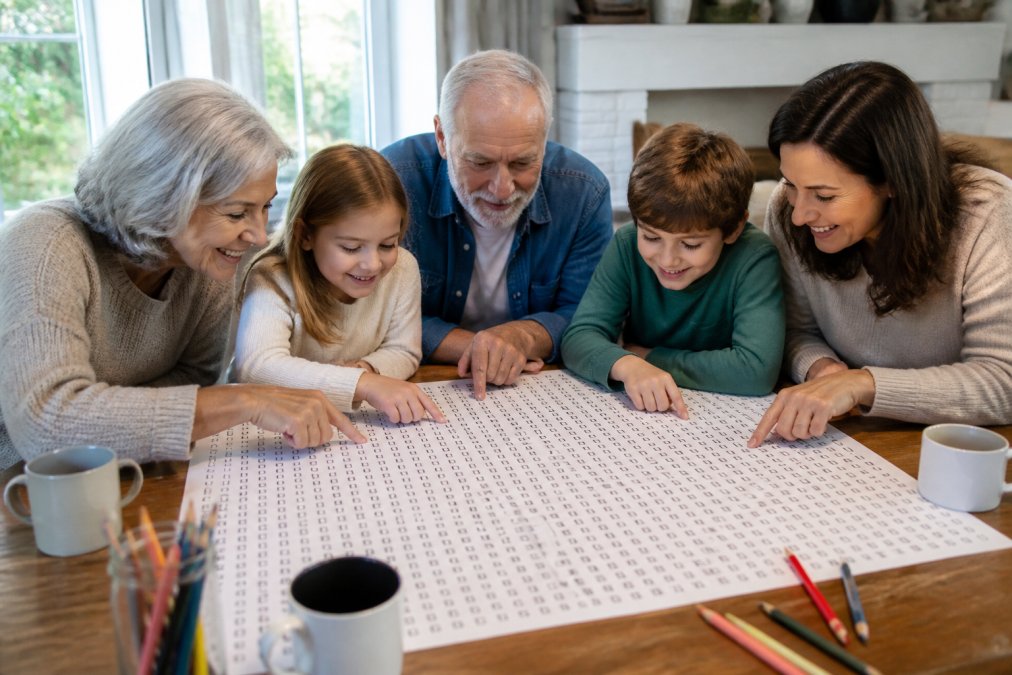
Here is a sequence that holds up in practice:
- Pick a theme everyone agrees on the day before, not the day of
- Clear the table completely and lay the puzzle flat or mount it on the wall
- Set out separate supplies so no one is sharing a single marker
- Assign light roles: one person reads clues, one hunts, one colors found words
- Plan a snack break at the halfway mark to reset attention
- Photograph the finished puzzle before you take it down
How Puzzle Games Build Critical Thinking and Teamwork
Puzzle games build critical thinking by forcing players to hold several possibilities in mind and test them against what they can see, the skill behind logical reasoning and strategy.
Navigating Conflict and Building Patience During Gameplay
Conflict during gameplay is normal, and how you handle it teaches more than the puzzle does. Two kids reaching for the same word is a chance to practice turn-taking, not a reason to end the night.
A Script for the First Ten Minutes
Setting expectations before the first clue is found does more than any rule imposed mid-game. Try language like:
- "Everyone gets a section. You are not competing with your brother; you are competing with the puzzle."
- "If you feel yourself getting hot, you can take a lap around the kitchen. The puzzle will still be here."
- "We stop when the timer goes off, not when someone wins."
Handling the Sore Loser in Real Time
When a child melts down because someone else circled a word first, name the feeling and redirect the effort:
- Acknowledge without rewarding. "It is frustrating to almost find it. That was a good scan."
- Reassign, do not punish. Give the upset player the clue-reading role for the next five minutes. It restores status and keeps them at the table.
- Separate the person from the outcome. "You did not lose. Nobody lost. We are all still on the same team."
- Reset the clock. A two-minute snack or water break changes the emotional temperature faster than a lecture.
Patience Is a Skill You Can Practice
Patience and persistence are the real skills here, and they are trainable. A puzzle that takes three sessions teaches a child that unfinished work is not failed work, a lesson that transfers to homework and chores.
A few concrete ways to build the muscle:
- Use a visible timer. Twenty-minute blocks with a five-minute break match the attention span of most elementary-age kids better than an open-ended session.
- Track effort, not output. A tally of "words I searched for" rewards the scanning work, not just the find.
- Let a session end unfinished on purpose. Leaving a puzzle half-solved overnight and returning to it the next day is the single best demonstration that persistence pays off.
Making Puzzle Games Work for Every Family Member
Making puzzle games work for everyone means adjusting the format rather than excluding the person who struggles. A few changes open the table to almost any family member.
Accessibility and Neurodiversity Considerations
Large-format puzzles are often easier for kids with fine motor challenges, because the pieces and letters are bigger and less precision is required. A word search on a 30" x 43.5" sheet lets a child circle a word with a broad marker stroke instead of a careful pencil line, removing the handwriting barrier that ends participation for many kids.
Board Games Giant Word Search Puzzle →
-
Chunk the work. Assign three words at a time instead of the whole list. A short, finishable unit beats a long, vague one.
-
Build in movement. Let the child stand, use a clipboard on the floor, or walk to the wall-mounted puzzle between finds.
-
Use color coding. Have each player circle in a different color so progress is visible and no one's contribution disappears.
-
Preview the plan. Show the puzzle and the timer before anyone sits down. Surprises are the enemy of a calm session.
-
Assign a defined role. Clue reader, word finder, or colorer. A named job reduces the ambiguity that makes group activities stressful.
-
Allow parallel play. Some kids do better working on their own section of the same puzzle rather than passing materials back and forth.
Mixed Ages, One Table
Families with mixed ages can share one puzzle by assigning different jobs: a non-reader colors the letters, a beginning reader hunts short words, an older sibling takes the longer ones, a grandparent reads clues aloud. Nobody needs a separate product, and nobody sits on the sidelines.
Balancing Budget-Friendly and Premium Options
Budget-friendly and premium puzzle experiences differ less than most catalogs suggest. A printed-at-home page costs almost nothing but curls, tears, and rarely survives a second session; a specialty jigsaw can run past $40 with pieces too small for younger hands.
Conclusion: Building Memories One Puzzle at a Time
The hardest part of family bonding is finding an activity that survives a tired Tuesday and a seven-year-old's attention span.
Frequently Asked Questions
What are the psychological benefits of solving puzzles as a family?
Solving puzzle games as a family supports cognitive development, critical thinking, and problem-solving skills. The shared goal of completing a puzzle fosters teamwork and communication skills, while the act of working together provides positive reinforcement and builds self-esteem in children. It also creates a space for emotional regulation and patience as family members work through challenges together, contributing to overall brain health and family dynamics.
How do giant puzzles encourage better communication between generations?
Giant puzzles, like a 30" x 43.5" word search, create a shared physical space that naturally encourages intergenerational bonding. The large format requires players to work side-by-side, prompting conversation, strategy development, and shared goals. This active participation breaks down communication barriers, allowing grandparents, parents, and children to collaborate as equals, sharing tips and celebrating small wins together without the distraction of screens.
Are puzzle games effective for reducing screen time in families?
Yes, puzzle games are an excellent tool for reducing screen time. They offer a tactile engagement that digital games cannot replicate, providing a compelling alternative for family entertainment. By organizing a family puzzle marathon or simply setting up a large puzzle on the table, you create an inviting, screen-free activity that promotes quality time and social interaction. This shift helps families balance digital literacy with hands-on, mind-sharpening fun.
What makes large-format puzzles better for group interaction than digital games?
Large-format puzzles promote active participation and teamwork in a way digital games often cannot. A giant puzzle on a table creates a communal workspace where everyone can see, reach, and contribute. This physical setup encourages face-to-face communication, shared problem-solving, and patience. Unlike a screen that can isolate players, a large puzzle is a central hub for family dynamics, making it one of the best large puzzles for families seeking genuine connection.
How can puzzle games help build patience and teamwork in children?
Puzzle games naturally teach patience and persistence because they require time and effort to complete. When children work on a puzzle with others, they learn to wait their turn, share space, and collaborate toward a common goal. This process builds teamwork and communication skills. The sense of accomplishment upon finishing reinforces positive reinforcement, boosting self-esteem and encouraging them to tackle future challenges with a collaborative spirit.