

Table of Contents
- Why Screen-Free Activities Matter More Than Ever in 2026
- 1. Giant Table-Sized Coloring Sheets: The Ultimate Screen-Free Crowd-Pleaser
- 2. Creative Activities for Kids at Home That Don't Need a Screen
- 3. How to Engage Siblings of Different Ages Without Screens
- 4. Building Screen-Free Family Traditions That Stick
- 5. Managing the Transition Away from Screens (Without Meltdowns)
- 6. Low-Prep, Neurodivergent-Friendly Screen-Free Ideas
- Frequently Asked Questions
Last Updated: September 17, 2026
Why Screen-Free Activities Matter More Than Ever in 2026
Families are tired. After years of screens becoming the default answer to boredom, many parents are searching for the best screen free activities 2026 has to offer. At Cherry Creek Lane, we hear the same thing from moms, teachers, and grandparents: kids who used to build forts and draw now reach for a tablet the moment they sit still.
1. Giant Table-Sized Coloring Sheets: The Ultimate Screen-Free Crowd-Pleaser
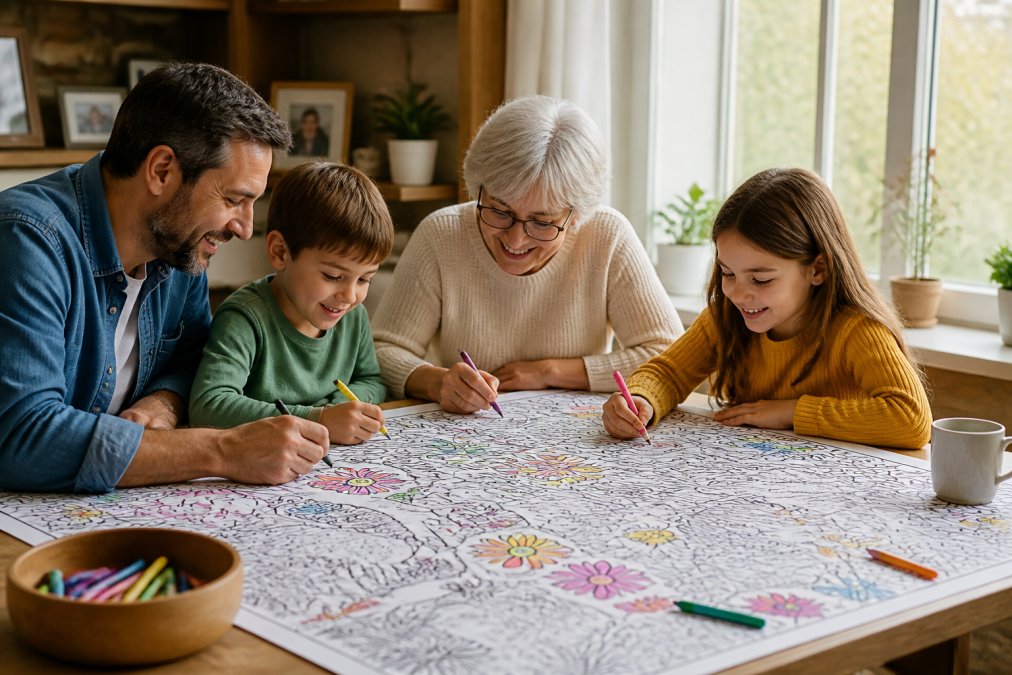
Giant table-sized coloring sheets are oversized coloring pages, typically around 50 by 30 inches, that turn a table or wall into one shared creative canvas. Cherry Creek Lane makes these in the USA and ships them from Utah, printed on high-quality paper that works with crayons, markers, and colored pencils. One sheet covers a full afternoon for multiple kids.
Why Size Changes Everything for Family Bonding
A standard coloring book is a solo activity. A giant sheet is a group activity by design: when the canvas is bigger than any one person's reach, kids negotiate territory, share colors, and talk to each other, turning coloring into family bonding rather than quiet time.
Picking the Right Giant Sheet for Your Family
Match the sheet to your family's interests rather than the season. A USA Coloring Map suits kids learning states and capitals, while the World Coloring Map works for older kids ready for countries and landmarks. For seasonal structure, the Full Year Activity Calendar BUNDLE gives you a full year of themed calendars with activity prompts your family fills in together.

2. Creative Activities for Kids at Home That Don't Need a Screen
Creative activities for kids at home work best when they are open-ended, no single correct way to finish them. Open-ended play builds problem-solving and creative expression because the child decides what the result looks like, unlike a worksheet or an app with a right answer.
Age-by-Age Creative Activities (and Why Each One Fits)
| Age | Activity | Developmental Fit |
|---|---|---|
| 0-2 | Edible finger paint (yogurt + food coloring), stacking cups, textured board books | Mouthing and grasping are the primary learning modes; taste-safe materials remove the constant "no" |
| 3-5 | Playdough with cookie cutters, chunky crayons on large paper, sticker collages | Fine motor control is emerging; big tools and forgiving surfaces prevent frustration |
| 6-10 | Friendship bracelets, cardboard fort building, comic strip drawing, simple sewing on plastic canvas | Planning, sequencing, and rule-following are developing; projects with steps reward persistence |
| 11-14 | Stop-motion with a phone on airplane mode, zine making, model kits, cooking a full recipe solo | Abstract thinking and identity exploration; projects that produce something shareable land well |
| Teens | Journaling, sketching, instrument practice, woodworking, photography walks | Autonomy is the driver; self-directed projects beat parent-assigned crafts every time |
A common pattern: the activity that fails is almost always one step above or below the child's actual skill level. If a five-year-old melts down over a craft, the fix is usually a bigger tool, not a bigger reward.
Open-Ended Play with Giant Maps and Calendars
A giant map invites questions. Where is this river? Why is this country small? Kids color, ask, and learn without realizing it. The 2026 Yearly Calendar works the same way: your family writes in birthdays, outings, and activities, turning planning into a shared hands-on project. For school-age kids, the 2026-27 School Year Calendar keeps the whole year visible on the wall.


Sensory Bins and Hands-On Learning
A sensory bin is a shallow container filled with a base material like dry rice, sand, or water beads, plus small scoops and toys. Sensory play supports fine motor skills and calm focus, making it a strong bridge activity right after screen time ends. Keep one ready so the transition takes seconds, not setup.
Three bins that cover most ages:
- Toddler bin: dry oats, large scoops, silicone muffin cups. No small parts.
- Preschool bin: kinetic sand, animal figures, a spray bottle. Add a towel underneath.
- School-age bin: water beads, tweezers, a sorting tray. This one doubles as a calm-down station.
Zero-Cost, Zero-Prep Creative Activities
Not every creative activity needs a supply run. These require nothing you do not already own:
- Box city: save delivery boxes for a week, hand over tape and markers, and let kids build a neighborhood.
- Story in a bag: each person pulls three random household objects and has to weave them into a told story.
- Shadow drawing: place a toy on paper near a window, trace its shadow, then color it in.
- Kitchen-table gallery: tape a long sheet of butcher paper to the table and let everyone draw one continuous scene.
3. How to Engage Siblings of Different Ages Without Screens
Engaging siblings of different ages without screens comes down to one principle: shared space, different jobs. Younger kids need big, forgiving tasks. Older kids need a challenge or a role. Give both on the same activity and the fighting drops sharply.
Zone the Giant Sheet So Everyone Gets Space
Divide the sheet into loose zones before anyone starts. A three-year-old gets a large open area to scribble freely; a seven-year-old gets a detailed section with smaller shapes. This solves most space disputes, because each child has a defined territory.
| Age Group | Best Role on a Giant Sheet | Why It Works |
|---|---|---|
| Ages 2-4 | Fill large open areas with color | Builds fine motor skills without precision demands |
| Ages 5-7 | Color named regions and shapes | Adds early learning and focus practice |
| Ages 8-10 | Label, plan, and coordinate colors | Gives ownership and a leadership role |
| Teens and adults | Join a zone or handle the setup | Models participation and keeps it social |
4. Building Screen-Free Family Traditions That Stick
Screen-free family traditions stick when they happen on a predictable schedule, not when the mood strikes. Pick one recurring slot, such as Sunday afternoon or Friday after dinner, and protect it. Predictability turns an activity into a tradition kids ask for.
A few traditions that work well for busy families:
- A weekly table session with a giant coloring sheet, no phones in the room
- A monthly calendar update where everyone adds one family activity
- A seasonal banner for holidays, like the Halloween Activity Calendar Coloring Banner or the Winter Activity Calendar Coloring Banner
- A grandparents' visit ritual built around one shared sheet
5. Managing the Transition Away from Screens (Without Meltdowns)
Meltdowns during screen-free transitions come from abrupt endings, not the activity itself. Kids need a warning and a landing pad: a five-minute heads-up plus an immediately available hands-on option prevents most resistance.
The Post-Screen Withdrawal Window
What parents call "boredom" in the first half hour after screens end is usually understimulation. Screens deliver fast, frequent rewards; hands-on activities deliver slower ones. That gap is what kids feel as discomfort, and it is temporary.
A common pattern is a three-phase arc:
- Protest (minutes 0-10): complaints, negotiation, sometimes tears. Do not argue. Redirect once, then stay quiet and present.
- Drift (minutes 10-25): restlessness, wandering, picking things up and putting them down. This is the phase where a prepared activity does the most work.
- Settle (minutes 25-45): engagement begins, often without announcement. Kids stop asking and start doing.
A Transition Sequence That Holds Up
- Give a five-minute warning before screens go off
- Have the replacement activity already set up and visible
- Sit with your child for the first few minutes
- Let them take over once they are engaged
- Keep the first session short, around 20 minutes, and build up
What to Do When the Protest Does Not Pass
If a child is still in phase one after 15 minutes, the problem is usually one of three things:
- The activity is too hard. Drop the difficulty. A younger child who cannot manage fine details will settle faster with a bigger tool.
- The activity is too easy. Older kids disengage from anything that feels like a downgrade. Give them a role with real responsibility, planning, labeling, leading a section.
- The child is genuinely tired or hungry. No activity fixes that. Offer a snack, a drink, and a quiet reset, then try again later.
Building Tolerance Over Weeks, Not Days
Most families find the withdrawal window shrinks with repetition. Week one might mean 40 minutes of protest; week four often means five. What matters most is consistency of the schedule, not the length of any single session.
6. Low-Prep, Neurodivergent-Friendly Screen-Free Ideas
Low-prep, neurodivergent-friendly activities share three traits: clear start and end points, low sensory load, and no fine-motor precision required to succeed. Many neurodivergent kids find open-ended crafts overwhelming because the options are too broad. A giant coloring sheet narrows the field while still allowing creative expression.
What works well in practice:
- A single large sheet with bold outlines, so the task is obvious
- A limited color palette, such as four crayons instead of forty
- A quiet, low-traffic space with soft lighting
- A defined time block with a visible timer
- A predictable cleanup routine after every session
Frequently Asked Questions
What are the benefits of screen-free activities for child development?
Screen-free activities build fine motor skills, focus, and problem-solving. Coloring on a giant sheet strengthens hand muscles, while puzzles and maps encourage spatial reasoning. Without screens, kids practice patience and creative expression. Family bonding also improves when everyone works on a shared project like a table-sized coloring page.
How can I encourage my children to choose screen-free play?
Start with low-prep options that are ready to go, like a giant coloring sheet or a puzzle. Set a specific screen-free time each day and join in yourself. Offer choices between two activities so kids feel in control. Keep materials visible and accessible. Celebrate the fun, not the outcome, to build positive associations.
What are some screen-free activities for siblings of different ages?
Giant coloring sheets work well because each child can claim a section. Younger kids color large shapes while older ones add details. Board games with team play, like cooperative puzzles, also bridge ages. For mixed ages, try a themed calendar where each child adds a drawing or sticker for the day.
How do I plan a successful screen-free week for my family?
Pick a week with no major deadlines. Stock up on open-ended supplies: giant coloring sheets, puzzles, and craft materials. Create a simple schedule with one anchor activity per day, like a family coloring night. Allow boredom; it sparks creativity. At week's end, reflect on favorite moments together.
How can large-format coloring and puzzles foster family bonding?
Large-format coloring sheets, like the 50x30 inch ones from Cherry Creek Lane, invite multiple people to work side by side. The shared space encourages conversation and teamwork. Completing a giant puzzle or map together gives a sense of accomplishment. These activities create traditions kids remember, like coloring a new calendar each month.