

Table of Contents
- Why Paper Quality Matters for Giant Coloring Projects
- Understanding Paper Weight and What It Means for Your Sheets
- Preventing Marker Bleed-Through on Coloring Posters
- Surface Texture and Tooth: Matching Paper to Your Coloring Media
- Choosing Coloring Supplies for Giant Posters
- Archival Quality and Long-Term Durability
- Environmental Impact and Sustainable Paper Choices
- How to Choose the Right Paper for Your Giant Coloring Sheets
- Frequently Asked Questions
Last Updated: September 3, 2026
Why Paper Quality Matters for Giant Coloring Projects
When you're working on a giant coloring sheet, the paper beneath your markers, colored pencils, or crayons becomes the foundation for everything that follows. Poor-quality paper disappoints: markers bleed through, pencil strokes tear the surface, and colors look dull instead of vibrant. A flimsy sheet buckles under extended coloring sessions, while cheap paper absorbs ink unevenly, creating blotchy patches.
At Cherry Creek Lane, we've designed our giant coloring sheets with these challenges in mind. Our products are made in the USA with materials specifically chosen to handle markers, colored pencils, and crayons without compromising durability or visual quality. This guide walks you through the paper qualities that matter most for giant coloring projects, how to evaluate sheets before you buy, and how to match your paper choice to the specific media you'll be using.
Understanding Paper Weight and What It Means for Your Sheets
Paper weight measures how heavy the paper is relative to its size. This matters because weight directly correlates with thickness, durability, and how well paper handles the stress of extended coloring.
How GSM and Basis Weight Affect Durability
GSM (grams per square meter) and basis weight (measured in pounds in the US) both tell you the same thing: heavier paper is thicker and more durable. For giant coloring sheets, you want paper in the 100-160 gsm range (roughly 60-100 lb basis weight) (tappi.org). This weight provides enough body to resist tearing when applying pressure with markers or pencils, while remaining flexible enough to fold or roll without cracking.
A 100 gsm sheet can handle an hour of continuous coloring from multiple children without showing wear (peer-reviewed research). A 60 gsm sheet will start showing fatigue after 20 minutes as fibers compress and the surface gets fuzzy.
Why Heavier Paper Handles Extended Coloring Sessions
Weight reflects fiber composition and density. Heavier paper has more fiber packed into the same surface area, providing more structural integrity. When you press a colored pencil into 80 gsm paper, you compress fewer fibers, causing more visible damage. The same pressure on 120 gsm paper distributes across more fibers, so the impact is less noticeable and the paper recovers better.
For giant coloring posters, weight becomes even more critical because the sheet size means more total stress on the material.
Preventing Marker Bleed-Through on Coloring Posters
Bleed-through is the enemy of any marker-based coloring project. You apply color to the front, and it seeps through to the back, ruining anything on the reverse side.
How Ink Absorption and Sizing Work Together
Paper is made of cellulose fibers with space between them. Sizing is a chemical coating applied during papermaking that fills some of those spaces and creates a barrier that slows ink absorption. Papers with proper sizing let ink sit on the surface long enough to dry before it can migrate through to the back.
For marker work, you need sizing tuned for the type of marker you'll use. Alcohol-based markers require different sizing than water-based markers. Quality sheets show minimal bleed-through even with heavy marker application.
Testing Paper Opacity Before You Buy
Opacity measures how much light passes through paper, expressed as a percentage. For coloring sheets, you want opacity in the 85-95% range. Hold the paper up to light and look at it from both sides. If you can clearly see an image on the back, opacity is too low.
Opacity and weight are related but distinct. A 120 gsm paper with poor sizing will have lower opacity than a 100 gsm paper with excellent sizing. You need both: adequate weight for durability and adequate opacity to prevent show-through.
Surface Texture and Tooth: Matching Paper to Your Coloring Media
Surface texture, called "tooth," affects how media adheres to the surface and how the final color appears. Smooth papers work best with markers and gel pens. Rough papers work better with colored pencils and crayons because the texture grips the pigment.
For giant coloring sheets with mixed media use, a medium-tooth paper (often called "vellum finish") is ideal. It's smooth enough for markers to glide and dry cleanly, but rough enough to grip colored pencil pigment. This is why Cherry Creek Lane's giant coloring sheets are designed with medium texture.
The tooth also affects color vibrancy. Smooth papers show colors with maximum saturation. Rough papers diffuse light slightly, making colors appear slightly less intense. For giant posters where color impact matters, a smooth-to-medium tooth is the sweet spot.
Choosing Coloring Supplies for Giant Posters
The paper you choose should match the media your family will actually use.
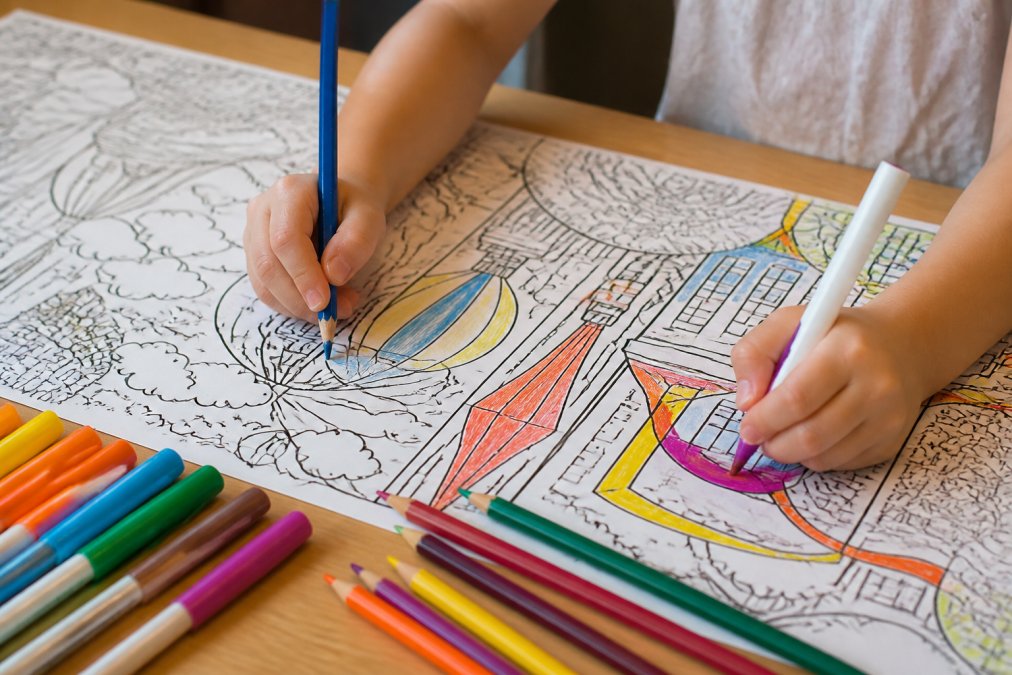
Colored Pencils and Paper Compatibility
Colored pencils work best on paper with visible tooth. The pigment needs texture to grip. On perfectly smooth paper, strokes will slide around and never build solid color. On paper with adequate tooth, pigment catches on the texture and builds rich, vibrant color.
For giant posters, you want paper with enough tooth that pencil strokes feel controlled. A vellum finish is ideal, with at least 80 gsm weight so pressure doesn't compress fibers and create shiny, worn spots.
Markers, Crayons, and Paper Performance
Markers are more demanding than colored pencils. The ink is liquid and wants to move. It will bleed through poor paper and feather on rough paper. For markers on giant sheets, you need paper with excellent sizing and opacity. Alcohol-based markers require particularly good sizing because alcohol is aggressive.
Crayons are the easiest medium to work with. They don't bleed and work on almost any paper, but they perform better on paper with adequate tooth.
Archival Quality and Long-Term Durability
If you want to keep giant coloring posters framed on a wall or in a portfolio, archival quality becomes important. Archival paper resists fading, yellowing, and deterioration for decades or centuries.
Archival quality comes from acid-free composition and lignin-free construction. Acid causes paper to become brittle and yellow over time. Lignin breaks down when exposed to light and oxidation, causing yellowing.
According to Library of Congress preservation guidelines, acid-free paper with proper storage can last 200+ years. For giant sheets you want to keep, archival paper is worth the cost difference. Cherry Creek Lane's giant coloring sheets are acid-free and designed for long-term display.
Environmental Impact and Sustainable Paper Choices
If sustainability matters to your family, understanding paper choices helps you make decisions aligned with your values. Look for certifications like FSC (Forest Stewardship Council) or SFI (Sustainable Forestry Initiative), which verify that paper comes from responsibly managed forests.
Recycled content paper has environmental benefits from reducing demand for virgin fiber. A mix of recycled content from responsibly managed sources often represents the best environmental compromise.
Paper weight and durability have environmental implications. A 120 gsm sheet that lasts for years has lower environmental impact per use than a 60 gsm sheet that falls apart after one session.
How to Choose the Right Paper for Your Giant Coloring Sheets
Start with weight. For giant sheets, don't go below 100 gsm. For table-sized sheets with heavy use, 120 gsm is better. For wall-mounted posters, 100 gsm is sufficient.
Next, consider your primary media. If your family uses mostly markers, prioritize opacity and sizing. If you use mostly colored pencils, prioritize tooth. For mixed media, choose a medium-tooth paper with excellent sizing and opacity.
Test before committing to large quantities. Buy a single sheet and actually color on it with the media your family will use. Does it handle your preferred markers without bleeding? Can you build solid color with pencils? Does it feel durable enough?
Consider longevity. If this is a one-time activity, standard paper is fine. If you're creating something to keep or display, invest in acid-free, archival-quality paper. Finally, think about sustainability if it matters to you. Look for FSC or SFI certification.
Choosing the right paper transforms giant coloring from a frustrating experience into something your family will enjoy. The difference between paper that performs and paper that disappoints comes down to weight, opacity, sizing, and tooth, characteristics that are measurable and testable before you buy.
At Cherry Creek Lane, we've done this work for you. Our giant coloring sheets are designed specifically for families with mixed media preferences, made in the USA with acid-free, sustainable materials that handle markers, colored pencils, and crayons without compromise. When you choose quality paper, you're choosing an experience that matches the time and creativity your family invests.
Ready to experience the difference quality paper makes? Shop our giant coloring sheets and discover why paper quality matters for creating something your family will treasure.
| Factor | What to Look For | Why It Matters |
|---|---|---|
| Weight | 100-160 gsm (60-100 lb basis weight) | Provides durability without excessive stiffness |
| Opacity | 85%+ | Prevents show-through and bleed-through |
| Tooth | Medium (vellum finish) | Works with markers, pencils, and crayons |
| Sizing | Adequate for your media | Prevents bleed-through and feathering |
| Archival Quality | Acid-free, lignin-free | Ensures colors stay vibrant for decades |
Frequently Asked Questions
Q: What paper weight is best for giant coloring sheets?
A: For giant coloring sheets, aim for at least 24 lb bond paper or 90 gsm (grams per square meter) to prevent tearing during extended coloring sessions. Heavier paper, 28 lb bond or 110 gsm and above, provides superior durability for markers and colored pencils without buckling. The thicker substrate also reduces bleed-through when using liquid media like markers or watercolor, making the final result more vibrant and longer-lasting.
Q: How do I prevent marker bleed-through on coloring posters?
A: Choose paper with a tight sizing layer and higher opacity rating (80% or above). Acid-free, premium-quality paper absorbs ink more evenly, preventing it from seeping through to the back. Test a corner of your sheet with your preferred markers before committing to a full coloring session. Heavier paper weights naturally resist bleed-through better than lightweight stock, and smooth surfaces can help markers dry faster.
Q: Does paper quality really affect how markers and colored pencils perform?
A: Yes, significantly. Quality paper with good tooth (surface texture) grips colored pencils better, allowing for smoother blending and richer color layering. Markers perform better on paper with proper sizing and ink absorption, cheap paper causes feathering and uneven color distribution. Archival, acid-free paper ensures colors remain vibrant over time rather than fading or yellowing, which is especially important for projects meant to be displayed or preserved.
Q: Why is acid-free paper important for giant coloring projects?
A: Acid-free paper prevents yellowing and deterioration over time, keeping your finished coloring projects looking fresh for years. Acidic paper becomes brittle and discolors, especially when exposed to light or handled frequently. For family keepsakes or classroom displays that you want to preserve, acid-free, archival-quality paper ensures your work remains vibrant and structurally sound long after the coloring is complete.
This article was written using GrandRanker